
The Supreme Court has strengthened the Constitutional safeguards governing arrest, holding that an accused released for violation of the fundamental right to be informed of the grounds of arrest is not released on bail, but from an “illegal and unconstitutional detention”.
A bench of Justices Ujjal Bhuyan and Atul S Chandurkar held on Monday (September 21) that the safeguards under Article 22(1) “are not mere procedural safeguards” but “fundamental principles which are required to be followed” whenever a person’s liberty is curtailed.

The court laid down a procedure requiring judicial approval before investigating agencies can arrest such a person again and held that High Courts may award compensation “as part of the public law remedy in a case of violation of Article 22(2) of the Constitution, with liberty to the accused to avail his remedy under the private civil law.”
The ruling builds on a line of judgments that have progressively strengthened the rights of arrested persons, particularly the requirement that they be informed, in writing, of the grounds of their arrest.
Facts of the case
The case stems from an FIR registered against a man under the POCSO Act and the Bharatiya Nyaya Sanhita for allegedly assaulting his minor stepdaughter. He was arrested on May 17 and produced before a magistrate more than 24 hours later. The magistrate ordered his release since he had not been given written grounds of arrest, saying the investigating agency could still “move an application for remand or custody.”
The same investigating officer moved a fresh custody application the same day. An Additional Chief Judicial Magistrate eventually dismissed it as not maintainable. The accused moved to the High Court, challenging the magistrate’s order allowing investigating agencies to arrest him again. The court denied that relief, stating that the investigating agency was not barred from arresting the accused as long as it was following the law. This order was eventually challenged in the Supreme Court.
The legal framework
The case turns on the interplay between the right to life under Article 21 and the protection against arrest and detention under Article 22.
Article 22(1) requires police to inform an arrested person of the grounds of arrest, and Article 22(2) requires production before a magistrate within 24 hours.
The question of whether an accused must be given a written copy of the grounds of arrest came up before the SC in Pankaj Bansal v. Union of India (2023). The case turned on Section 19 of the Prevention of Money Laundering Act, 2002, which says that a person must be informed “of the grounds of such arrest”, but does not spell out how that information is to be conveyed.
The Court noted that Article 22(1) of the Constitution guarantees an arrested person the right to know why they are being arrested. It said that this safeguard would mean little if the grounds were merely read out and not handed over in writing. The Court ruled that a written copy of the grounds of arrest must be furnished to the accused “as a matter of course and without exception”.
That position was watered down in Ram Kishor Arora v. Directorate of Enforcement (2023); the Court held that the Pankaj Bansal ruling would apply prospectively. Since the arrest predated that judgement, the Court found that informing the accused of the grounds of arrest and allowing him to read them was sufficient compliance with Section 19 of the PMLA, even though no copy was furnished to him. Thus, the SC upheld that arrest.
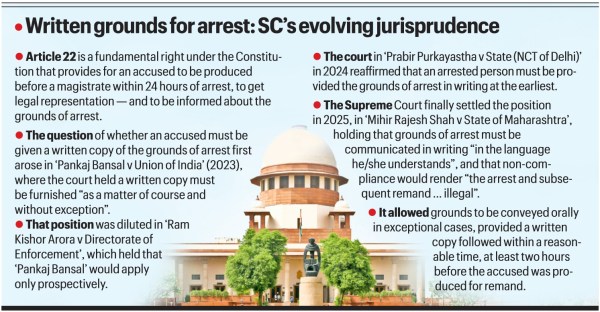 Supreme Court’s evolving jurisprudence.
However, the SC in 2025 settled the position in Mihir Rajesh Shah v. State of Maharashtra, where the court held that the constitutional requirement of communicating the grounds of arrest is mandatory to arrests under all statutes, saying that “the grounds of arrest must be communicated in writing to the arrestee in the language he/she understands,” and that non-compliance would render “the arrest and subsequent remand … illegal.” It allowed grounds to be conveyed orally in exceptional cases, provided a written copy followed within a reasonable time, at least two hours before the accused is produced for remand.
Senior Advocate Nitya Ramakrishnan told The Indian Express that the requirement of furnishing written grounds of arrest is especially important in serious offences, where securing bail is often difficult.
Referring to earlier judgments such as Pankaj Bansal and Prabir Purkayastha, she said the courts had recognised that the safeguard assumes significance in cases where an accused’s ability to challenge arrest or oppose remand may otherwise be constrained. “The significance of its application to serious offences was not only recognised, but reiterated and reemphasised with greater rigour,” she said.
“The grounds of arrest under Article 22 were not considered the ground for release,” Senior Advocate Sidharth Luthra told The Indian Express. “It was not given that high and an appropriate stature. Later on, through SC decisions, it was sought to be given some content. Then there has been dilution, then an attempted reconsideration of its standards.”
What the court held
Monday’s judgement builds directly on Mihir Rajesh Shah. It held that any violation of Article 22(1) or 22(2) invalidates the arrest itself. It said: “Any breach or non-compliance would entail immediate release of the arrested person because such arrest is unconstitutional. We cannot tinker with the most important safeguards provided under Article 22.”
The State had argued that the seriousness of the offence meant Article 22(2) should not give the accused “blanket immunity” from re-arrest. The court rejected this, holding that where an arrest is unconstitutional, police cannot simply re-arrest the accused on their own.
It said that “when there is violation of the Constitution, question of prejudice or demonstrable prejudice does not arise. The safeguards adumbrated in Article 22(1) are not mere procedural safeguards; these are fundamental principles which are required to be followed in the event liberty of a person is sought to be curtailed.”
Building on its earlier ruling in Mihir Rajesh Shah, the Court said that “the power to re arrest the accused must not be left to the discretion of the very same authority who had violated” Article 22 and that the process “must have the judicial imprimatur.”
It laid down a procedure tightening the process — agencies that believe custody is necessary must first furnish the grounds of arrest, then move the jurisdictional magistrate with an application explaining the need for custody and the reasons for the earlier non-compliance, endorsed by the officer’s immediate superior. This, the court said, is necessary “to rule out any foul play or collusion” and to put the superior officer on notice that “necessary remedial steps will have to be taken”.
“The significance of the judgment is mainly in the context of re-arrest,” Ramakrishnan said. Unlike a release on bail, she said, the Court has treated such cases as involving an arrest that is invalid in law itself.
“The arrest ceases to be. So, you are not being released on condition. It’s a non-arrest. The arrest is an illegality, so that arrest is set at nought and therefore the accused has to be out. Because it is in law that arrest is bad, so it is as though you were never arrested,” she said.
She said the decision marks a supervision of the judiciary over the State’s power to deprive a person of liberty, though not over the investigation itself. “Because arrest is done during the course of investigation of cognizable offences… but it’s not in relation to the integrity of the investigation. It’s really more judicial supervision over the state’s police power to affect personal liberty.” The judgement also requires a superior officer to endorse a re-arrest application to transfer the investigation to another officer and order a departmental enquiry.
Luthra said the judgment reinforces the constitutional nature of arrest safeguards. “The Constitution is the fundamental core of our law. Breach of constitutional provisions and rights should have consequences. Because if there is a right, there has to be a remedy and a result,” he said.
According to him, the ruling makes clear that Article 22 protections cannot be applied selectively or diluted depending on the nature of the offence. “This judgment comes at a point where it says that these are sacrosanct principles which ought not to be diluted, and you cannot make it offence specific unless Parliament chooses to do so,” he said.
He also said courts unfortunately do not award compensation enough in cases of illegal arrest or detention. “Courts should grant adequate compensation for illegal arrest or illegal detention. Such decisions are very crucial for judges and courts as examples which should be followed from the trial court onwards,” he said, adding that the need for such questions to repeatedly reach the Supreme Court shows that “our system is not working as efficiently as it should”.
Ramakrishnan, however, said the directions are intended to promote greater accountability in the exercise of police powers. “Conceptually, it is meant to give greater accountability to the police powers of the State,” she said. At the same time, she cautioned that in practice, enforcing such rights often places a heavy burden on those affected. “In practice, it leaves the accused and their families to wage a lone battle, running from pillar to post,” she said.

 Share


