
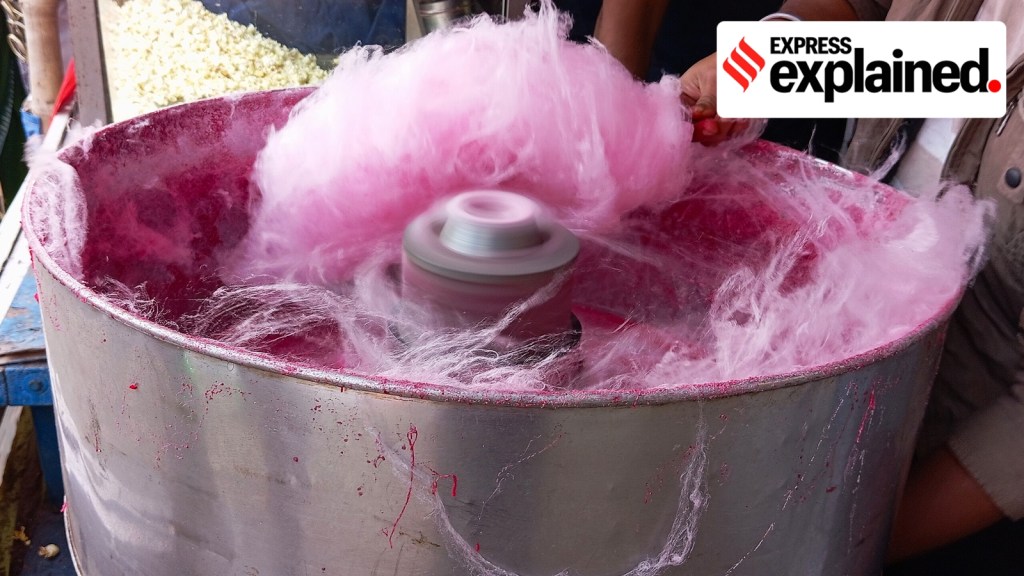
Bright red chutney served with samosas, pink cotton candy sold outside schools, vivid red tandoori chicken — food colourings have come under scrutiny in Uttar Pradesh after authorities found non-food grade industrial dyes in chutney.
Amid the festive season, with Diwali approaching, the state’s Food Safety and Drug Administration (FSDA) has issued detailed guidelines about where and how food colours can be used, which ones cannot be used, and how vendors must measure and account for the colours they buy.

The instructions place particular emphasis on street food, sweets, snacks and bakery products, where colour is often used to make food look more appealing. Here’s what the guidelines say.
Red chutney, pink cotton candy under scanner
For street-food lovers, one of the most direct changes concerns the green and red chutneys served with samosas, chaat, momos and rolls. The guidelines prohibit adding colours to chutney and advise vendors to use ingredients such as tomatoes, beetroot, coriander and mint to achieve the desired colour and flavour.
Cotton candy and ice lollies have also been included. The use of non-food colours, particularly Rhodamine-B, is prohibited. This industrial dye is used in textile and paper colouring and cannot be used as a substitute for food-grade colour.
The same restriction applies to the use of other industrial dyes to give a bright red appearance to chicken tikka, kebabs, chaap and fried fish. Vendors have been advised to use suitable food ingredients, including Kashmiri red chilli and degi mirch, for colour and flavour.
Is the use of Rhodamine-B in food common?
A food safety officer had earlier told The Indian Express that Rhodamine B is usually reported from small road-side vendors in small cities. “Small vendors are not aware that this dye can be harmful as effects might not always be felt immediately. They might just go to a shop and ask for a red colour,” the officer had said.
“This is usually not seen in bigger cities such as Delhi and Mumbai. Although no colouring is allowed in cooked food, in the bigger cities usually edible food colours are used to give the red colour in butter chicken and tandoori chicken,” he said.
What risks do prohibited dyes in food pose?
The guidelines list several non-permitted industrial dyes, including Rhodamine-B, Metanil Yellow, Butter Yellow, Malachite Green, Auramine, Orange II and Sudan dyes.
Their suspected illegal uses range from giving a bright pink or red appearance to cotton candy, chutney and sweets to making turmeric, pulses, chilli powder and other spices appear more vibrant. Sudan dyes have also been associated with adulteration of edible oils and packaged sauces.
Their consumption can pose health risks, including toxic effects, possible liver and kidney damage and allergic reactions. The risks vary by substance and level of exposure.
The use of Rhodamine B in food for a long time, for instance, could lead to liver dysfunction or cancer. When exposed to large amounts over a short period, it results in acute poisoning.
Tartrazine is a synthetic yellow food dye and has been indirectly linked to hives, food allergies like swelling of the lips, tongue, throat, and neck.
Carmoisine, a red dye, can trigger hypersensitivity reactions, including skin swelling, breathing difficulties, particularly among asthmatics and hives.
Can artificial colours be used in sweets and cakes?
Yes, but only when the colour is permitted for the particular food category and the prescribed limit is followed.
Under the Food Safety and Standards (Food Products Standards and Food Additives) Regulations, 2011, specified artificial colours can be used in certain sweets and confectionery, cakes, pastries, biscuits, icing, some dairy products, processed fruits, beverages and savoury snacks.
For listed sweets and confectionery, the general maximum limit for permitted artificial colours is 100 mg per kg, subject to the applicable category-specific conditions. The same general limit applies to specified bakery products. For processed fruits, the guidelines prescribe up to 200 mg per kg for canned or glazed cherries and 100 mg per kg for other covered processed fruits.
These are not universal allowances. Just because a colour is food-grade does not make it suitable for every food. For instance, a colour permitted in a cake cannot automatically be used in bread, chutney or another product.
This is because colours serve different purposes in different foods. Their safety also depends on how much quantity is consumed and how the colour behaves during processing. For instance, Food Safety and Standards Authority of India says that assessing a colour’s use in deep-fried snacks may require information on its heat stability and the formation of by-products.
Natural colours, too, are subject to category-specific conditions.
Everyday foods in which colour cannot be added
The guidelines prohibit adding colour to several everyday foods. These include the following —
Milk and plain dairy products: Raw and pasteurised milk, cream, plain curd, unflavoured butter, chhena and paneer.
Fresh produce and beverages: Fresh fruits and raw vegetables, natural fruit juices, packaged drinking water and mineral water.
Kitchen staples: Ground spices, tea, coffee, cereals, pulses, flour and semolina.
Other foods: Edible oils and fats, jaggery, honey, dry fruits, infant food and infant milk substitutes.
Colour addition is also prohibited in cooked foods such as dal, vegetables, biryani, chutney and French fries. Artificial colours cannot be used in the main body of bread and buns.
No more colour by the spoonful
The guidelines also target the way colours are added. Vendors and food businesses have been instructed not to pour colour straight from an open packet into a cooking vessel or estimate the quantity using a spoon or pinch.
A suitable digital weighing scale must be used to measure the amount accurately. If the prescribed quantity cannot be measured, the colour should not be used.
Food businesses must also buy colours from authorised sources, check their labels and supplier details, and preserve purchase bills, invoices and batch numbers for inspection. Unlabelled chemicals and loose colours bought from open markets or ordinary grocery shops must not be used.
Packaged food must comply with applicable labelling requirements, including declarations relating to permitted colours where required.
What happens if a vendor breaks the rules?
Using a prohibited industrial dye, adding colour to a food in which it is not allowed, exceeding the prescribed limit or violating mandatory labelling requirements can invite action under the Food Safety and Standards Act of 2006. Depending on the nature of the violation, action may be initiated under the following provisions of the central legislation.
Section 51 (Sub-standard food): A penalty of up to Rs 5 lakh may be imposed.
Section 52 (Misbranded food): A penalty of up to Rs 3 lakh may be imposed. The adjudicating officer may also direct corrective action or the destruction of the food.
Section 59 (Unsafe food): Depending on the consequences, the punishment ranges from imprisonment of up to six months and a fine of up to Rs 1 lakh where no injury results, to imprisonment for life and a fine of at least Rs 10 lakh where the violation results in death. The Act also prescribes penalties for cases involving non-grievous and grievous injury
The FSDA has directed sweet shops, bakeries, restaurants, hotels, dhabas, food manufacturers and street vendors to follow the rules. The guidelines are also to be publicised through trade associations and food vendor groups.


 Share


