Saudi Arabia has temporarily shut its East-West oil pipeline after multiple attacks on the crucial network on Thursday, raising fresh concerns over global oil supplies already strained by disruption in the Strait of Hormuz. The pipeline, also called Petroline, is one of the most important Hormuz-bypass routes for exporting Saudi Arabian crude.
This came even as Yemen’s Houthi rebels seized the strategically vital Mayun Island located at the entrance to the Red Sea — developments that mark a dangerous new front in the wider war with Iran. Both Saudi Arabia and Iraq have said that the attack originated in Iraq, where Iranian-backed militias operate.

An official source at the Saudi Ministry of Energy said the attacks took place in the Riyadh and Madinah regions on the morning of Thursday, September 10. The pipeline was shut down while emergency and technical teams moved to secure it and assess its safety. The attacks also caused an unspecified number of injuries. Saudi authorities described the shutdown as a precautionary measure.
A CNN report citing US officials and satellite imagery separately confirmed that pumping stations along the pipeline were struck and that fires were visible at the sites. The extent of any damage to the pipeline system itself, and how long the shutdown may last, remain unclear. The attacks on the pipeline system came from Iraq, most likely from Iran-backed militias there.
The timing of the suspension of the pipeline’s operations is critical. Apart from attacks on the pipeline system itself, Iran-backed Houthi forces have tightened their grip around the Bab el-Mandeb and Red Sea shipping route, which could further reduce oil flows, particularly from the world’s largest exporter, Saudi Arabia. Riyadh has relied upon for its oil exports amid the effective halt in shipping from the Persian Gulf.
The development is also likely to push up oil prices, which are anyway at their highest levels in over three months. The immediate effect on Saudi oil exports, and consequently on international supplies and prices, will depend on the extent of the damage and how quickly the pipeline can resume operations. For energy-import-dependent India, too, there will be ramifications affecting supplies, and more importantly, prices.
East-West pipeline’s importance amid Hormuz crisis
The East-West pipeline. (U.S. Energy Information Administration)
The East-West Pipeline runs roughly 1,200 km across Saudi Arabia, from the Abqaiq oil processing centre in the kingdom’s oil-rich east to the Red Sea port of Yanbu in the west. From Yanbu, oil tankers usually sail east to Asia through the Bab el-Mandeb, while those headed west go through the Suez Canal.
Operated by Saudi Aramco, the pipeline allows Saudi Arabia to move crude oil overland from its main producing region to the Red Sea, rather than shipping it from terminals on the Persian Gulf through the Strait of Hormuz. In fact, the pipeline was built partly to hedge against risks arising from disruptions in oil flows through Hormuz.
The Strait of Hormuz is the narrow waterway between Iran and Oman that accounted for a fifth of global oil flows before the West Asia war started over six months ago. It is the main outlet from the Persian Gulf. Saudi Arabia, Iraq, Kuwait, Qatar and the UAE have traditionally depended heavily on it to reach global markets, particularly top oil importers China and India.
The Petroline has the capacity to transport around 7 million barrels per day (bpd) of crude, of which about 5 million bpd is available for exports, while the remaining carrying capacity is for feeding the Kingdom’s domestic refineries, according to the EIA.
This makes it Saudi Arabia’s principal route for rerouting crude exports amid disruption in shipping through the Strait of Hormuz since the West Asia war began late February. Before the conflict erupted, the pipeline operated at just a fraction of its capacity, as exports from the regular route through the Strait of Hormuz were normal. But with maritime traffic through the chokepoint grinding to an effective halt, Aramco started pumping more oil through the Petroline.
While the actual volume of crude moving through the pipeline has been lower than its capacity, with estimates ranging around 4-5 million over the past few months, it is still significant and represents 4-5% of global oil supplies. This route has therefore served as an important safety valve for global oil supplies during the current crisis. Its targeting, however, has demonstrated that alternative routes themselves can become targets in a wider regional conflict.
Likely impact on oil market
Brent crude had already moved above $100 a barrel earlier this week, triggered by the recent sharp escalation in the West Asia conflict, including attacks on oil tankers and petroleum infrastructure in the region. The $100 threshold was breached on Wednesday, and Brent futures continue to trade above that level till Friday, closing at about $105 per barrel, the highest since May. The Petroline shutdown arrives when traders are already nervous.
The duration of the shutdown will be critical in the prevailing circumstances. If Saudi Arabia is able to restore the pipeline quickly, the market impact could remain largely psychological and short-lived. Tankers can be redirected, inventories can be drawn down, and Saudi Arabia can use its other export infrastructure. But if the shutdown lasts weeks, the consequences become much more serious.
From here, there are three broad possible scenarios that industry analysts and experts are taking into consideration. If the pipeline is repaired or reopened within days, and attacks on Saudi infrastructure do not continue, oil prices could retreat from their current elevated levels.
If the shutdown lasts several weeks while dangers around the Strait of Hormuz and Bab el-Mandeb persist, oil prices could move higher. The scenario that the markets fear most is a further widening of the conflict. If attacks spread to additional Saudi oil facilities, Yanbu, tankers or other Gulf export infrastructure, the disruption could turn into a wider supply shock, which would certainly push up oil prices.
The worry for India
In a bid to bypass the Hormuz chokepoint, Gulf countries have been scrambling to ramp up infra.
Saudi Arabia had traditionally been among the top sources of crude oil for India. While supplies from Riyadh have fallen notably amid the Hormuz crisis, Saudi oil still accounted for 7-8% of India’s total oil imports over the past couple of months. And a vast majority of these came from the Yanbu export facility. In August, India imported about 332,000 bpd of Saudi oil, accounting for 7.2% of New Delhi’s total oil imports for the month, as per tanker data from Kpler. In July, oil imports from Riyadh stood at about 414,000 bpd and made up 8.2% of India’s oil imports.
The first impact of the Petroline’s shutdown for India would be on supplies, and Indian refiners will have to find replacement volumes. While that can be managed, given India’s highly diversified crude import slate, higher prices for those alternative barrels will be the bigger headache. Amid the West Asia conflict, India’s crude oil import bill surged by over 56% on a year-on-year (y-o-y) basis in April-July to $63.4 billion, even as import volumes rose slightly to 81.9 million tonnes — or about 600 million barrels — from 81.5 million tonnes, as per data from the Petroleum Planning and Analysis Cell (PPAC).
Energy imports are a major component of India’s overall imports, and any meaningful increase has ramifications for the country’s trade balance, current account, inflation, and the rupee’s exchange rate, among others. India is the world’s third-largest consumer of crude oil and depends on imports to meet over 88% of its requirements. Put simply, an oil shock can be considered an external tax on the Indian economy.
Given its high oil consumption and import dependency, India is already bearing the brunt of high oil prices. The country imports 1.8-2 billion barrels of oil a year, and every $1-per-barrel increase in price bumps up its oil import bill by up to $2 billion on an annualised basis.
It also said that every 10% oil price increase typically widens India’s current account deficit by 0.4% of the GDP. Crude oil alone is the country’s largest merchandise import. According to Commerce Ministry data, crude oil imports in 2025-26 stood at about $135 billion. If oil prices sustain at $100 per barrel in the current financial year and import volumes don’t decline, the oil import bill could be upwards of $200 billion for the year. If the price sustains at a much higher level, the implications would be even graver.

 Yemen's Houthi rebels in Sanaa on September 10. The attack on the East-West pipeline, which is said to have originated in Iraq, came even as the Houthis seized the strategically vital Mayun Island near the entrance to the Red Sea. (AP Photo)

 The East-West pipeline. (U.S. Energy Information Administration)
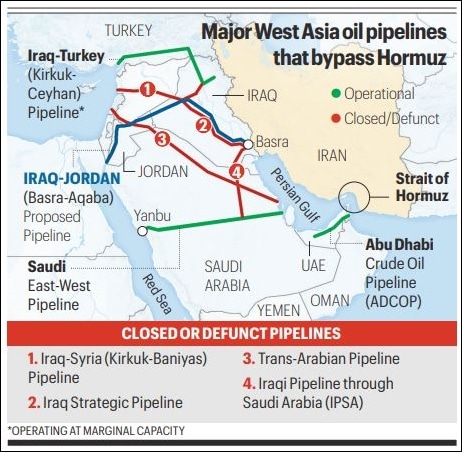 In a bid to bypass the Hormuz chokepoint, Gulf countries have been scrambling to ramp up infra.


 Share


