


© The Indian Express Pvt Ltd
Tags:


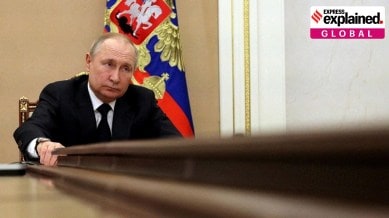
Vladimir Putin India Visit: Russian President Vladimir Putin first came to India for a summit with Prime Minister Atal Bihari Vajpayee in October 2000.
Putin was then new to the President’s job — having been elected earlier in 2000 — and Vajpayee was also in the early years of his Prime Ministership.

New Delhi was under sanctions from the West for the Pokhran-II nuclear tests, while Russia was a pale shadow of the erstwhile Soviet Union. After the Soviet Union’s collapse, the US dominated the scene in a unipolar world.
India and Pakistan were in a bitter relationship, after the Kargil war and the IC-814 hijack in 1999. In fact, Putin’s visit took place months before the Red Fort attack in December 2000.
In short, Russia was weak and India was facing the brunt of Western sanctions.
Now, 25 years later, Putin will come to India on December 4-5 for the 23rd annual summit between India and Russia.
This is his first visit to India after Russia invaded Ukraine in February 2022. Putin’s Russia is facing sanctions from the Western world, while India is also at the receiving end of secondary sanctions and high tariffs from the US. India and Pakistan have once again seen conflict in May, and Delhi just witnessed a blast near the Red Fort.
There are too many similarities in the global and regional context in the quarter century, but India and Russia have evolved not just in their bilateral relationship but also in terms of their place in the world.
India has built a strong and robust relationship with the West, including the US, forging security, defence, economic and people-centric partnerships.

With Russia, it has maintained a strong defence partnership — a legacy from the Soviet Union era — but has also diversified to other sources for technology.
Over time, India has reduced its defence import dependence on Russia. But there is legacy equipment that needs spares and servicing from Russia, and thus, about 60 % of the defence equipment is still from the country. India has bought the S-400 air defence system from Russia. Moscow has been able to deliver 3 out of 5 batteries, and now there is a demand for another 5 of them. But mired in the Ukraine war, Russia has not been able to deliver the entire equipment on time.
European analysts say the sanctions on Russia have also slowed down its capacity to manufacture cutting-edge defence equipment — something that Moscow rejects.
The oil question
Delhi started buying oil from Russia at discounted prices once the Ukraine war began. That helped India keep fuel prices in check.
Bilateral trade between India and Russia reached a record high of $68.7 billion in FY 2024-25. But this has been lopsided, as India’s exports are worth $4.9 billion and imports from Russia (mainly oil) amount to $63.8 billion. Last year, the two countries set an ambitious target of trade worth $100 billion by 2030.
Now, with US President Donald Trump throwing a tariff curveball on India — New Delhi is in a bind. The US and Europe have also put secondary sanctions on Indian oil companies for buying Russian energy. Thus, since the cost advantage has evaporated, Indian companies will reduce their oil purchases from Russia. This throws into question the $100-billion target.
What’s likely to happen
With India under pressure from the US and Europe over its Russia ties, the conversations between Putin and Prime Minister Narendra Modi will be watched very closely. Delhi prepares to host Putin with a private dinner, a state banquet, bilateral meetings, and an address to CEOs. The visit is expected to be high on optics and pageantry associated with a State visit.
The West had raised eyebrows at Modi hugging and holding hands with Putin earlier this year in Tianjin on the sidelines of the SCO leaders’ summit. All that is expected to be repeated in Delhi over December 4 and 5.
There is likely to progress on a labour mobility pact, negotiations for a trade deal with the Eurasian Economic Union, new defence purchases, including the S-400 and the latest Sukhoi aircraft, and access to Indian goods like perishables (fruits, vegetables) to pharmaceuticals for the Russian market.
India wants strong ties with the US and Europe, as they are the source of technology and capital and remain the aspirational destination for ambitious Indians. It is in the process of negotiating trade deals with both these powerhouses.
But Russia remains a strategic partner because of long-term defence needs. Delhi is also concerned about Moscow’s no-limits partnership with China. With 50,000 Indian troops still stationed at the India-China border, Beijing remains Delhi’s biggest strategic challenge.
Former National Security Advisory Board chairman P S Raghavan, a former Indian ambassador to Russia, wrote, in the book, Strategic Challenges: India in 2030, “President Putin has said that Russia does not transfer to any other country the military technologies shared with India. This is an assurance that India must constantly verify in respect of the weaponry and technologies that Moscow supplies to Beijing, as also the nature of their intelligence-sharing arrangements.”
So, to counter Beijing’s belligerence along the 3,488-km border and in India’s neighbourhood, Delhi needs both the West and Russia on its side. The red-carpet to Putin during the State visit will be an exercise in keeping him on India’s right side, while not losing the West.


