IRGC was tasked with protecting the nascent Islamic regime and counterbalancing the distrusted Imperial Army. Because the revolutionary leadership retained the Artesh while creating IRGC, Iran has since had two separate armed forces.
“The very existence of the IRGC affords the organization special status, as it stands deliberately separate from the country’s regular armed forces,” writes Udit Banerjea in The Devil’s Rebirth: The Terror Triangle of Ikhwan, IRGC and Hezbollah (2021). The head of IRGC reports directly to the Supreme Leader. Under Iran’s constitution, the Supreme Leader alone holds the authority to appoint, dismiss, or accept the resignation of the IRGC’s chief commander.
Sinkaya suggests that the creation of such an army is common after spontaneous revolutions, as was the case with National Guards in France and the Red Guards in Russia. He further notes that IRGC’s ideological and political outlook is anchored in three principles: first, the centrality of Islam; second, belief in velayat-e faqih or the view of clerics as an honoured class (clerical elitism); and third, the perpetual struggle between good and evil.
Institutional structure
Overall, IRGC consists of an estimated 125,000 members across its various divisions. Most members of the Sepah appear to be drawn from the urban lower and lower-middle classes. Employees of the Sepah, according to Banerjea, are typically required to be between the ages of 16 and 40. Recruitment into the organisation is also made flexible by its ability to incorporate both civilian and military personnel.
In addition to its more conventional military branches — the IRGC Land Forces, the IRGC Air Force, and the IRGC Naval Forces — the organisation houses Iran’s principal unconventional warfare, covert operations, and intelligence units. These include the Quds Force, the Basij, and the IRGC Intelligence Organization (formerly the IRGC Intelligence Branch). The paramilitary Quds Force, notably, conducts military operations abroad.
IRGC missions
Initially, IRGC’s aim was to safeguard the Islamic Revolution in Iran and advocate its expansion. Over time, however, its interests broadened to include economic, social, cultural, and political spheres, inevitably turning it into a political actor that views developments in Iran through the prism of its ideology.
IRGC’s domestic operations focus on internal security and the suppression of dissent. In practice, it protects critical centres in the country, and guards ministries and government departments. The Guards also play an ideological training role by pursuing cultural activities aimed at spreading revolutionary culture and the Islamisation of society. “In this regard, the IRGC set up many Islamic libraries across the country, published books and magazines, distributed films, and even set up theatres,” writes Sinkaya.
IRGC has also taken on a significant role in internet surveillance and censorship in recent years. It controls Iran’s leading internet service provider. “The IRGC has also launched its own official website, Gerdab, which it uses to track the activities of suspected dissenters and to post public denouncements of them,” notes Banerjea.
In the realm of foreign affairs, its operations are usually directed at the US and its allies in the Middle East, particularly Israel and Saudi Arabia. IRGC has consistently supported foreign armed groups that further Iranian interests in the Middle East and beyond. After the 1982 Israeli invasion of Lebanon, for instance, the Quds Force played an integral role in the creation and development of Hezbollah.
Moreover, during the US invasion and occupation of Iraq, it supplied Shia insurgent groups and, in some cases, even Sunni insurgents with training and material to conduct a proxy war against the US and its coalition partners.
Ideological indoctrination, military training, and financial support for various Islamic movements, particularly Shia militias in the region, are also among its roles.
Growing power
Today, IRGC has gradually institutionalised and turned into an influential actor in Iranian politics. “The homogenization of IRGC ranks in terms of political outlook, growing bureaucratization, and relatively autonomous structure of the organization has increased the sense of corporateness among IRGC ranks,” notes Sinkaya. Thus, while the ideological outlook of IRGC has rendered it a political actor, its growing corporate-like structure has helped it become an influential force in post-revolutionary Iranian politics.
For Banerjea, IRGC’s growing power is the result of several factors: a coordinated effort with Khamenei to purge and weaken the Ministry of Intelligence of Iran, or MOIS, while consolidating power; the reputation and influence of individual IRGC leaders; and the gradual entrenchment of the IRGC in Iran’s economy.
Yet there are significant challenges to IRGC’s current position, including internal dissent. “Consequently,” notes Banerjea, “the fate of the IRGC is linked with the fate of the Iranian theocracy. The two forces have formed a symbiotic relationship that keeps the current system in place. But if that system is threatened, the IRGC’s leadership will have to adapt to a rapidly evolving environment to preserve its position of dominance.”

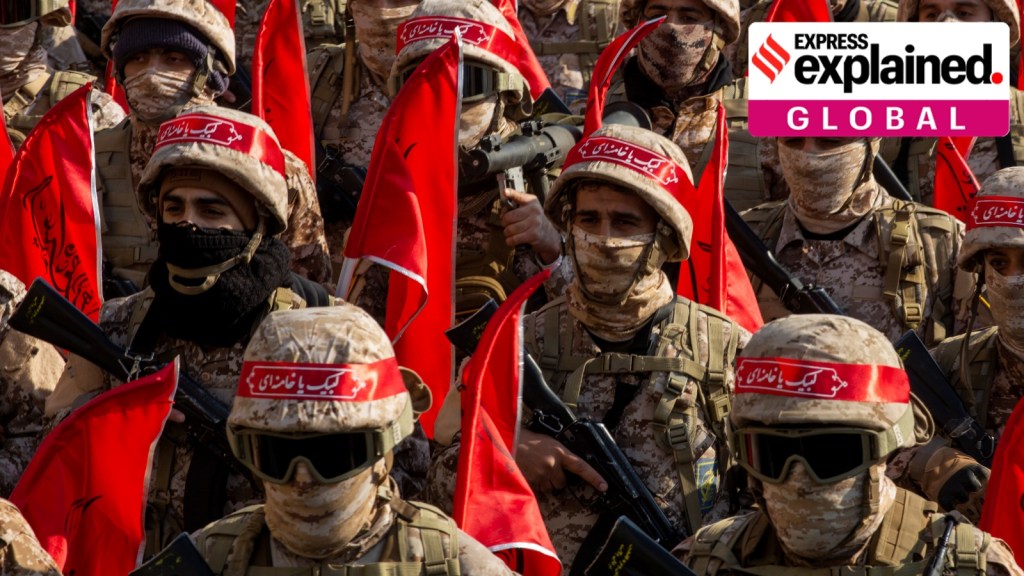 Members of the Basij paramilitary volunteer militia of the Islamic Revolutionary Guards Corps during a military “force parade” in Tehran, on January 10, 2025. Photo: Arash Khamooshi/The New York Times


 Share


