


Journalism of Courage
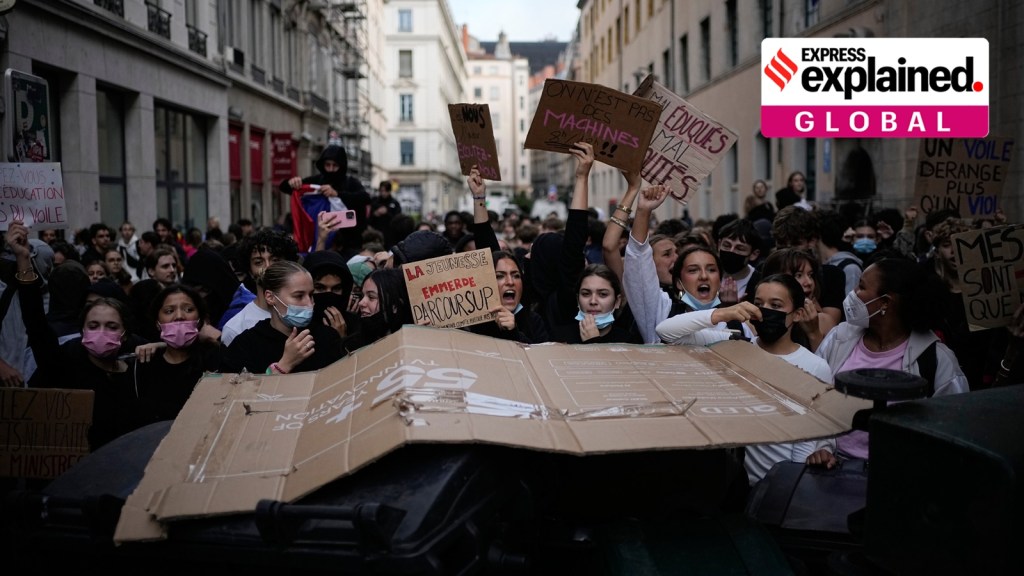 France Student Protests: Students shout slogans in front of a high school blockade, in Lyon, France, Friday, Oct. 2. (AP Photo)
France Student Protests: Around 500 schools stayed shut across France on Monday (October 5), amid raging students’ protests. According to the French government, around 500 high schools, out of the country’s 3,700, are fully or partially closed.
The country’s education minister, Édouard Geffray, has announced a feedback programme for high school students, along with an action plan to quickly hire more teachers beginning today.
The protesters have blockaded schools, set fire to waste bins, and in some cases smashed furniture, doors and windows. According to French officials, damage across 40-odd schools is worth around €3million (Rs 32.5 crore).
Among the high school students’ complaints is that there are up to 40 students in a class.
The unrest has taken on political colours, coming around six months before the Presidential elections and coalescing with grievances across other sections of the public. On Tuesday, more protests by different unions are planned in support of the students.
The protests began on September 17 at the Saint-Exupéry high school in Créteil, a Paris suburb, where students joined teachers protesting a lack of staff and resources. They quickly spread through the Paris region and then to cities including Marseille, Strasbourg, Tours and Lille.
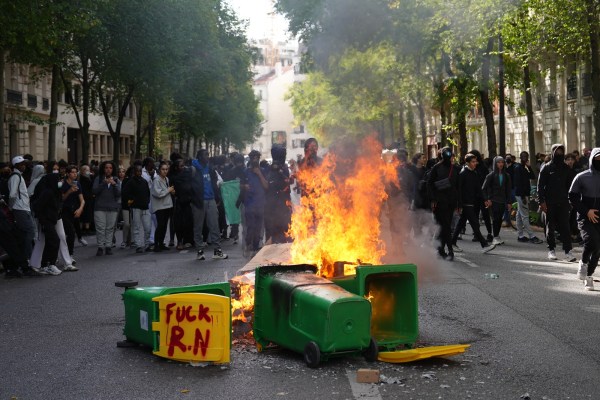 Students burn garbage bins as they protest against under-resourced schools, in Paris, Friday, Oct. 2, 2026. (AP Photo)
The demonstrations have increasingly involved fires, thrown projectiles and clashes with police. In some places, rubbish bins and other objects were set alight, while police used tear gas and rubber bullets.
The Education Ministry said 65 education staff, including 40 school principals, had been injured; students have also been injured. More than 4,000 people had been arrested since Monday, according to the Interior Ministry.
The government has said the students’ grievances are legitimate but that violence cannot be tolerated. Students, meanwhile, have accused police of using excessive force.
The major grievances are overcrowded classrooms, fewer teachers, no nurses or social workers in some schools, and crumbling infrastructure. Inequality is also a factor, with students from poorer suburbs saying their address is impacting their education.
A French government report on education from April this year says, “During the 2024-2025 school year, 9.8% of teaching hours were not provided in public secondary schools, of which 7.5% was due to the non-replacement of absent teachers and 2.3% was due to the total closure of the establishment.”
The report adds that the “proportion of teaching time not provided increased by 0.7 points compared to the previous year due to a greater number of days of school closures.”
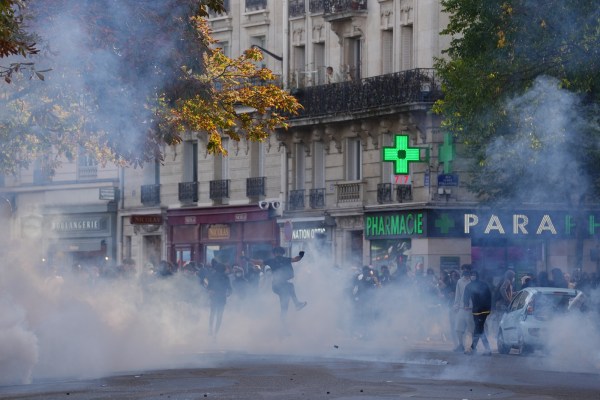 A student kicks a tear gas canister during a protest against under-resourced schools, in Paris, Friday, Oct. 2, 2026. (AP Photo)
Some of the protesting students have said there are 40 of them packed in a classroom, when the average for French high schools is around 30 in a class.
The length of the school day is another complaint — French high school days can extend from 8 am to 5 pm, with a lunch break, which many say is too long.
The extreme heat wave France saw earlier this year has added another dimension. Students have complained about having to sit examinations in classrooms reaching 35°C to 40°C, while others said classrooms became unbearable during the heatwaves in May and June.
French public schools are often not air-conditioned and built to keep heat in rather than out, so 40°C in poorly ventilated classrooms for children not accustomed to such temperatures can feel difficult.
While in many schools, teachers have protested side by side students, in other cases, school staff have said the protesters are not from among their pupils.
This, the scale of the violence, and flags of Palestine and Algeria at some of the protests have led those on the right wing and even the centre to claim that the hard left party France Unbowed (LFI) is playing its part in the protests.
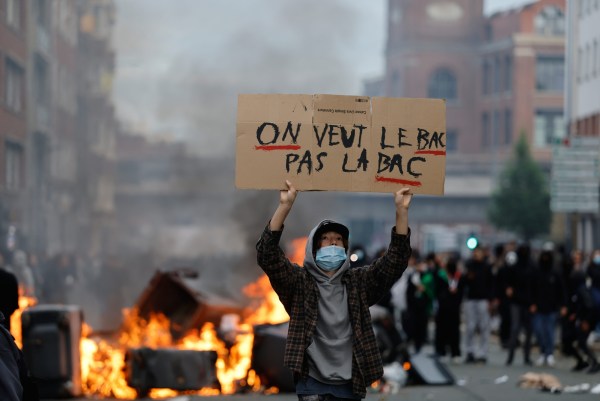 A student holds a board reading, “we want the BAC (High School Diploma) Not the BAC (Anti-criminality units)” during a protest to demand more resources at school, in Lille, France, Thursday, Oct. 1. (Photo: AP)
France will go to polls next year as the centrist government of Emmanuel Macron is under unprecedented stress from both the right and the left, over the issue of migration and identity politics on one hand and rising inequality and spending cuts by the government from the other.
While support for the hard right party National Rally led by Marine Le Pen has surged, the LFI’s presidential candidate, Jean-Luc Mélenchon, is popular among the youth. However, the French youth often do not turn up to vote in large numbers. Some analysts believe that the LFI is fuelling the high school students’ protests to rally the youth and make them vote for it next year.
For the government, it is a tight spot. In its 2027 budget, education spending is set to rise by 1.7% to €65.53 billion, excluding teacher pensions — an increase below inflation. Now, it has to balance students’ demands while remaining committed to its programme of cutting government spending.