


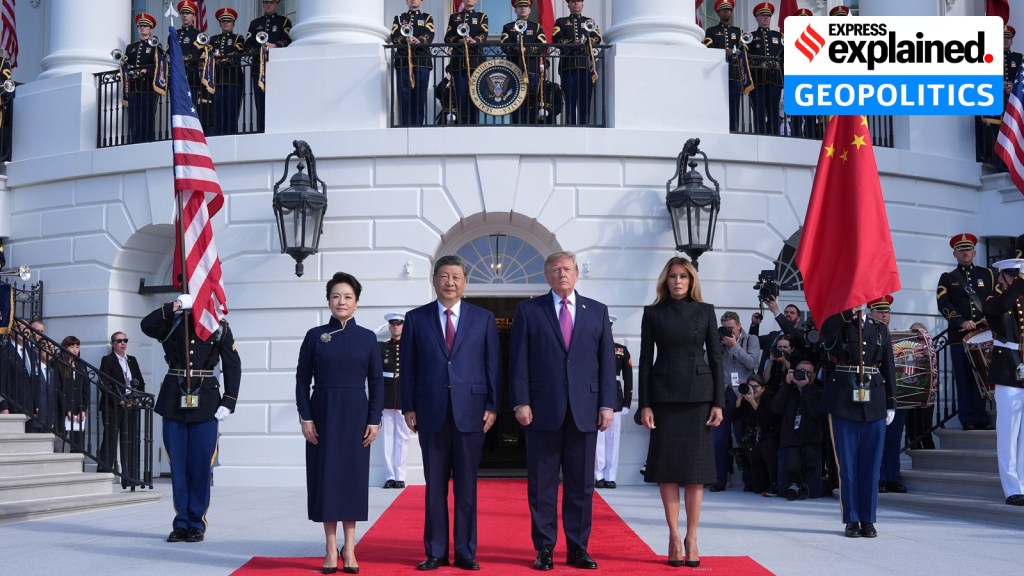
 US President Donald Trump and first lady Melania Trump with China's President Xi Jinping and his wife Peng Liyuan on the South Portico of the White House on Sept. 24 in Washington. (AP Photo/Alex Brandon)
During Chinese President Xi Jinping’s visit to the United States, issues ranging from tariffs to artificial intelligence (AI) regulation were on the agenda, with global ramifications.
But for China, perhaps the most significant concern may be the US government’s policy on Taiwan.
The Chinese government has earlier described the island of Taiwan as a “red line” that cannot be challenged. Xi recently said in Washington, DC, that “China hopes the US side will adhere to the correct position of opposing ‘Taiwan independence,’ and handle the Taiwan question with caution, so as to lay a solid foundation for China-US strategic cooperation…”
China has long made historical claims to Taiwan, even as Taiwanese political leaders have increasingly referred to themselves as functioning independently anyway. Concurrently, the Chinese claims are being made with greater intensity, alongside tactics like aircraft flybys near Taiwan.
How does the Taiwan issue add to the complexities of the US-China relationship? Lyle Morris, Senior Fellow on Foreign Policy and National Security at the US-based Asia Society Policy Institute’s Center for China Analysis, who also served in the Office of the Secretary of Defense (OSD) as the Country Director for China, explains.
In Donald Trump’s first term, beginning in 2017, his policies centred on strategic competition and correcting unfair trade with China. This view has evolved, largely due to his belief that his personal charm and business approach can persuade autocratic leaders — a playbook he used with Vladimir Putin and Kim Jong Un. It hasn’t worked well with Putin, since there has been no agreement on Ukraine.
With China, it’s unclear. I give Trump credit for understanding the importance of respect in Chinese culture and going above and beyond to show that. But what comes next, and what concessions can the US extract? During the last trade war, when China restricted rare earths, the US lost its leverage.
If this meeting yields agreement on AI principles, extended trade, or better personal rapport that prevents escalation in a future crisis, those are positive outcomes. But as far as securing a grand bargain is concerned, that ship has sailed.
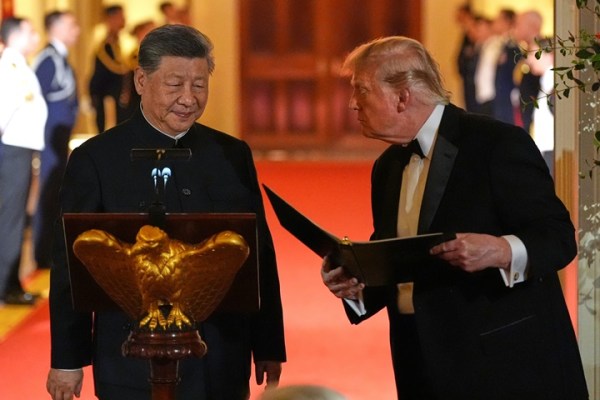 US President Donald Trump talks with China’s President Xi Jinping during a State Dinner in the East Room of the White House. (AP Photo/Alex Brandon)
Here’s a quick history: before 1979, the US officially recognised Taiwan as representing China internationally. Then we had the three Joint Communiqués signed by the governments of the US and mainland China through 1982 that led to them recognising each other diplomatically, conditional on the US revoking recognition of Taiwan. The third document also stated that the US would gradually decrease its arms sales to Taiwan.
At the same time, the US put forth the Six Assurances — a classified memo to Taiwan — stating it had not agreed to an end date on arms sales and would not negotiate with China over them. That balanced Taiwan’s feeling of being left behind.
Since then, the Taiwan Relations Act of 1979 has formed the basis of unofficial relations between the US and Taiwan, with the US being its primary arms seller. We have a deep commitment to aid Taiwan’s defensive needs so they can credibly deter China from contemplating a military contingency.
Previous US presidents understood that. Joe Biden, on many occasions, dispensed with strategic ambiguity — the policy of not explicitly committing to providing military support to Taiwan in case of a possible Chinese attack. He said the US would intervene militarily. Trump has softened that, changed the tone, and echoed Xi’s talking points like ‘no one wants to go to war’ and ‘Taiwan’s 9,500 miles away’. That sends worrying signals to Taiwan while making China happy.
Last year, Trump signed off on a $10 billion package to Taiwan, and this $14 billion package will be the largest ever, once cleared by Trump. It’s unclear if this package has become a “red line of red lines” for Xi. Behind closed doors, China has probably communicated that approving it would bring consequences.
Some reports say China is attempting to have the US hold off on this package. Why is that?
First, I think Xi looks at Trump as malleable, for lack of a better word, when it comes to Taiwan. After they met in May in Beijing, Trump gave a few interviews on Air Force One in which he basically echoed Beijing’s talking points and didn’t really take the opportunity to reassert longstanding US policy on Taiwan, including arms sales. Xi and China see an opportunity to continue to press Trump to see how far they can get him to align with Beijing on Taiwan.
And so we’re all going to see in the next few days what Trump says and does on Taiwan. He has clearly paused the $14 billion package, perhaps to accommodate China in service of getting a bigger deal. Maybe that’s a token gesture Trump could offer Xi to placate him to get what Trump wants, which is mostly trade and bilateral investments.
In some ways, Trump is kind of sacrificing Taiwan, and people I talked to in Taiwan feel a little left out to dry. I would predict that eventually, Trump will approve the package, but timing will be really important; he will probably wait a significant amount of time after this visit. If he doesn’t approve it, that’s a very worrying precedent.
In the last decade, since TSMC in Taiwan became the world’s number one chip maker [chips or semiconductors are essential for producing key electronic components], supply chains have assumed added significance.
There are theories that China might invade to take over TSMC, which I don’t think has much credibility. Nonetheless, if a conflict occurred, chip supply chains would be significantly constrained. That’s a major worry for the US and all countries importing chips from TSMC. Both Trump and Xi understand a Taiwan conflict would be disastrous. It has led to more US-Taiwan discussions on supply chain resiliency, and Trump has pressured Taiwan to outsource chip manufacturing to the US, leading to investments in Arizona. So, TSMC’s success has added a critical new layer to the equation.
How are these events influencing the US’s regional partners?
Japanese Prime Minister Sanae Takaichi made explicit remarks on Taiwan last year, on a naval blockade being a “survival-threatening situation” for Japan. The US would rely on countries like Japan, the Philippines, and Australia for basing, operations, or troop support in that scenario. The whole region is concerned about what China is doing in the region.
That concern over Chinese military modernisation is also the underlying basis for AUKUS, the security partnership among the US, the UK and Australia. Countries are hedging, building up their militaries, and discussing joint exercises and evacuation contingencies with the US because they are worried. From Beijing’s perspective, they are perhaps undertaking a cost-benefit analysis about what their actions in the region might yield.