
Of the 140 paragraphs in the BRICS New Delhi Declaration adopted last week, 11 paras were devoted to recent developments in West Asia.
Each BRICS declaration expresses the in-principle position of any state at the time and does not create any binding obligation. But since they are passed by consensus, each document acts as a broad yardstick to identify shifts in the postures of particular states.

In this light, the 2026 New Delhi Declaration is the first consensus document from a multilateral grouping featuring China, Russia and Iran that mentions the UN Security Council’s Resolution 2803 — the Donald Trump-backed Gaza peace plan that was adopted on November 17 last year with China and Russia abstaining and Iran subsequently condemning it.
The declaration also reflects subtle shifts in the Iranian, Emirati and Saudi positions on key conflict variables in West Asia. Both are considered below.
On Palestine
The New Delhi Declaration, in paragraphs 30 and 31, takes “note of the adoption of UNSC Resolution 2803” and reaffirms the “Arab Peace Initiative that includes the establishment of a sovereign, independent and viable State of Palestine within the internationally recognised 1967 borders, which included the Gaza Strip and the West Bank, with East Jerusalem as its capital”.
The Arab Peace Initiative, a “land-for-peace” arrangement outlined in 2002, is a result of Arab positions turning more pragmatic after the failure of the Oslo Peace Process and the onset of the Second Intifada.
It made Arab recognition of Israel contingent on verifiable Israeli steps towards recognising a Palestinian state with borders before the expansion of Israeli occupation during the Six-Day War of 1967.
For Israel, the 1967 requirement has long been a deal-breaker, with its positions hardening since October 2023. Israeli diplomatic resistance to the ‘1967’ obligation (reiterated in at least 13 legally binding UNSC Resolutions) has since been reinforced by Israel’s increasing occupation of Gaza and illegal settlements in the West Bank.
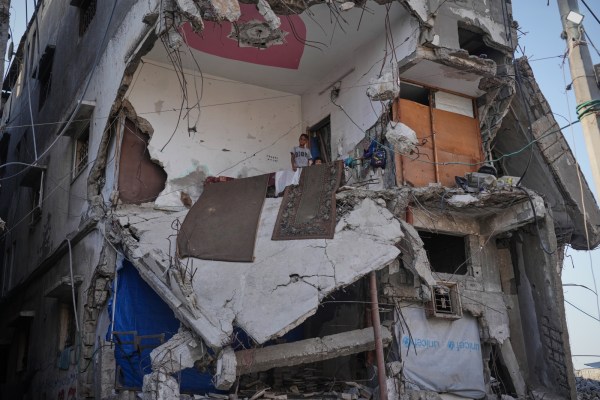 Displaced Palestinians shelter inside a building heavily damaged by an Israeli strike in Gaza City on Thursday. (AP)
However, UNSC Resolution 2803 was the first Security Council resolution on Palestine that omitted Israel’s obligation to return to 1967 borders and the UN’s foundational principles on Palestine. The resolution reflected an American position peculiar to both Trump administrations, causing both Russia and China to abstain.
Trump‘s Comprehensive Peace Plan for Gaza, endorsed in the resolution, omits both Israel’s obligation to revert to its 1967 borders or aid the establishment of a Palestinian state with East Jerusalem as its capital. It also refrains from terming Israel’s control of Palestinian territories as “occupation”.
Note that the first Trump administration was the first world government to recognise undivided Jerusalem as Israel’s capital, reversing Washington’s decades long sensitivity to the Arab posture and alignment with past UNSC resolutions.
No Gulf Arab state was present at the UNSC November session, with Pakistan and Algeria being the sole Islamic countries to assent. However, motivated largely by a then-urgent need to support a US-led effort to force a ceasefire in Gaza, Arab states later assented to the resolution, its endorsement of Trump’s peace plan, as well as the Board of Peace.
However, unlike the American-Israeli posture, Arab states convened multiple times in the immediate aftermath of UNSCR 2803. The 46th Session of the Gulf Cooperation Council’s Supreme Council (December 3, 2025), the Joint Summit of the African Union, Organisation of Islamic Cooperation, and the Arab League (December 16, 2025), and the OIC’s Emergency Executive Committee Meeting (February 26, 2026) all referenced UNSCR 2803 alongside a reiteration of “the need to end the Israeli occupation and establish an independent Palestinian state on the 1967 borders with East Jerusalem as its capital”.
In fact, the OIC emergency session references all 13 UNSC Resolutions since 1967 which declare East Jerusalem as Palestine’s capital — a customary invocation in all UNSC Resolutions on Palestine (except 2803).
The New Delhi Declaration, then, is an institutionalisation of the Arab effort to ensure that resolution 2803’s implementation is not seen as divorced from the 1967 need. Moreover, it reflects China, Russia, and Iran’s implicit acknowledgement that UNSCR 2803 and the Trump peace plan can act as a roadmap for Gaza, as long as the 1967 obligation is respected, thus restoring greater balance in the positions of major stakeholders on the theoretical road to Palestinian statehood. This is notwithstanding Israel’s continued rejection of such positions.
The Iran war
In the months leading up to the September declaration, India’s BRICS presidency was fraught with the challenges of an unprecedented geopolitical context in West Asia — the US-Israeli war on Iran and Tehran’s strategy of retaliating against targets in Arab states.
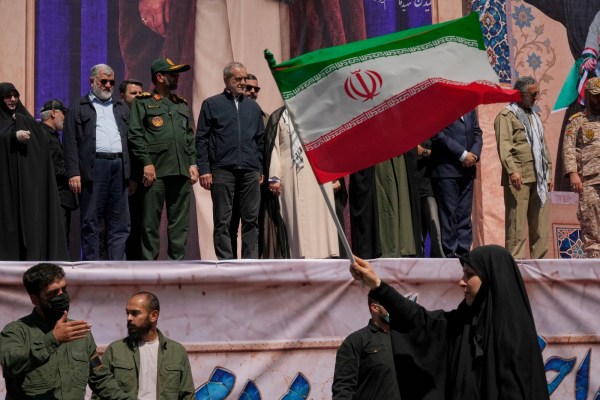 Iranian President Masoud Pezeshkian at a parade in Tehran on Friday. (AP)
India became the first BRICS chair in the grouping’s history to issue a Chair’s Statement at the end of the BRICS Foreign Ministers’ Summit in May that included mentions of member-specific reservations to key paragraphs. Across March, April and May, the decisive breakdown in the détente between Iran and its Arab Gulf states had meant that they disagreed specifically over the situation in West Asia — enough to prevent consensus.
In the months since, as US military efforts to dislodge the Islamic Republic or its control over the Strait of Hormuz failed, Gulf Arab states have shown an openness to engaging with Tehran, even as skirmishes between American and Iranian forces continue in Hormuz.
This was particularly evident in President Masoud Pezeshkian’s meeting with the Crown Prince of Abu Dhabi on BRICS sidelines where they “agreed to put the past behind us and look to the future”, despite Iran having targeted the UAE more than any other Gulf Arab state in its retaliatory strikes.
A crucial Yemen omission
While the UAE has historically maintained its own unique forms of engagement with Iran to mitigate threats, it is Saudi Arabia’s assent to the New Delhi Declaration which presents the most prominent shift.
This is particularly due to the document’s omission of any reference to the Yemen conflict, despite unprecedented Houthi reciprocal strikes against multiple Saudi cities, as well as a Houthi-imposed blockade on Saudi shipping in the Bab-el-Mandeb Strait since July.
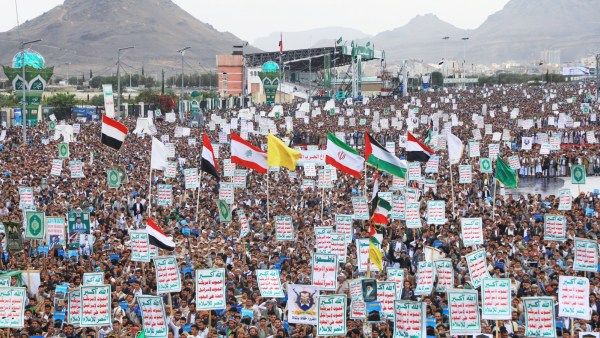 Houthi supporters gather in Yemen’s Sanaa to protest Saudi Arabia’s accusation that the group targeted Islam’s holiest site, Mecca. (AP)
This omission becomes more conspicuous when set against the Chair’s Statement in May which both expressed support for a UN-led Yemeni peace process as well as the need to ensure freedom of navigation for all states in the strait.
As Saudi-Houthi escalation continues and Riyadh faces a historic double blockade in the straits of both Hormuz and Mandeb, it is evident that this omission favours the unnamed member state (arguably Iran) that expressed reservations to the Yemen/Bab-el-Mandeb reference in May and indicates a Saudi concession.
Moreover, the New Delhi Declaration also endorses South Africa’s case against Israel — which is named explicitly — at the International Court of Justice (ICJ) as well as an overt call for Israel “to withdraw its occupying forces from all of the Lebanese territory”. States such as the UAE have traditionally adopted quieter postures (especially vis-à-vis South Africa’s ICJ case), than Iran or Saudi Arabia.
The actual positions of Arab states will ultimately be determined by the contours of the ongoing conflict of the region. However, consensus for the 2026 New Delhi Declaration reflects three crucial characteristics — India’s success as a convenor, as it oversaw the reconciliation of crucial reservations from May; Iranian, Russian and Chinese sensitivity to the Gulf Arab approach over Palestine; and Saudi-Emirati recognition of the need to engage Iran for long-term regional stability despite the Yemen escalation.
The author is Senior Research Associate at the Council for Strategic and Defense Research, New Delhi

 Share


