Many of the thousands of Bolsonarists who stormed and ransacked government buildings in Brasilia on January 8 had been camping outside military barracks, ever since President Luiz Inácio Lula da Silva narrowly won the presidential elections of October 2022.
The supporters of the defeated right-wing leader Jair Bolsonaro have been calling on the military to overturn the result of the election. Several reports have suggested that they are hoping to convince Bolsonaro sympathisers within the army to ensure the ouster of Lula, who took charge on January 1.
Interestingly, while the military did help the police restore peace after several hours of rioting on January 8, the protesters faced virtually no resistance at the barricades as they marched 8 km from the military headquarters to the plaza in the heart of the capital where the seat of power is located.
Brazil has had a turbulent history of military interventions in government, and was ruled by a military dictatorship between 1964 and 1985. However, there is no indication at the moment that the Brazilian military might act against President Lula or his democratically-elected government.
The political crisis of the 1960s
The political climate worsened in Brazil after then President Jânio Quadros resigned from his position in 1961 — he had come to office that same year after a huge victory in the elections, but his tenure was marked by political instability as he faced opposition from his former allies and Congress. This paved the way for João Goulart, who was the vice president at the time, to get the top job.
However, he was deeply unpopular among the conservative section of the ruling coalition and even within the armed forces. According to reports from the time, some military officials accused him of being a “communist” and tried to block his rise to the presidency. After long negotiations, a deal was struck. Goulart became president, but his powers were substantially curtailed by creating a new position of prime minister.
The ‘leftist’ reforms of João Goulart
Around two years later, Brazil returned to the presidential system after a referendum, and Goulart not only retained his position but also got back all those powers that he had lost earlier. Buoyed by his new-found success, the president proposed to bring in sweeping changes, which included agricultural, financial, electoral, and educational reforms. He also promised to extend voting rights to illiterates, nationalise foreign oil refineries, and re-distribute land.
These measures weren’t well-received by the conservative sections of society, including the Catholic Church, and a large number of army officials, who saw them as being part of a “socialist” agenda.
With the Cold War at its peak, the US too was looking closely at Goulart’s seemingly leftist reforms. According to an analysis published in The Washington Post, the administrations of President John F Kennedy and his successor, President Lyndon B Johnson, “pushed an anti-Goulart agenda” during the 1960s.
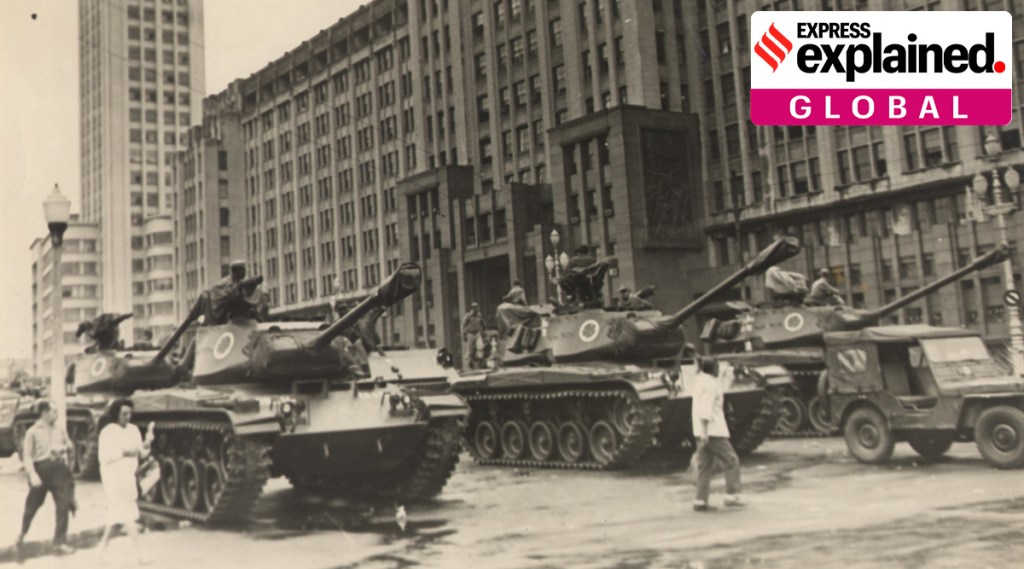
The military coup of 1964
On April 1, 1964, the Brazilian army staged a coup and forced Goulart and his allies to flee to exile in Uruguay. “The Johnson administration presided over Goulart’s demise. Notes from a top-level meeting just days before the coup showed that the White House was expecting the military to take action,” The Washington Post said.
The military dictatorship in the country continued for the next 21 years. During this time, thousands of dissidents were tortured and hundreds were killed.
Return of democracy
Brazil’s transition to democracy began in 1985 after the military junta claimed to have successfully averted a “communist revolution”. This led to the indirect election of Tancredo Neves, leader of the Brazilian Democratic Movement (MDB) party, as the first civilian president in 21 years.
Three years later, a new constitution came into force, under which Brazil held its first national election since the end of the military dictatorship. In 1990, Fernando Collor, the Brazilian Labour Party’s leader, emerged as the first democratically elected president since the 60s.


 Share


