The far-right Alternative für Deutschland (Alternative for Germany or AfD) came within reach of power at the state level for the first time since World War II on Sunday (September 6), recording its strongest-ever electoral performance in the eastern state of Saxony-Anhalt. It won 43.8% of the vote and 39 of 83 seats, just three short of an outright majority.
The result was also a severe blow to Chancellor Friedrich Merz’s Christian Democratic Union (CDU), which had governed Saxony-Anhalt since 2002 but won just 17.2% of the vote. Whether the AfD can form a government, however, remains unclear, as other major parties have so far refused to work with it.

The victory marks the latest milestone in the AfD’s transformation from a fringe Eurosceptic party to one of Germany’s largest political forces.
Who are the AfD and how did they become a major political force?
The AfD, previously the Electoral Alternative 2013, was founded in 2013 by Bernd Lucke, Alexander Gauland, Frauke Petry and Konrad Adam, a Eurosceptic band of economists opposed to the then-German government’s decision to bail out poorer European countries during the Eurocrisis.
The party took a hard-right pivot in the following years. As a record 1.3 million refugees, mainly from Syria, Iraq and Afghanistan, sought asylum in Europe in 2015, the AfD rode a wave of anti-immigrant and anti-Muslim sentiment to make electoral gains regionally. By 2017, it had entered the Bundestag, winning 94 of 709 seats and finishing third.
The AfD has doubled down on these views since. It advocates “remigration”, a controversial policy that implies the forced deportation of immigrants and their European-born descendants not deemed “ethnically” European by ethnonationalists. It is also deeply Eurosceptic, has campaigned for a “Dexit” from the European Union, and opposes Germany’s climate policies.
Members of the party have also sought to distort the significance of the Holocaust. Björn Höcke, the AfD leader in Thuringia, called the Holocaust memorial in Berlin a “monument of shame” in German history in 2017.
The party has found particularly fertile ground in the former communist east. Post-communist eastern regions have long lagged behind western Germany in incomes, employment and productivity, while voters have also expressed resentment at a lack of political representation and the perceived failure of mainstream parties to address economic stagnation, inflation and migration.
But the grievances behind the AfD’s rise have broadened beyond immigration. Gurjit Singh, who served as India’s Ambassador to Germany, points to economic anxiety, deteriorating infrastructure and pressure on the welfare state as factors behind the growing protest vote.
“The basic life of a German is no more as good as it used to be,” Singh told The Indian Express, citing frustrations over public infrastructure and the strain on the welfare system. He said that while immigration had been an initial source of discontent, social anxiety, poor economic performance and deterioration of infrastructure were now important drivers of AfD support.
In September 2024, the AfD became the first far-right party since World War II to win a German state election, taking 32.8% of the vote in Thuringia.
So why is this significant?
Sunday’s victory goes considerably further than the AfD’s previous electoral successes. In Saxony-Anhalt, the party more than doubled its vote share from 20.8% in 2021 and came close to securing enough seats to govern without a coalition partner. Voter turnout was also unusually high at 77.8%.
The result also shows how far the AfD has grown at the national level: it is already the largest Opposition party in the Bundestag, with recent national polling putting it at around 28%, ahead of the parties in the governing coalition.
But Saxony-Anhalt is also part of a longer pattern of AfD success in eastern Germany. The party has drawn on long-standing economic and political discontent in the region.
The east-west divide has long shaped the party’s rise. Establishment parties such as the CDU and SPD, which are rooted in western Germany, have struggled to establish themselves as firmly in the post-communist east. The region has also lagged behind western Germany in economic development, while the lack of eastern representation in successive governments since reunification has fuelled a sense of political alienation.
Unlike voters in the west and south, eastern voters have also tended to switch political allegiances more frequently between elections, creating greater space for newer parties such as the AfD. The divide has also been visible in attitudes towards Russia and the war in Ukraine, with voters in the east generally more sceptical of sanctions on Moscow and military support for Kyiv than those in western Germany.
Singh said the factors driving AfD support were not necessarily the same in every state. “I wouldn’t put immigration necessarily at number one in every state that the AfD is popular because in some states … there are not so many immigrants but other issues are more important,” he said.
What is Germany’s firewall? Can AfD govern?
Given Germany’s Nazi past, mainstream political parties have maintained a “firewall”, a political commitment not to cooperate with far-right parties such as the AfD.
This has so far kept the AfD out of government even when it has emerged as the single-largest party. After it won 32.8% of the vote in Thuringia in 2024, other parties combined to prevent it from taking power.
But the firewall has come under increasing strain. In January 2025, Merz relied on AfD support to pass a non-binding parliamentary motion calling for tougher immigration rules, triggering accusations that he had broken a long-standing political taboo.
The Saxony-Anhalt result shows how complicated the political arithmetic has now become: The AfD needed 42 seats for a majority, and won 39. The CDU has 15 seats, while the Social Democrats, Greens and Left each have eight, and the leftist Sahra Wagenknecht Alliance has five. With the other major parties continuing to rule out cooperation with the AfD, forming a stable alternative government could prove difficult.
The question, then, is whether the firewall can hold as the AfD continues to gain support. Singh argued that its continued rise could eventually force other parties to reconsider how they deal with it. “If AfD is going to keep getting popular, other parties need to learn to work with it rather than ignore it,” he said, suggesting that a major party such as the CDU could eventually seek to engage the AfD on a coalition agenda.

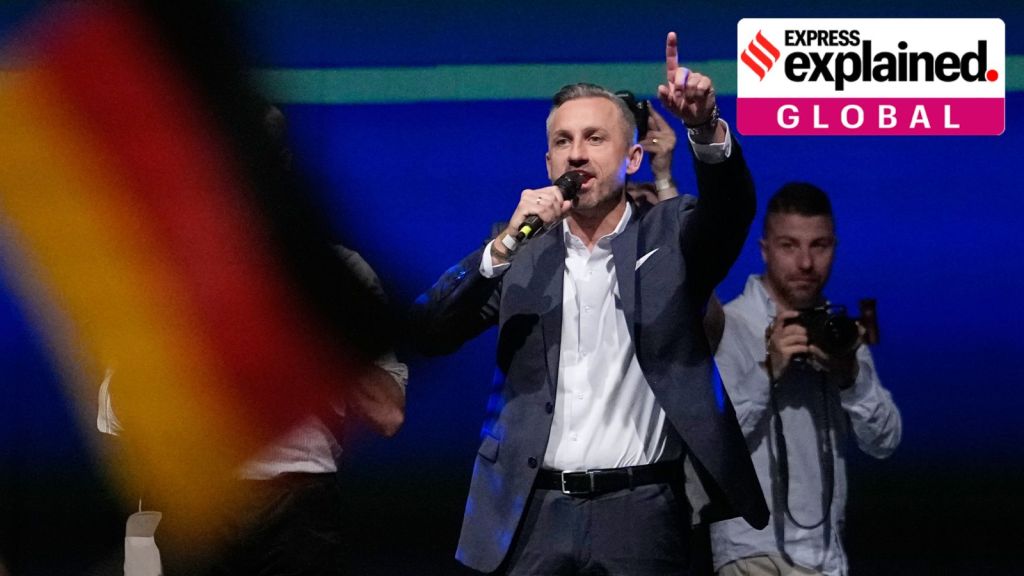 Top candidate Ulrich Siegmund speaks at an election party of the "Alternative for Germany" (AfD) after the Saxony-Anhalt state elections in Magdeburg, eastern Germany, Sunday, Sept. 6, 2026. (AP Photo/Matthias Schrader)


 Share


