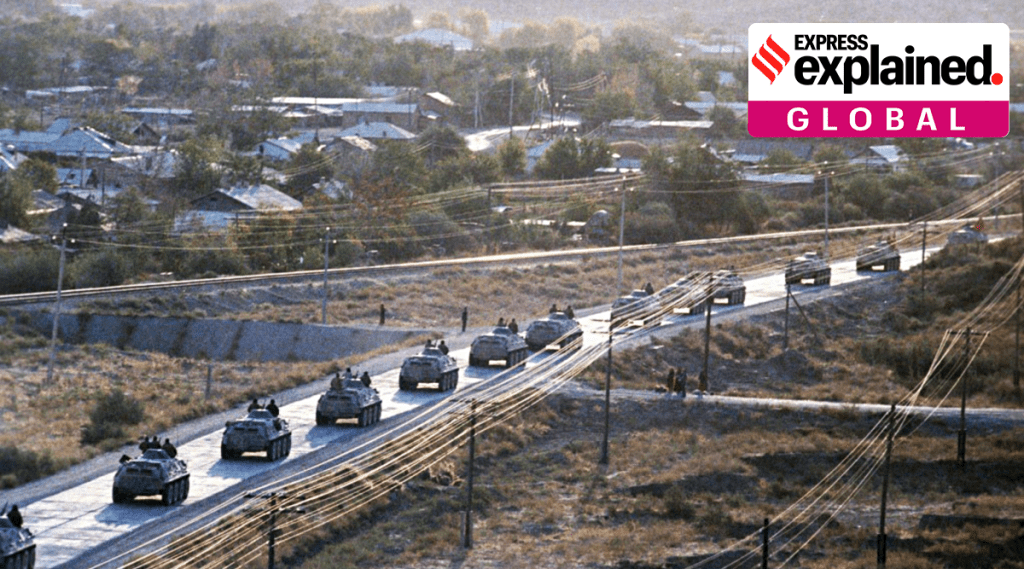
On February 15, 1989, the Soviet Union (USSR) withdrew the last of its troops from Afghanistan, ending its nine-year occupation of the country. The conflict is estimated to have led to the deaths of around a million civilians, Mujahideen fighters, and Soviet and Afghan soldiers, and left Afghanistan in ruins.
The war had far-reaching and long-term consequences, including the disintegration of the USSR, the Afghan civil war, the rise of radical Islamism, and the formation of al-Qaeda and the Taliban. Thirty-four years after the end of the conflict, the world continues to witness its after-effects.
In 1978, the Saur Revolution, led by communist revolutionaries and leaders such as Nur Muhammad Taraki, Hafizullah Amin, and Babrak Karmal, led to the overthrow of the authoritarian regime of Mohammed Daoud Khan, and the establishment of the Democratic Republic of Afghanistan.
Taraki became head of state and solidified Afghanistan’s ties with the Soviet Union. However, the communist government had little support among ordinary Afghans, especially the orthodox Muslims, who found its atheism at odds with their Muslim faith. After Taraki and his cabinet announced sweeping social and land reform, widespread protests swept across the country.
The government retaliated by imprisoning, torturing, and killing several religious leaders. In response, the rebels banded together to form an anti-communist resistance movement called the Mujahideen.
As chaos spread across Afghanistan, fractures appeared in the relationship between Taraki and his close confidant, Amin. In September 1979, the latter ousted Taraki, and ordered his execution.
However, Amin failed to curb the anti-communist movement, and the Mujahideen declared jihad against him and his supporters. The Mujahideen received funding and support from the United States, which routed arms and cash to the fighters through its then close ally, Pakistan and its military intelligence agency, the ISI.
With the situation spiralling out of control in its neighbourhood, the Soviet Union, wary of the activities of its Cold War superpower adversary in its sphere of influence, decided to invade Afghanistan.
On December 24, 1974, some 30,000 Soviet troops entered the country and toppled the short-lived government of Amin. The Soviet Union aimed to strengthen the Afghan army and help them secure strategically important cities, lines of communication and transportation. But the Mujahideen offered fierce resistance, and the Soviets could never implement their plans for Afghanistan.
What led to the Soviet Union’s withdrawal from Afghanistan?
Although the Soviet Union poured billions of dollars into the war and sent in more than 100,000 troops, the war soon settled into a violent stalemate. While the Soviet soldiers controlled the cities and larger towns, the Mujahideen were in charge in the countryside.
In an interview with Radio Free Europe/Radio Liberty, Lieutenant General Aleksandr Mayorov, who was a senior Soviet military adviser to the Afghan regime in 1980 and 1981 said that as the war progressed, the rebels improved their “organisation and tactics and began using imported and captured weapons, including US Stinger anti-aircraft missiles.”
Mayorov, the author of a book called ‘The Truth About The Afghan War’, also said that the Soviet troops became increasingly demoralised.
Mikhail Gorbachev, who took over the leadership of the Soviet Union in March 1985, concluded that it was unsustainable to continue with the Afghan campaign. In one of his speeches, he termed Afghanistan as a “bleeding wound”.
In November 1986, the Soviet Union decided to leave. Gorbachev summoned the Afghan communist leaders and informed them that they had two years to prepare for the withdrawal of the Red Army. He also assured them of massive economic, financial and military aid in the following years.
The departure was finalised two years later, when, in April 1988, the Soviet Union signed the so-called Geneva Accords with the United States, Pakistan, and Afghanistan and agreed to withdraw its troops. The accords also set a strict timetable for the withdrawal of the troops and, by mid-February 1989, all the Soviet soldiers had left Afghanistan.
What happened after the Soviets left Afghanistan?
The Soviet Union had hoped that with its help, the communist government led by its ally Muhammad Najibullah, leader of the People’s Democratic Party of Afghanistan (PDPA), would be able to properly govern Afghanistan. But in 1992, Najibullah was removed from his position, following which a phase of intense jockeying for power among the various Mujahideen factions began. The context of the breakdown of governance and intense war fatigue among the Afghan people set the stage for the emergence of the Taliban in 1994.
By 1996, the Taliban, led by a former Mujahideen commander, Mohammad Omar, seized control of Afghanistan. Their rule came to an end when the US launched a series of military operations in the nation in a bid to capture Osama bin Laden, the leader of al-Qaeda and the mastermind of the 9/11 attacks.
But in an ironic twist of history, in August 2021, America left Afghanistan for good, and the Taliban stormed back to power in Kabul.


 Share


