On July 11, 2008, when Brent crude prices hit an all-time-high of $147.5 a barrel, the world experienced not just fuel inflation.
No less painful was global food inflation, which – based on the annual increase in the United Nations’ Food and Agriculture Organization’s (FAO) Food Price Index – ruled at double-digits for 22 months in a row from November 2006 to August 2008, averaging 34.8% for that period.
It was the same during the oil shock following Russia’s full-scale invasion of Ukraine in late-February 2022. Brent crude went as high as $139.13 per barrel on March 7, 2022. Then too, elevated global oil prices were accompanied by double-digit inflation in the FAO index for 19 consecutive months from January 2021 to July 2022 and averaging 26.8% year-on-year.
It’s different this time
The global energy shock from the United States-Israel versus Iran war has led to Brent prices soaring from an average of $64.6 per barrel in January and $69.2 in February to $98.2 in March 2026, peaking at $119.5 on March 9. With a fragile ceasefire since April 8 and the Strait of Hormuz still not open to most oil and gas traffic, Brent closed last week at $95.2 per barrel.
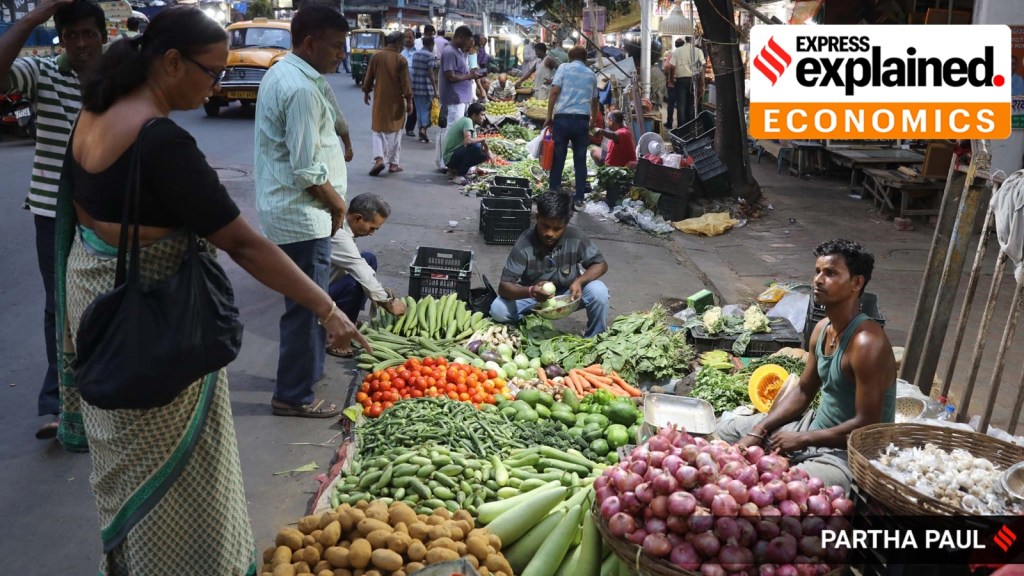
What is striking this time, however, is there being no concurrent spike in international food prices – unlike in 2022 and 2008.
The FAO index (a weighted average of the world prices of a basket of food commodities over a base period value, taken at 100 for 2014-16) in March 2026, at 128.5 points, was hardly 1% higher than for the same month last year. Annual FPI inflation has been negative or at low single-digits since September 2025, which contrasts with the high double-digit rates of 2021-22 (see chart).

This is also reflected in export prices of wheat shipped from Argentina, European Union and Russia currently quoting at $230, $238 and $239 per tonne, as against their corresponding year-ago levels of $248, $247 and $254 respectively.
Exports of rice from India are similarly going at around $367 per tonne (compared to $372 a year ago), while falling even more from Thailand ($405 to $382) and Pakistan ($395 to $351). Export prices are similarly down for corn (maize) from Argentina ($219 to $209) and Ukraine ($240 to $227), and marginally up from the US ($214 to $217) and Brazil ($223 to $225).
Raw sugar prices in New York, too, are at 13.75 cents per pound, a sharp dip from 18.1 cents last year at this time. The FAO dairy price subindex in March was 18.7% below its level a year earlier.
Only edible oils have registered notable price increases in the recent period. Landed prices of crude palm oil imported into India are at $1,265 a tonne, higher than the average of $1,112 for April 2025. They are up for crude soyabean ($1,355 versus $1,107) and sunflower ($1440 versus $1,219) oil as well.
Why is it different now?
The primary factor is ample supplies on the back of record world production of wheat, corn, oilseeds and sugar, estimated at 844.2 million tonnes (mt), 1,301.1 mt, 698.2 mt and 189.3 mt respectively for 2025-26 by the US Department of Agriculture. Global ending stocks of rice for 2025-26 are also projected at an unprecedented high of 192.3 mt.
This wasn’t the case in 2007-08, when a combination of supply shortages and increased diversion of crops such as sugarcane and maize towards biofuels – aggravated by financial speculation, with institutional investors putting big money into agricultural commodities that emerged as a distinct asset class like stocks and bonds – drove up international food prices. These rose in tandem with crude prices; both peaked around March-July 2008 before collapsing with the bursting of the speculative bubble by October 2008.
In 2022 also, global food prices had begun firming up alongside crude from the previous year itself. The driver was the post-Covid demand recovery with the easing of lockdowns. The Russia-Ukraine war only took both still higher. The FAO index scaled an all-time-high of 160.2 points in March 2022, the same month when Brent crude touched $139.13 per barrel.
Can food prices surge again like before?
That possibility cannot be ruled out, despite the FAO index averaging only 128.5 points in March 2026 and the world entering this crisis with abundant reserves of cereals, oilseeds and sugar. India, too, is well placed with respect to current stocks. It is set to harvest a bumper rabi (winter-spring) crop on top.
There are two routes through which food prices can potentially harden in the months ahead.
The first is cost-push. The Iran war and closure of the critical Hormuz waterway have triggered not just an oil, but a full-fledged energy shock also impacting supplies of petrochemical feedstocks and intermediates that go into a host of industries, including fertilisers and crop protection chemicals.
According to World Bank data, average prices of urea (Middle East origin) and di-ammonium phosphate (shipped from US Gulf ports) were at $725.6 and $658.3 per tonne respectively in March 2026, higher than their corresponding rates of $394.5 and $615.1 for March 2025.
Constrained availability and high cost of fertilisers, herbicides, insecticides, fungicides and diesel could affect acreages and yields of the 2026-27 crops. In the US, corn plantings happen in April-May and that of soyabean in May-June. India’s kharif (monsoon) sowings are mainly during mid-June to mid-August.
If the present ceasefire does not translate into a full re-opening of Hormuz – the failed Pakistan-mediated US-Iran peace talks offer little hope – it may threaten the prospects for the upcoming agricultural season and, in turn, push up food prices.
The second route for food inflation is diversion of crops for biofuel. If crude prices stay high for long, there would be that much incentive to divert corn, rice or sugarcane for making ethanol that can be blended with petrol. Vegetable oils – palm, soyabean or rapeseed – can, likewise, be used to produce fatty acid methyl ester (FAME), a substitute for diesel.
One reason for palm oil prices going up, notwithstanding a record global production of 80.7 mt expected for 2025-26, is aggressive biofuel blending mandates by Indonesia. The world’s largest palm oil producer had already raised the FAME content in its diesel from 35% to 40% since January 2025. It plans next to launch B50 – a blend containing 50% FAME and 50% normal diesel – from July this year. The Indonesian government has further issued a decree to make the B50 standard compulsory for all diesel sold nationwide by 2028.
It all eventually boils down to how long this energy supply crisis, the most significant since the 1970s, lasts.

 In 2007-08, supply shortages along with diversion of crops towards biofuels, aggravated by financial speculation, drove up food prices



 Share


