The West Asia war that began on February 28 has created not just the largest supply disruption in the history of the global oil market, but is emerging as a key stress test: how the $117 trillion global economy can be held hostage to a 50-kilometre stretch of waterway being commandeered by a few hundred men with guns.
In a little over a month and a half, the crisis has already sparked a change in energy consumption patterns. There are parallels here to the 2011 Fukushima nuclear power plant incident, triggered by the earthquake in Japan, which forced a worldwide shift away from nuclear power.

Energy shifts
According to Fatih Birol, the Executive Director of the International Energy Agency (IEA), the trend of using more coal instead of natural gas and a push towards renewables is already visible in Asia.
The agency also forecasts a potentially strong push for nuclear power in most countries, including efforts to extend the lifetime of existing nuclear power plants. There may also be a turn towards electric vehicles. A realisation has sunk in that the Gulf states are acutely vulnerable to an event like this, and that other countries that are big in the gas supply chain, including Russia or even the US, could be unreliable partners.
There is another grim prognosis from the IEA. The best-case scenario of the war drawing to a close by the end of May now appears to be optimistic by most yardsticks. Even if that were to happen, the 100-odd tankers loaded with oil and LNG stuck on one side of the Strait of Hormuz might come to the markets in the weeks after the cessation of hostilities.
Ship data from Hormuz. (IEA website)
Tanker data from Hormuz. (IEA website)
But to reach pre-war levels of oil and gas production in West Asia could take several months, because multiple energy facilities in the region have been damaged. The IEA monitors all these facilities — oil fields, gas fields, refineries, pipelines — and its latest internal assessment is that over 80 facilities have been damaged, of which more than a third are severely impacted. They will need months, if not years.
Flows to Asia affected
About 80% of oil and oil products transiting the strait in 2025 were destined for Asia. In addition, over 110 billion cubic metres (bcm) of LNG passed through the Strait of Hormuz in 2025. About 93% of Qatar’s and 96% of the UAE’s LNG exports transited through the strait, representing almost one-fifth of global LNG trade. There are no alternative routes to bring these volumes to market, the IEA noted in its April 2026 note, ‘The Middle East and Global Energy Markets’.
Most LNG from Qatar and the UAE goes to Asia. In 2025, almost 90% of the total volumes exported via the Strait of Hormuz were destined for the Asian market — accounting for more than a quarter of the region’s total LNG imports. Just over 10% went to Europe.
The other issue pertains to the reliance on natural gas, which, while being an incredibly useful fuel for segments of the global economy, is more prone to geographical constraints than perhaps oil. There’s already a discussion across countries, including India, on how to replace the fuel supply from the West Asia region, which is now appearing fragile and vulnerable.
That leads to another important question: the use of certain critical minerals needed for automation and defence sectors, for ingredients for medicines, and the domination of these areas by a single country — China.
This comes amid fresh reports in sections of the Iranian state-linked media that claimed the Islamic Revolutionary Guard Corps (IRGC) has forced American troops to retreat from the Strait of Hormuz during a heightened naval confrontation. It has been suggested that Iranian forces confronted US naval units, prompting a withdrawal. The options to end the conflict remain limited, even as another round of talks gets underway.
Long way out
Only two possible solutions appear to be on the horizon: a deal that looks remarkably similar to what Iran was willing to consider before the war, or an expanded conflict with no clear endgame, according to Dennis Citrinowicz, a West Asia National Security and intelligence expert and a nonresident Fellow at the Atlantic Council.
“The war seems to have been futile thus far… considering what the Iranians were reportedly agreeable to in Oman (prior to the February 28 US-Israeli strikes). If you believe they were going to keep their word… the US reneging on the JCPOA (Iran nuclear deal that was negotiated by the Obama administration) and the attacks of June 2025 have eroded their (Iranian) trust. That’s all the more the case now,” a shipping and strategy expert said.
“Having started this war, and the Iranians bullish at having foiled the US, there is a greater risk that they will go after nukes once sanctions are lifted, whatever they may sign up to. Even if they don’t enrich it, maybe other countries are willing to supply them with enriched uranium (including possibly Russia). In the current situation, perhaps the only way the Americans can secure their goal is by knocking out Iran’s oil exports and maintaining sanctions …. eventually forcing change in Iranian behaviour over the long run,” he told The Indian Express.
Finally, he said, it would all boil down to forcing open the Strait of Hormuz. “It’s what is putting pressure on [US President Donald] Trump, but I think they will have to find a way. That is the single lever — apart from whatever (Iranian) capacity remains to fire missiles and drones at everyone. It is hard to understand why, having gone to war, the US is now stopping short of taking on what should have been a highly likely operation to undertake,” he said.
Former Biden administration advisor Amos Hochstein said in a post on X that misunderstandings among negotiators put the Americans “in a worse position.” “My concern is no matter how the war ends – the Iranians now have a card they never had before in practice,” he said. “In theory, we knew they could close the Straits, but they never did, and now, for the foreseeable future, they have this card against us and against their neighbors.”
According to Citrinowicz, Israel’s ability to influence the negotiations is “very limited” as long as it demands zero enrichment in Iran and that it will be very hard to return to the JCPOA. The US might even need China’s support to increase the pressure on Iran.
American economist Paul Krugman, in a Saturday (April 18) update on the situation in the Strait of Hormuz, said that “It’s been clear for a while that the US has basically lost this war, and that the original aims of the war — achieving regime change and possibly to take Iran’s uranium — are both ostensibly unachievable”. What’s worse for the Americans is that two months ago, gas prices were at $2.80, and the Strait was open. It is now $4.06, and the US Navy is having to resort to firing on ships to keep the channel closed.
In addition, the Iranian regime is now more hardline than before, and the country has ended up strengthened with demonstrated ability to shut global maritime traffic as a strategic leverage. It is extremely unlikely, not even under the current dispensation, that the US will commit ground troops to attempt to dismantle Iran’s nuclear programme on a sustained basis.
The Iranians have meanwhile instituted a process to allow “free passage” of shipping through the Strait, by basically allowing passage for vessels that stay close to the Iranian coast and pay a toll along the way. In practice, this could be a strategic defeat for the US, but something that the Trump administration could try to spin as a victory, Krugman argued. But to get that, they have to actually deliver on some version of a deal. That really is the problem now.

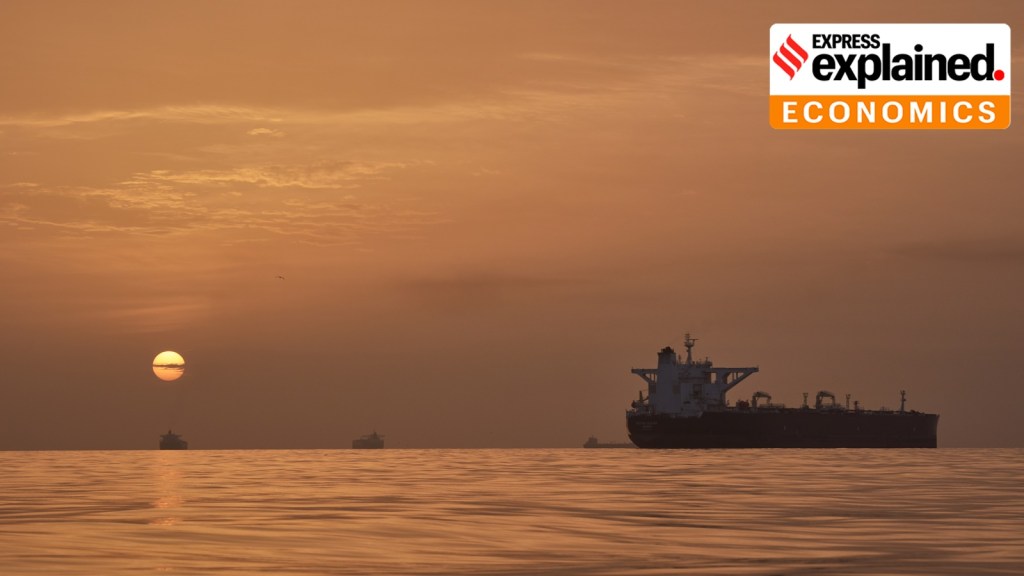 Tankers anchored in the Strait of Hormuz off the coast of Qeshm Island, Iran, Saturday, April 18, 2026. (AP Photo/Asghar Besharati)

 Ship data from Hormuz. (IEA website)
 Tanker data from Hormuz. (IEA website)


 Share


