At the time of Independence, there were about 5,000 tractors in farms across India. Domestic consumption of nitrogen (N), phosphorous (P) and potassium (P) through chemical fertilisers totalled 69,800 tonnes in 1950-51, with only one large factory of the Fertilisers and Chemicals Travancore near Kochi (Kerala) that produced ammonium sulphate.
Cut to the present, where tractor sales hit a whopping 1.16 million units during 2025-26 (April-March) alone. Consumption of fertiliser products in terms of N, P and K was over 32.9 million tonnes (mt) in 2024-25, the last full fiscal year for which data is available.

The contrast captures the extent of “fossilisation” that has changed the face of farming in India, especially post the Green Revolution from the late-1960s. It is also relevant in the context of the United States-Israel versus Iran conflict, which has exposed the vulnerability of Indian agriculture to supply disruptions in fossil fuel-based inputs.
De-bullockisation
Farming in India was traditionally bovine-based, providing both draught power and nutrients for plant growth.
Bullocks – basically male cattle and buffaloes castrated to make them more docile for use as draught animals – not only ploughed the fields. They also treaded the crops to separate the grain from straw and chaff, powered the Persian wheels to draw water from wells for irrigation, and pulled the carts for transporting farm produce and people.
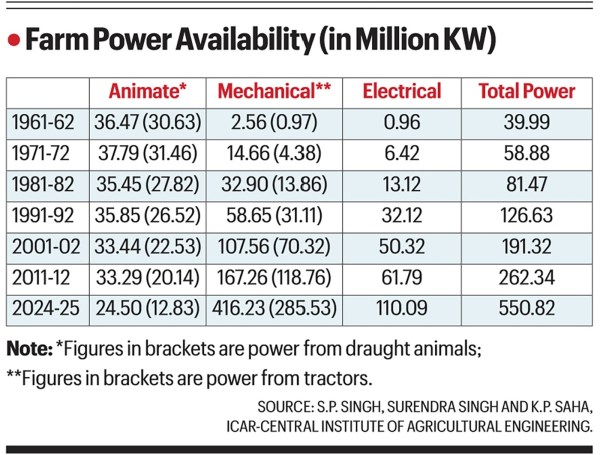
The accompanying table shows that draught animals contributed more than half of the total farm power availability in India till the early 1970s.
The power from mechanical sources (tractors, power tillers, diesel engines and combine harvesters) overtook that from animate (draught animals and agricultural labourers) for the first time in 1991-92. Since then, even the power from electrical sources — mainly to drive motors in irrigation pump sets — has surpassed that from draught animals and farm labourers.
SP Singh, Surendra Singh and KP Saha from the Bhopal-based ICAR-Central Institute of Agricultural Engineering have estimated the total farm power availability in India at 550.8 million kilowatts for 2024-25, with the share of draught animals at just 12.8 million KW or 2.3%.
The “de-bullockisation” of Indian agriculture is borne out by the country’s population of working cattle and buffalo bullocks falling from 80.8 million in 1972 to 60.2 million in 2003. The latest Livestock Census for 2019 puts the total number of draught animals at 34.8 million, comprising 31.9 million male adult non-breeding cattle and 2.9 million buffalo bullocks.
De-bullockisation has been accompanied by “fossilisation”. From 5,000 in 1946-47 and 37,000 in 1961-62, the total stock of tractors in India has now crossed 12 million units.
Tractors have rendered bullocks redundant in field operations, while enabling use of implements such as rotavators and reversible mould board ploughs that can do deep tillage, mixing and pulverisation of the soils and break their hardpan layers. They have largely taken over haulage operations, too, from bullock carts.
Combines have replaced both human labour (for harvesting) and bullocks (for threshing). These machines harvest, thresh, clean and deliver the grain from field to the farmer’s tractor trolley in a single go. Watering is, likewise, done mostly by pumps driven by electric motors or diesel engines. The rehat or bullock-powered Persian wheel has practically become history.
Chemical fertilisation
Farmers reared cattle also for their excreta used as a source of plant nutrients. Farmyard manure — the decomposed mixture of dung and urine along with agricultural residues like straw — contains 0.5% N, 0.2% P and 0.5% K on an average.
The chemical fertilisers manufactured initially in India were ammonium sulphate and single super phosphate (SSP). The former has 20.5% N and 23% sulphur (S), while SSP contains 16% P and 11% S.
With the advent of the Green Revolution, even these gave way to high-analysis fertilisers such as urea, di-ammonium phosphate (DAP) and muriate of potash (MOP). These were products that supplied nutrients in higher concentrations: 46% N (urea), 46% P and 18% N (DAP), and 60% K (MOP).
The Green Revolution was about breeding semi-dwarf crop varieties with strong stems that could respond to high nutrient application; these plants didn’t fall flat when their ear-heads were heavy with well-filled grains. With farmers planting more of the high-yielding semi-dwarf varieties, the demand for high-analysis fertilisers grew.\
The 32.9 mt of NPK consumption in 2024-25 came from 70.7 mt of fertiliser products. A bulk of that was urea (38.8 mt) and DAP (9.3 mt), as against only 0.9 mt of ammonium sulphate and 4.9 mt of SSP.
Fertilisers apart, the Green Revolution boosted the consumption of crop protection chemicals, with farmers seeking to defend their yield gains against attacks by insect pests, pathogens (fungi, bacteria and viruses) and weeds. This meant applying insecticides, fungicides and herbicides, in addition to chemical fertilisers.
Fossil fuel vulnerabilities
The primary feedstock for N in chemical fertilisers is gas, whether natural or synthetic.
India’s first major ammonium sulphate plant commissioned in 1947 used synthetic gas produced from firewood to manufacture ammonia. The ammonia was further fixed with gypsum and sulphuric acid to form ammonium sulphate.
However, as the demand for urea and DAP (which also requires ammonia) rose, fertiliser makers switched first to naphtha (distilled from crude petroleum) and then natural gas. With over 50% of its natural gas consumption requirement being imported — and India having hardly any rock phosphate (for P), potash and mineable sulphur reserves — this has made the country’s fertiliser sector (and, by extension, food security) highly vulnerable to global supply shocks.
Those effects are being felt particularly with the closure of the Strait of Hormuz, through which roughly a third of the global seaborne fertiliser trade passes. The resultant spike in international prices has led Russia (which has a 20% share of world trade) and China (India’s top source of urea and DAP till 2023-24) to also prioritise domestic supply and restrict exports, compounding the shortages.
The vulnerabilities linked to fossil fuels aren’t limited to fertilisers. Tractors and combine harvesters run on diesel. A typical 50-horsepower tractor burns 6-7 litres of diesel per hour if it draws a rotavator, cultivator/tiller, disc harrow or mould board plough. The consumption would be 2-3 litres even if it runs without load.
The solvents and emulsifiers used for dissolving and mixing the active ingredients in pesticides, to create stable and uniform formulations for spraying, are mostly derived from naphtha and other petroleum-based raw materials. Not for nothing that crop protection chemicals, too, are feeling the heat from the unresolved conflict in West Asia.

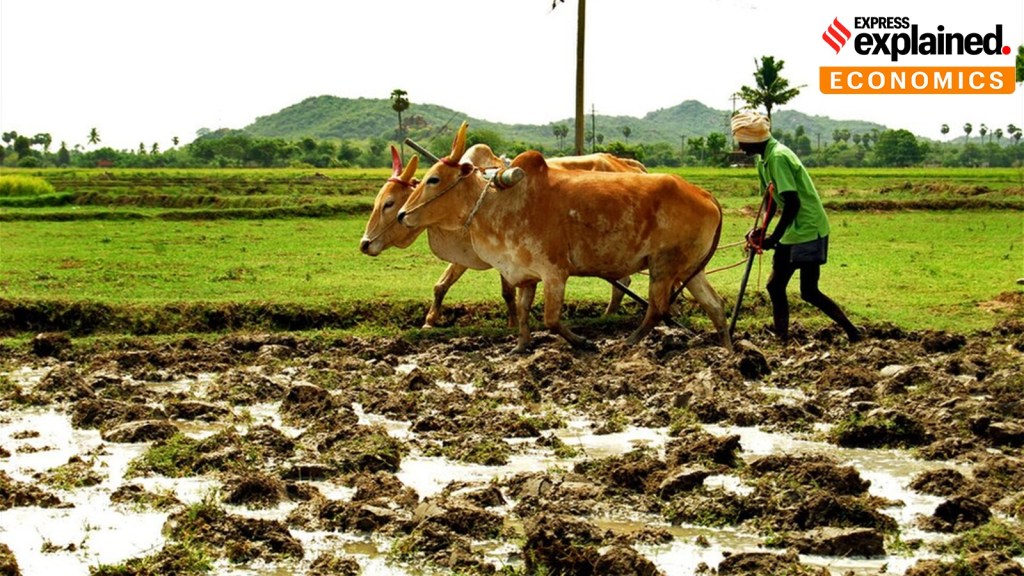 Farming in India was traditionally bovine-based, providing both draught power and nutrients for plant growth. (Photo: Wikimedia Commons)



 Share


