


Journalism of Courage
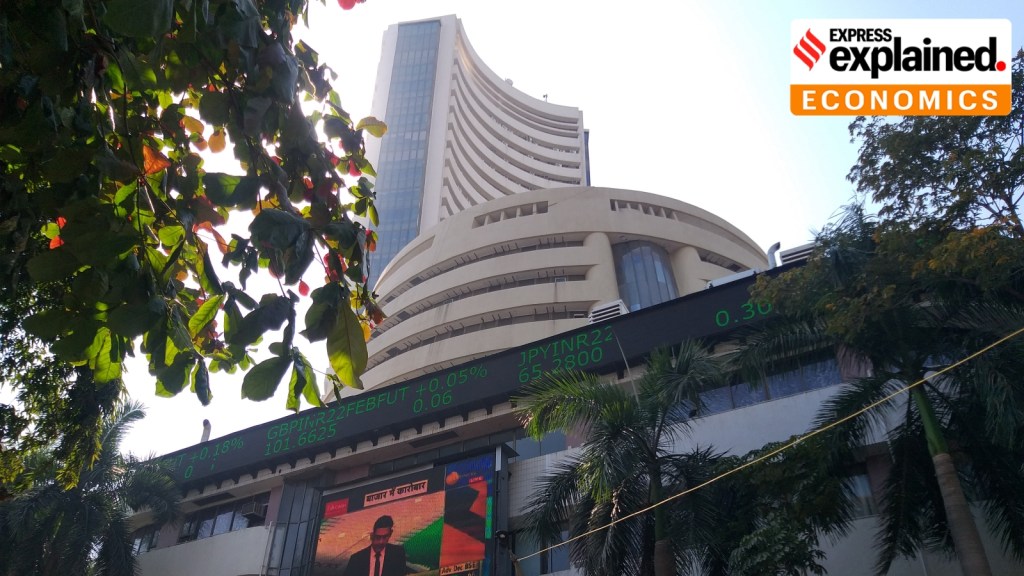 The Sensex and the Nifty are both down over 6% in September. (File)
India’s stock markets have been among the worst performers among the world’s major bourses in 2026: foreign investors have exited amid elevated crude oil prices, a weak rupee, high global interest rates, and the absence of AI-related stratospheric returns.
On Tuesday, the two key benchmark indices were down almost 1% again in the first hour of trading, following up Monday’s slump of 1.5-1.6%. The crash on Monday saw foreign investors dumping shares worth $558 million — the highest in four weeks — taking cumulative sales in September to $2.2 billion.
The Sensex and the Nifty 50 are both down over 6% in September, with the price of India’s crude oil basket an eye-watering $120.86 per barrel on Friday, as per latest data, amid renewed tensions in West Asia.
But look under the hood, and there are signs of investment hope, with Motilal Oswal Financial Services noting that while the market is “calm at the surface”, it is “active beneath”. But which sectors are the oases in the desert that is the Indian stock market?
Pharma shines
A host of pharmaceutical players, particularly contract development and manufacturing organisations (CDMOs), have boomed over the past few months. Despite being down around 1% in September, the Nifty Pharma index is up 6% over the past three months and a massive 23% since the start of April.
Take Divi’s Laboratories, which has surged over 40% over the past three months. Then there is Laurus Labs, which has gained 32% over the same period. Gland Pharma is up over 20%. But why?
In December 2025, the US passed the BIOSECURE Act to limit its exposure to biotechnology sourced from China, which supplies a large chunk of active pharmaceutical ingredients (APIs) – the biologically active component of a drug that targets the illness – to US pharma companies. As a result, American pharma players have had to look for alternative sources of APIs.
This legal change-enforced shift is where Indian CDMOs come in.
“This conversation has been going on for 15 months or so now. The data is limited for us due to government restrictions on import and export data for the sector, but over the last 3-4 months, we have seen optimism in the sector based on management commentaries and large capex plans announced by some of these players to meet the demand. So, it’s a long process. But over the next 4-5 years, we might see many of these CDMOs benefiting massively,” an analyst tracking the sector at a top domestic broking firm said.
In the short term, CDMOs — which get most of their revenue from exports — have also benefited from a weaker rupee.
“So, what was hurting the market was helping pharma. It also gave fund managers a defensive argument with earnings visibility, currency tailwind, the US overhang reducing, and IPM (Indian pharma market) growing,” said Nirali Shah of Ashika Investment Managers.
Further, some Indian pharma players such as Sun Pharma, Zydus Lifesciences, and Dr Reddy’s have also been manufacturing and adding capacity for semaglutides — the generic version of drugs like Ozempic and Mounjaro. These drugs have taken the world by storm and provide a massive opportunity for Indian manufacturers after Danish giant Novo Nordisk’s patent expired earlier this year in March.
AI infra builders gain further
While India lacks “pure play” listed AI companies, shares of some who help build the infrastructure in the sector have continued to gain after moving up early in the year.
E2E Networks, which provides cloud infrastructure for data centres, has seen its share price more than triple so far this year. Sterlite Technologies, which manufactures optical cables, is up almost 700% — or nearly eight times — this year.
To name a few others, Syrma SGS and Avalon Technologies, who both make electrical components and printed circuit boards (PCBs) used in chips, have more than doubled this year.
While questions remain over the long-term feasibility and profitability of the AI investment boom, data centres continue to be built. This in turn provides tangible business for those involved in setting them up.
Mid and small-cap pickings
While large and many mid-caps have borne the brunt of the negative sentiment in the Indian equity market, some small-cap players have benefited. Analysts attribute this to sector rotations, the relatively limited upside potential of large caps, and the faster earnings growth of these smaller companies.
“While the segment remains a bit frothy, such a market environment makes mid- and small-caps more enticing. Large caps clearly feel bloated with limited upside potential,” a head of research at a domestic broking firm said.
As a result, share prices of some mid-cap and small-cap companies have soared in recent times. For example, metal pipes and other metal products maker Welspun Corp has more than tripled this year, while electric vehicle manufacturer Ather Energy has doubled as EV adoption steadily grows. The likes of Redington and Sona BLW Forgings are up 50% or more.
Experts also point to the “vibrant” IPO market.
“Between April 2023 and September 2026, a record Rs 10.1 lakh crore was mobilised through public markets, including IPOs, FPOs, OFS and QIPs. At the same time, the vibrant primary market has absorbed a meaningful share of available liquidity, diverting some flows away from the secondary market and contributing to its subdued performance amid a prolonged phase of consolidation,” noted Deven Mistry and Aanshul Agarawal of Motilal Oswal Financial Services in a note on Monday.


