
India’s disinvestment history
As the transaction with Fairfax is expected to be completed — which requires final regulatory approvals — by March 2027, the Central government has essentially met its full-year disinvestment target of Rs 80,000 crore with the entirety of the second half of the fiscal still left.
The Centre has already raised Rs 55,757 crore from disinvestments so far in 2026-27 and will get Rs 26,544 crore from the IDBI Bank stake sale, taking the total to Rs 82,301 crore. This may not seem much: it is only 1.5% of the government’s estimated expenditure of Rs 53 lakh crore this year. But purely in terms of disinvestment proceeds, it is already the third-highest ever, ranking only behind Rs 1 lakh crore in 2017-18 and Rs 84,972 crore the following year.
In fact, in nine of the last 12 years, the Centre has got more money as dividend from its shareholding in companies than by selling shares in its enterprises.
A long process
One should not expect the resolution of IDBI Bank to lead to a flood of other, if smaller, deals. Why? Because of how difficult and involved the process is. Bids had to be invited twice after the first set were significantly lower than what was expected. Two different methods were then used to value IDBI Bank, which resulted in an average per share valuation of Rs 75.99. Fairfax’s winning bid turned out to be Rs 81 per share.
Of course, IDBI Bank’s circumstances did not help the entire process.
Like pretty much every other Indian bank, IDBI Bank’s bad loan ratio — the percentage of loans given out that were not being repaid by borrowers — started climbing steadily around 2010. But the bank’s situation was clearly far worse than that of others, with nearly a third of the entire loan book having turned bad by September 2018.
Consequently, the Reserve Bank of India (RBI) put IDBI Bank in a “Prompt Corrective Action” framework, which imposes strict business restrictions. It was only in March 2021, after almost four years, that these restrictions were lifted as the bank started showing signs of becoming healthier.
IDBI’s troubles
Over these four years (2017-18 to 2020-21), IDBI Bank posted a total loss of nearly Rs 35,000 crore, with the final year seeing a small profit of Rs 1,359 crore. Its deposit base — which is a bank’s lifeblood because it determines how much money it can lend out to earn interest — was 14% smaller in March 2021 than it was in March 2017.
How IDBI Bank’s shares suffered.
Rising bad loans mean banks have to set aside more money to cover the non-repayments. And while non-repayments mean interest income of a bank dries up, the setting aside of money to cover bad loans hinders the ability to make further loans, which hits future interest income. The bad-loan cycle is truly vicious.
Since coming out of the RBI’s corrective framework, IDBI Bank’s profitability has improved. That does not mean it’s in rude health; it has paid the price for the years of weakness. At the end of 2009-10, IDBI Bank accounted for 3.7% of all banks’ deposits. This has fallen to 1.3% by 2025-26. On the loans front, the bank’s share has declined from 4.3% to 1.2% over the same period.
The disinvestment process itself is no cakewalk. While some major ones have been completed, several others have fallen by the wayside for a variety of reasons.


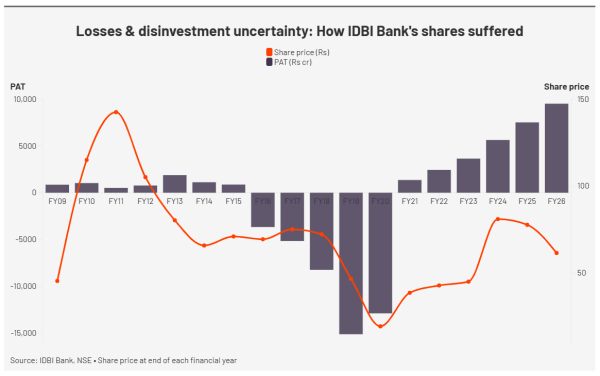 How IDBI Bank’s shares suffered.


 Share


