The programme for blending of ethanol in petrol was initiated primarily to help sugar mills make timely payments to farmers, by creating an additional revenue stream from the processing of cane.
Till 2017-18, mills produced ethanol only from so-called C-heavy molasses, the final dark brown liquid byproduct of cane processing containing sucrose that cannot be further economically recovered and crystalised into sugar.
From the 2018-19 supply year, mills began making ethanol from an earlier ‘B-heavy’ stage molasses (having higher sucrose content available for fermentation) and also directly from whole cane juice or syrup. They were encouraged to do so by the Narendra Modi government’s decision to pay mills more for ethanol produced from the B-heavy and direct cane juice/syrup routes, in order to compensate them for the revenues foregone from reduced/ nil recovery and sale of sugar.
The result: Between 2013-14 and 2018-19, the total supply of ethanol to oil marketing companies (OMC) shot up from a mere 38 crore to nearly 189 crore litres. The all-India average ethanol blending in petrol, too, rose from 1.6% to over 4.9%.
From sugar to grain
But it wasn’t just sugarcane.
From 2018-19, the Modi government also fixed separate ex-distillery prices for ethanol derived from rice, maize and damaged foodgrains. This was, again, intended mainly to help sugar mills. Many of them installed multi-feedstock distilleries that could run on molasses and juice/syrup during the crushing season (November-April), and on grain in the off-season (May-October) when cane wasn’t available.
Ethanol production basically involves fermentation of sugar by yeasts. In molasses or cane juice, sugar is present in the form of sucrose. Grains contain starch, a complex carbohydrate that has to first be extracted and broken down into simple sugars before further fermentation, distillation and dehydration to ethanol with 99.9% alcohol concentration.
The incentives for ethanol production from grains led to not only sugar mills using these as an alternative, off-season feedstock — in no time, exclusively grain-based ethanol distilleries came up in states such as Punjab, Haryana, Bihar, Andhra Pradesh, Madhya Pradesh, Maharashtra, Karnataka, Rajasthan and Chhattisgarh.
The grains were largely maize and rice. That included surplus and broken/damaged grain sourced from the Food Corporation of India (FCI) as well as the open market.
More grain than sugar
In the 2023-24 supply year (November-October), the OMCs procured 672.49 crore litres of ethanol from distilleries, with the all-India average blending ratio reaching 14.6%.
Significantly, out of the total 672.49 crore litres, only 270.27 crore litres or 40.2% came from sugarcane-based feedstock: C-heavy molasses (57.56 crore), B-heavy molasses (148.81 crore) and cane juice/syrup (63.90 crore).
The balance 402.22 crore litres ethanol supply was from grains: Maize (286.47 crore), broken/damaged foodgrain (115.62 crore) and FCI rice (0.13 crore). Thus, maize alone contributed more ethanol than all sugarcane-based fermentable material!
The same pattern has been repeated in the current supply year. Out of the total 920 crore litres likely procurement, 300 crore or less than a third would be from sugarcane-based feedstock and the rest 620 crore from grain (see table). Maize’s share in that would be around 420 crore litres.

There are two reasons why cereal grains have become the mainstay of the ethanol blended petrol programme rather than its originally targeted beneficiary, sugar.
The first was the drought-induced poor sugarcane crops in 2023-24 and 2024-25. The Modi government responded by limiting the use of B-heavy molasses and cane juice/syrup for making ethanol. The sugar diverted for production of ethanol through these routes, then, fell from 45 lakh tonnes (lt) in 2022-23 to 24 lt and 35 lt in the following two seasons. The country’s net sugar output also plunged from a record 359.25 lt in 2021-22 and 330 lt in 2022-23 to 319 lt in 2023-24 and an estimated 261.1 lt in 2024-25.
The second reason had to do with differential pricing. For the 2024-25 supply year, the ex-distillery price of ethanol produced from maize was fixed at Rs 71.86 per litre. This was more than the per-litre prices payable by the OMCs for ethanol from C-heavy molasses (Rs 57.97), B-heavy molasses (Rs 60.73), cane juice/syrup (Rs 65.61) or even FCI surplus rice (Rs 58.50) and broken/damaged grains (Rs 64).
Simply put, what started as a programme for the sugar industry has turned out more beneficial for standalone grain (especially maize)-based ethanol manufacturers.
Policy implications
For 2025-26, the OMCs invited tenders for the supply of 1,050 crore litres of ethanol, corresponding to an average blending target of 20% (the actual ratio achieved during November-August 2024-25 was 19.12%).
But as against the requirement in the tender that closed on October 7, the distilleries offered a total quantity of 1,776.49 crore litres. That included 1,304.86 crore litres of ethanol from grain and 471.63 crore from sugarcane-based feedstock.
The largest share was from maize (831.89 crore litres), followed by FCI surplus rice (396.60 crore litres).
It is quite likely that the OMCs will end up sourcing only the required 1,050 crore litres, spilt between grain (650 crore) and sugarcane (400 crore).
From a policy perspective, the problems are two-fold. The first is the excess capacity. At last count, there were some 499 distilleries in India that had invested roughly Rs 40,000 crore in building an annual ethanol production capacity of 1,822 crore litres. And there are limits to how much more ethanol blending in petrol is technically feasible.
The second relates to the familiar “fuel versus food and feed” debate. The ethanol blending programme has certainly given a boost to maize growers, by creating a new market for the grain consumed mostly as a poultry and livestock feed ingredient.
However, taking an average 380 litres of ethanol production from one tonne of maize, the 420 crore-odd litres supplied in 2024-25 would have used over 11 million tonnes (mt) of the feed grain. Given India’s domestic production of about 42 mt — and rising milk, eggs and meat consumption also driving feed demand — the sustainability of maize as a fuel grain is an open question.
The same goes for rice, where the 396.60 crore litres of ethanol supply offered by distillers for 2025-26 has been predicated upon overflowing stocks in FCI godowns. But this surplus grain scenario may not repeat every year. The fuel vs. food dilemma is probably less in sugar, where domestic consumption isn’t growing as much. That leaves more surplus cane as feedstock for biofuel.

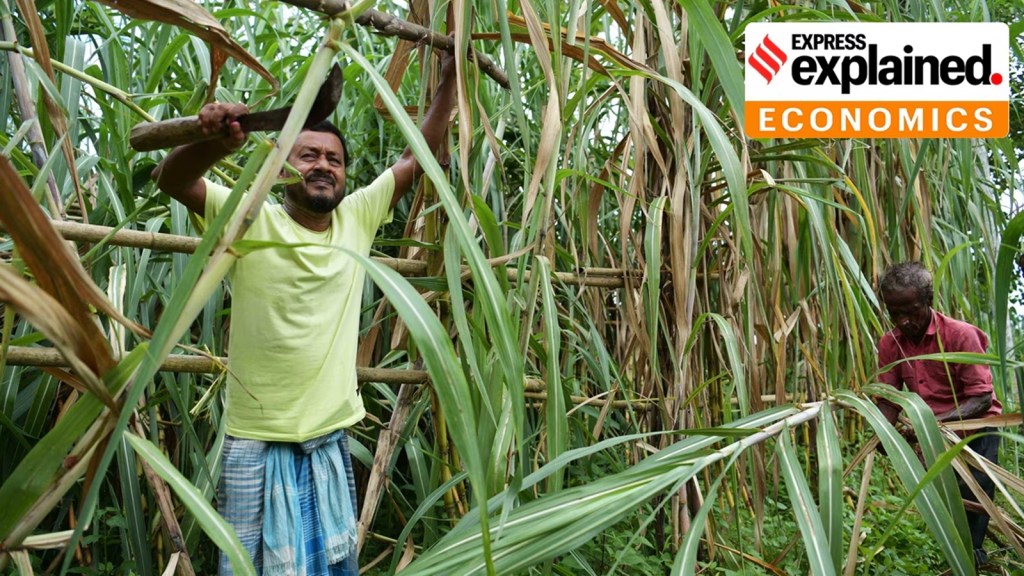 Ethanol production basically involves fermentation of sugar by yeasts. In molasses or cane juice, sugar is present in the form of sucrose.



 Share


