5 min read

© The Indian Express Pvt Ltd



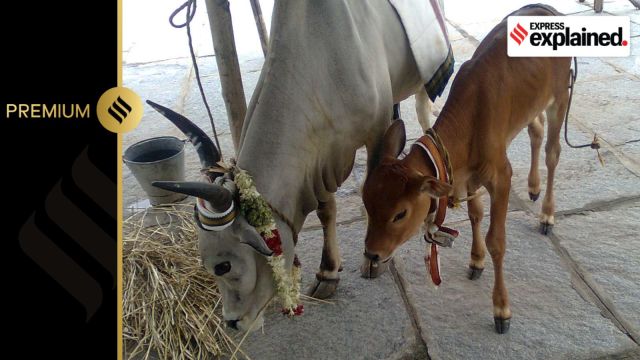 There are 19 breeds of indigenous cows in Maharashtra. (Wikimedia Commons)
Earlier this week, the Maharashtra government announced a subsidy of Rs 50 per animal per day for cattlesheds (gaushalas) that take care of indigenous (desi) breeds of cows.
The financial incentive will help preserve the state’s desi cow population, the Cabinet note said. The government has also declared the state’s indigenous cow breeds as “RajyaMata-Gomata”.
The subsidy scheme to preserve desi breeds of cows will be implemented by a Goseva Ayog, which will have scrutiny committees in all districts. Gaushalas that house indigenous breeds will have to apply online, and the subsidy will be released after the district-level committee submits a report.
The numbers of indigenous cows were on the decline, the government said. According to the 20th Livestock Census conducted in 2019, Maharashtra had 46,13,632 cows under the “indigenous/ nondescript” category. This was 8.7% less than the population of 50,53,490 for these cows recorded in the previous Census (2012).
The official government resolution (GR) for the scheme is yet to be released. It is, therefore, not clear whether the subsidy will be for all cows under the indigenous/ nondescript category, or only for those animals that are certified as indigenous. It is financially not feasible to provide Rs 50/ day to 46 lakh cows.
Indigenous cows are those that belong to any of the breeds registered as such by the Karnal-based National Bureau of Animal Genetic Resources, a body under the Indian Council of Agricultural Research (ICAR) that aims to “protect and conserve indigenous farm animal genetic resources for sustainable utilisation and livelihood security”.
Nondescript cows, on the other hand, have no recognised breed characteristics.
The Maharashtra Animal Husbandry Commissionerate defines indigenous cows as including both descript and nondescript animals, with the latter having at least 50% indigenous-breed blood. A large proportion of the state’s cattle population comprises nondescript animals with less than 50% blood of any recognised indigenous breed.
There are 19 breeds of indigenous cows in Maharashtra. Khillari accounts for half the indigenous cow population in the state. The breed is favoured by farmers for its sturdiness and potential for use as a draught animal. Most of the state’s Khillari cattle population is found in Pune division, where bullock cart races are held regularly.
Other indigenous breeds in Maharashtra include Deoni, Red Kandhari, Sahiwal, and Tharparkar.
There are 37 indigenous cattle breeds in India, of which only four are good milch animals, Dr Nayaran Hegde, former president of the Pune-based nonprofit BAIF Development Research Foundation, said. The vast majority of indigenous breeds are primarily used for agriculture and transport.
Indigenous breeds produce only 3.44 kg of milk per day on average, compared to 8.55 kg per day for exotic/ crossbred animals, according to the central government’s Basic Animal Husbandry Statistics (BAHS) 2023.
While Indian breeds are hardier and believed to be better suited to Indian conditions, for farmers, milk production is key.
The conservation of indigenous breeds has long been on the agenda of the BJP both at the Centre and in the state. The National Gokul Mission which was launched in December 2014 had a component of the preservation and promotion of indigenous breeds of bovine animals. The decision of the Eknath Shinde government has come as the state heads to Assembly elections.
Advocates for desi breeds claim they produce ‘A2’ milk, which is supposed to be healthier than the ‘A1’ milk produced by animals that have been crossed with exotic breeds like Holstein Friesian, Jersey, and Brown Swiss. A1 and A2 contain genetic variants of proteins, which differ in their amino acid sequence.
There is no scientific consensus on whether A2 milk is really healthier. Dr Hegde said the claims about A2 are not supported by research or ground observations. In August, the food safety regulator Food Safety and Standard Authority of India (FSSAI) advised Food Business Operators (FBOs) to not market their milk and milk products “in the name of A1 and A2”, but withdrew the advisory days later.
The scheme has been announced for animals reared in gaushalas, and not by farmers. Most farmers are more keen on remunerative prices for their milk. While the state government has announced a Rs 5/ litre subsidy to farmers battling low realisations, the release of the subsidy is conditional upon farmers receiving a base price of Rs 30/ litre from dairies. And most dairies are not paying more than Rs 27-28 per litre of milk.