India’s new fuel-efficiency rules for passenger vehicles will force carmakers to increasingly manage the efficiency of their entire vehicle portfolio, rather than individual models, from April 2027. The final Corporate Average Fuel Economy (CAFE)-III framework, notified on September 29, has introduced a new formula to relax norms for smaller cars, while doing away with an earlier proposed special concession for the category, and gives electric vehicles the biggest compliance benefit among the different powertrains.
The CAFE norms will apply from April 1, 2027, to March 31, 2032. They cover M1 category passenger vehicles manufactured or imported for sale in India. At the heart of the system is a fleet-wide calculation: a manufacturer’s permitted fuel consumption is determined by the weighted average unladen weight of the vehicles it sells.

This means a carmaker selling a large number of lighter vehicles and one selling predominantly SUVs do not face exactly the same target. The heavier the average fleet, the higher the permitted fuel consumption.
CAFE-III is a set of fleet-level fuel-efficiency standards for passenger vehicles. First introduced in 2017 under the Energy Conservation Act, they require manufacturers to keep the average fuel consumption — and therefore CO2 emissions — of all eligible passenger vehicles they sell within a prescribed limit, rather than requiring every individual model to meet the same number. The first CAFE-III proposal dates back to 2024, with the rules subsequently going through several revisions covering the weight formula, treatment of powertrains and compliance mechanisms.
Progressively stricter emissions norms
The government has set an annual formula for calculating each manufacturer’s target:
Here, W is the weighted average unladen mass of the manufacturer’s eligible vehicles. The reference weight, or b, has been fixed at 1,229 kg. The figure ‘a’ determines how much the fuel-consumption target changes for every kilogram that a manufacturer’s average fleet weight is above or below the reference weight, and ‘c’ is the baseline fuel-consumption target, expressed in litres per 100 kilometres.
For FY28, the formula uses an ‘a’ value of 0.00158 and a ‘c’ value of 3.9960 litres per 100 km. By FY32, these fall to 0.00131 and 3.3273 litres per 100 km respectively, making the standard progressively tighter over the five-year period.
The important change from earlier proposals is not just the removal of the small-car concession. The underlying weight equation has also been altered. Earlier versions had used a lower reference weight (1,170 kg) and a steeper weight adjustment. The final formula uses 1,229 kg and a flatter annual multiplier.
The result is that the final framework does not create a separate regulatory category for cars below 909 kg. Instead, the effect of vehicle weight is built into the broader fleet formula.
Small vs big car: How new CAFE rules settle the debate
The small-car question became one of the most contentious parts of the CAFE-III process because India’s market is dependent on compact, relatively light petrol cars – with carmaker Maruti Suzuki having an oversized presence in the small cars’ space compared to its competitors.
The treatment of small cars had emerged as one of the biggest points of contention during the drafting of CAFE-III. Maruti Suzuki, which dominates India’s small-car market, is understood to have pushed for additional regulatory relief for lightweight cars, arguing that smaller vehicles have limited scope for further efficiency improvements and that the cost of meeting tighter norms could disproportionately affect the affordable end of the market.
A September 2025 draft subsequently proposed an additional 3 g/km benefit for petrol cars weighing up to 909 kg. Some rival carmakers opposed the carve-out, arguing that it would disproportionately benefit a segment dominated by Maruti Suzuki. The disagreement eventually reached the Prime Minister’s Office.
However, now, the final rules do not give a separate 3 g/km benefit to cars below the 909-kg threshold.
But that does not mean the final formula treats a small car and a large SUV identically. Weight remains central to the calculation. A lighter fleet has a lower permitted fuel-consumption figure, while a heavier fleet gets a higher one.
The new norms have been welcomed by India’s carmakers. “It is a comprehensive regulation arrived at after scientific data calculations and detailed stakeholder and inter-ministerial consultation with ambitious targets for energy efficiency improvement and CO2 reduction. The regulation recognizes the contribution of multiple powertrain technologies and fuels encouraging multi-faceted R&D and innovation,” said Rahul Bharti, senior executive officer, corporate affairs, at Maruti Suzuki.
“The norms provide a clear and predictable regulatory roadmap through a 3+2 year compliance block structure, enabling manufacturers to undertake long-term product and technology planning with greater certainty,” said Tarun Garg, MD and CEO, Hyundai Motor India Limited.
EVs carry distinct edge
The biggest powertrain-specific benefit in the final rules goes to battery-electric vehicles. However, the norms do open up multiple energy pathways for carmakers to balance out their overall fleet emissions.
“The framework recognises the contribution of renewable and low-carbon fuels, including ethanol-blended petrol, biofuels and CBG, through the introduction of the Carbon Neutrality Factor (CNF). This provides manufacturers with an additional pathway for improving their fleet-level CAFE performance, alongside vehicle efficiency improvements and electrification. The provision supports India’s broader transition towards cleaner fuels while encouraging innovation across multiple technology pathways,” the Ministry of Power said in a statement.
A battery-electric vehicle (BEV) and a range-extended electric vehicle (REEV) get a volume derogation factor of 3. In effect, one such vehicle contributes three times its actual sales volume when the manufacturer’s fleet performance is calculated.
The factor is 2.5 for plug-in hybrids and strong hybrids running on flex fuel, 1.6 for strong hybrids and 1.1 for flex-fuel vehicles.
The benefit for EVs comes on top of the way their energy consumption is calculated. Conventional vehicles have their fuel consumption derived from measured CO2 emissions, with different conversion factors for petrol, diesel, LPG and CNG. EV consumption is measured in kWh per 100 km and converted into a petrol-equivalent figure using a factor of 0.1028.
So a manufacturer can improve its fleet-level CAFE performance through a combination of the EV’s low calculated energy consumption and the 3x volume factor. Carmakers who are more reliant on various hybrid powertrains can also benefit.
A long rope on compliance
CAFE-III does not require manufacturers to balance their books completely every year.
A manufacturer whose fleet performs better than its target earns credits, while one performing worse accumulates debits. These are recorded in a manufacturer-level passbook. Credits can be carried forward within a compliance block and traded between manufacturers.
A manufacturer with an outstanding deficit can also buy credits from the Bureau of Energy Efficiency. The buyout price starts at Rs 2,500 per g CO2/km in FY2027-28 and rises by Rs 500 each year, reaching Rs 4,500 in FY2031-32.
Encouraging innovative technologies
The rules allow manufacturers to claim efficiency improvements from specified technologies, including start-stop systems, tyre-pressure monitoring, regenerative braking, six-speed-or-higher transmissions, efficient alternators, motor-generators, LED lighting, advanced glazing, electric water pumps and more efficient air-conditioning systems.
Each qualifying technology can provide a claimed reduction of 1 g CO2/km, subject to an overall cap of 9 g CO2/km. The first compliance block allows self-declaration of such claims, while claims in the second block will require validated testing.
The framework also recognises the use of alternative fuels through carbon-neutrality factors, including an 8 per cent factor for E20-and-above petrol and a 22.3 per cent factor for flex-fuel ethanol vehicles. For very small manufacturers producing or importing fewer than 1,000 eligible vehicles in a reporting period, the specific CAFE target does not apply, although they will still have to report their actual fleet-average fuel consumption.

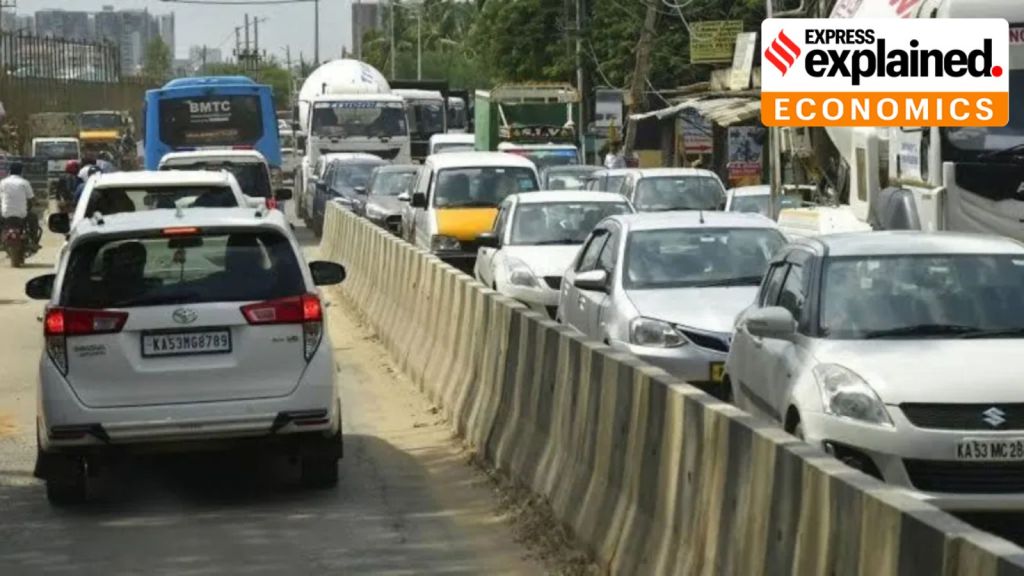 CAFE-III will regulate the average fuel efficiency of a carmaker’s entire passenger-vehicle fleet from April 2027. (Express Photo)


 Share


