Zyeth Atham (Jyeshtha Ashtami), observed on the eighth day of Shukla Paksha (the waxing phase of the moon) in the Hindu month of Jyeshtha (May–June), which fell on June 3, holds profound importance for the Kashmiri Pandit community. On this day, devotees honour Goddess Ragnya Devi, also known as Kheer Bhawani, at her temple in Tulmulla, in the Ganderbal district of Jammu and Kashmir.
The temple derives its distinctive name from kheer—a rice and milk pudding—which is offered to the goddess as the principal prasad. The Kashmiri Pandit community reveres Goddess Kheer Bhawani, an incarnation of Mata Durga, as their Kuldevi (family deity).
Tulmulla is approximately 25 kilometers northeast of Srinagar. The temple, nestled amidst chinar trees and built over a sacred spring, finds mention in numerous ancient texts, including Kashmiri historian Kalhana’s 12th-century chronicle Rajatarangini.
“Mention of this place is made in the last chapter of the Ragnya Pradurbhava which is a section of the Bhringish Samhita,” writes Kashmiri educationist and ornithologist Samsar Chand Kaul in his book ‘The Mysterious Spring of Khir Bhawani’.
The shrine features a hexagonal spring surrounding a marble temple that houses the idol of the presiding deity. The current marble structure was constructed by Dogra ruler Maharaja Pratap Singh in the early 20th century and was later renovated by Maharaja Hari Singh.
Of guarding serpents and a Lanka connection
According to a legend, Ragnya Devi was once worshipped in Lanka by King Ravana. Displeased with his tyranny, she left Lanka and, with the assistance of Lord Hanuman, relocated to Kashmir, choosing Tulmulla as her abode.
“…the goddess, wrathful at Ravana’s misdeeds, cursed him and ordered Hanuman to take her to Sad Sar (Kashmir) on her vehicle along with 360 Nags.
Hanuman selected a spot in the northern side of the Valley within the space surrounded by the villages of Borus (Bhawanish), Ahatung (Tungish), Ladwun (Labdawan), Wokur (Bhageh). Here he installed the goddess with all her satellites. She was called Khirbhawani or Raji Ragyni, exclusively preferring milk, sugar, rice and all vegetarian forms of offerings,” Kaul writes.
Sharing details about another legend attached with Goddess Ragnya Devi in his book, Kaul further states: “… Another version which is said to have brought the spring to light states that a Brahman Krishna Pandit saw a vision in which he was informed by a Deva (an angel) that the spring of Khir Bhawani lay among the swamps of Tulamulla. ‘How shall I be able to find out the spring? He asked. ‘Engage a boat as far as Shadipor (village in Kashmir), and from there a serpent will guide you. When you reach near the spring, the serpent will jump into it. That is the spring.”
The spring: Changing colours and fortunes
Waters of the sacred spring, known as ‘Nag’ in Kashmir, are known to change colour, and according to local belief, reflect the fortunes of the Valley. Light hues such as blue and green are considered auspicious, while darker shades, particularly black or red, are viewed as forewarnings of turmoil.
“For generations, locals have looked to the spring’s waters as a mirror of the Valley’s fate — when the water runs clear, it is taken as a sign of harmony, when it darkens, it is considered inauspicious,” says Jammu resident Girja Bhat, who has been attending the mela regularly and was “happy” when she found that “Nag pooyin ous saaf (spring water was clear)” this year.
Kashmiri Pandits narrate that in 1990, around the time of their mass exodus, the spring reportedly turned black, a phenomenon that has since been etched into the community’s collective memory.
Quoting the then British Land Settlement Commissioner to Kashmir Walter Lawrence, in the research paper ‘Manifestation of Goddess Kheer Bhavani: A Psychological Exploration’, University of Delhi scholar Swati Tickoo states: “In 1888, Lawrence wrote the following report about the temple of Mata Kheer Bhavani; “…perhaps the most sacred place in Kashmir is the Kheer Bhawani; spring of Kheer Bhawani at the mouth of the Sind valley… When I saw the great spring of Kheer Bhawani at Tula Mula, the water had a violet tinge, but when famine or cholera is imminent the water assumes a black hue.”
‘Reaffirmation of faith’
The mela at Kheer Bhawani Temple, managed by Jammu and Kashmir Dharmarth Trust, continues to draw thousands of devotees annually.
“To mark the Ashtami, devotees perform hawan in reverence to Mata Ragnya, accompanied by rituals such as offering milk and dropping Kaand (sugar cones) into the sacred spring, scattering flowers and aromatic leaves known as Vyna Patar. The festival serves as a reunion for the Kashmiri Pandit diaspora, a reaffirmation of faith, and a symbol of resilience,” says retired IFS officer Poshkar Nath Pandit.

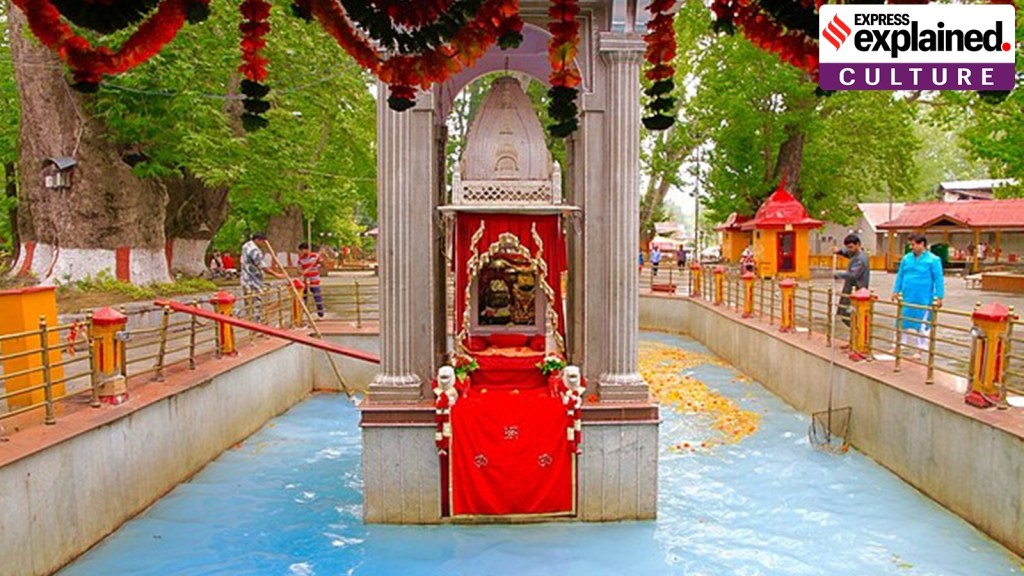 The Kheer Bhawani temple is nestled amidst chinar trees and built over a sacred spring, called Nag in Kashmir. (Photo: Wikimedia Commons)


 Share


