Charred frames of cars and homes, scorched electricity poles, ashy roads, and a towering banyan tree blackened by the fire but still standing – these images of the aftermath of the devastating fire in Hawaii’s Maui island have grabbed the world’s attention. The wildfires, which have already killed nearly 100 people and left thousands homeless, have become part of a wider global list of unusually intense blazes that have raged across Europe, Canada and the United States.
Hawaii is no stranger to fires, which burn on a smaller scale with some regularity, especially in the drier parts of the island. The current fires – active in Lahaina, Upcountry and Pūlehu/Kīhei – are believed to have started on Tuesday (August 8), with the one in Lahaina spreading quickly across the town.

The exact cause of the fires is still under investigation, but experts agree that the fires were bolstered by strong winds from Category-4 Hurricane Dora, which was passing through the Pacific Ocean – far to the southwest of the island. In fact, parts of Maui County were under a high-wind warning from US National Weather Services till Wednesday morning.
Low humidity and dry vegetation too precipitated the issue. Initial reports suggest that the changing land-use patterns in Hawaii, which has seen farm and forest lands being replaced by flammable non-native species of grasses like Guinea grass, are a likely cause for the easy spread of the fire.
“Over the past few decades, wildfire has been increasing in Hawaii as a result of changing climate, as a result of increases in invasive species, and a lot of our active agriculture going out… and becoming fallow. And so we have invasive species, we have fuels on the ground, we have all the conditions that make for a ripe wildfire environment…,” Elizabeth Pickett, co-executive director of the Hawaii Wildfire Management Organization, told Sky News in an interview.
“And then we have infrastructure and policies and communities who have not quite caught up with the level of threat that we face,” she added.
What is the link between wildfires and climate change?
Wildfires have been a part of life on Earth, usually following a seasonal pattern during the June-August period. Be it natural or human-made, the phenomenon is a critical part of the ecosystem. A healthy fire is key to ensuring that forests remain robust and resilient. It also aids the natural replenishment of nutrients in the soil, helps sunlight reach the forest floors, and encourages the germination of seeds.
It is the increasingly intense nature of the wildfires – aided by the warming weather, dry conditions and change in rain cycles – that is now becoming a source of worry. Experts have compared it akin to the difference between throwing a lighted matchstick on a pile of wet, green wood and on dry kindling. And increasingly, climate change is determining the degree of dryness of the latter. July 2023, for instance, saw the highest temperatures on record across the planet and evidence suggests that the record will be broken sooner than later.
Zoom out, and you’ll notice that what happened in Hawaii is not an isolated event. In the past month, firefighters in Algeria, Tunisia, Greece, Italy, Spain, Portugal, and Canada, among others, have been battling blazes with varying degrees of success.
“The Northern Hemisphere has seen significant wildfire activity since the beginning of May this year, with widespread record-breaking fires in Canada and large fires across eastern Russia,” European Union’s Copernicus programme, which monitors atmospheric conditions on Earth, said in a statement on August 3.
Besides the destruction of lives and livelihoods, these catastrophic wildfires also release an immense amount of carbon dioxide and other greenhouse gases into the atmosphere. The Canadian wildfires alone have emitted 290 megatonnes of carbon between Jan 1 and July 31, representing over 25% of the global total for 2023 to date, as per data from the Copernicus programme. Climate change aids wildfires, which, in turn, release the carbon stored in trees as CO2 and methane, evolving into a vicious cycle.
There is also one immediate issue – these immense fires contribute adversely to air pollution, leading to long-term and short-term respiratory issues, heart disease and lung cancer. In June, the skies of New York and neighbouring regions turned a hazy orange for days as the smoke from Canadian wildfires drifted south, with those in the state facing levels of pollution over five times the national air quality standard.
While tackling the climate crisis is of the utmost importance, there are measures that communities need to take to mitigate the loss of lives.
In Maui, the county’s hazard mitigation plan had identified Lahaina and other West Maui communities as at risk from wildfires. It had also noted that the county had the second-highest rate of households without a vehicle and the highest rate of non-English speakers.
“This may limit the population’s ability to receive, understand and take expedient action during hazard events,” said an Associated Press article, quoting the plan. These factors, combined with unreliable mobile network coverage and the swift pace of the fire (onlookers say an entire town was burned down in less than four hours), contributed to the climbing death toll.
It is high time that our communities take stock of their susceptibility to wildfires and form coherent mitigation procedures to deal with one. As Hawaii Governor Josh Green said while announcing a review of the island’s current policies, “People have asked why we are reviewing what’s going on and it’s because the world has changed. A storm now can be a hurricane-fire or a fire-hurricane.”

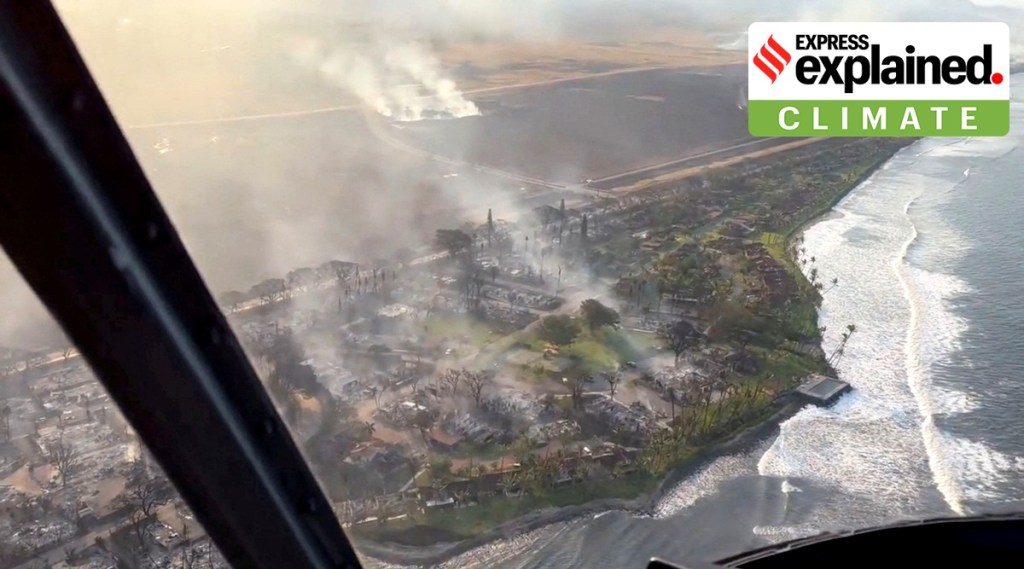 An aerial view shows damage along the coast of Lahaina in the aftermath of wildfires in Maui, Hawaii, U.S. August 9, 2023 this screen grab obtained from social media video. (Richard Olsten/Air Maui Helicopters/via REUTERS)


 Share


