More than 50 per cent of the world’s largest lakes and reservoirs have shrunk over the past three decades primarily due to climate change and human activities, according to a new study. From these water bodies, approximately 600 cubic km of water was lost between 1992 and 2020 — an amount equivalent to the total water used in the United States for the entire year of 2015.
It also noted that more than half of the reservoirs located in peninsular India have witnessed substantial water storage decline, mainly due to sedimentation. Moreover, among the worst affected natural lakes in the country is Ladakh’s Tso Moriri.
Published in the journal Science last week, the study, ‘Satellites reveal widespread decline in global lake water storage’, has been done by Fangfang Yao, Ben Livneh and Balaji Rajagopalan, from the Cooperative Institute for Research in Environmental Sciences (University of Colorado Boulder, USA), Yoshihide Wada from Climate and Livability Initiative (King Abdullah University of Science and Technology, Saudi Arabia), Jean-François Crétaux and Muriel Berge-Nguyen, from Laboratory of Space Geophysical and Oceanographic Studies (France).
The continued shrinking of lakes, Yao and Rajagopalan told The Indian Express by email, has led to a decline in freshwater supply, environment degradation and deterioration of water quality for humans and livestock. Meanwhile, water shortage beyond a certain level in reservoirs of hydroelectric dams could adversely impact the generation of hydroelectricity.
 Central Asia’s Aral Sea has significantly dried due to unsustainable water consumption. On the left is a satellite image taken in 2000 and on the right is an image clicked in 2018. (Photo: NASA Earth Observatory)
“If lakes are encroached upon (such as the case in India with smaller lakes), they disappear as a water source but also contribute to severe urban flooding. Loss of lake levels leads to groundwater pumping and depletion, leading to a host of other issues.,” Rajagopalan added.
How was the study carried out?
For their study, Yao and his team examined 1,975 of the world’s largest lakes, including 1,052 natural lakes and 921 reservoirs — researchers studied lakes which are larger than 100 sq km and reservoirs with more than 1 cubic km of storage capacity. The analysis was done following a novel methodology that involved combining two-dimensional water areas with one-dimensional water levels to estimate the three-dimensional change in water storage.
“We used 250,000 lake-area snapshots captured by satellites between 1992-2020 to survey the area of 1,972 of Earth’s biggest lakes. We collected water levels from nine satellite altimeters and used long-term water levels to reduce any uncertainty. For lakes without a long-term level record, we used recent water measurements made by newer instruments on satellites.,” Yao explained.
“Combining recent level measurements with longer-term area measurements allowed us to reconstruct the volume of lakes dating back decades.,” he added.
What are the findings of the study?
The researchers found that out of the 1,052 natural lakes that were examined, 457 had significant water losses in the past three decades. Meanwhile, 234 natural lakes gained water and 360 of such water bodies didn’t show any notable trend.
They attributed 57 per cent of the net decline in the water quantity in natural lakes to human activities, such as unsustainable consumption of water, and increasing temperature and potential evapotranspiration (PET) — loss of water due to both evaporation and transpiration — with the latter two indicating the role of climate change.
The study also pointed out the worst affected largest lakes across the world and why they are shrinking in size. For instance, the Aral Sea in Central Asia, Lake Mar Chiquita in Argentina, the Dead Sea in the Middle East, and the Salton Sea in California have mainly dried due to unsustainable water consumption. Whereas, increasing temperature and PET caused the complete disappearance of Lake Gowd-e-Zareh in Afghanistan, Toshka lakes in Egypt, and marked drying of Lake Kara-Bogaz-Gol in Turkmenistan, Lake Khyargas in Mongolia, and Lake Zonag in China.
The Arctic lakes have shrunk as a result of a “combination of changes in precipitation, runoff, temperature, and PET, which are likely a concurrent result of natural variability and climate change.,” researchers said in the study. Notably, lakes have shrunk or disappeared completely across 82 per cent of the Arctic’s lake-rich regions in the past 20 years, as per a 2022 study.
In India, apart from Tso Moriri Lake, Andhra Pradesh’s Pulicat Lake and Kolleru Lake have been affected but they didn’t feature in the study as they were “below our threshold so did not make it in our analyses,” Rajagopalan told The Indian Express.
Another finding is that contrary to previous studies, natural lakes located in humid tropics and high altitudes are also experiencing water shortages.
Besides this, the latest paper mentioned that two-thirds of all reservoirs across the globe have experienced significant storage declines. Reservoirs, however, showed a net global increase in water levels, owing to 183 recently filled reservoirs. The main reason behind the drop in water levels is sedimentation — the process of particles such as sand and stones settling to the bottom of a body of water.
“Our finding suggests that sedimentation is the primary contributor to the global storage decline in existing reservoirs and has a larger impact than hydroclimate variability, i.e., droughts and recovery from droughts,” the researchers said.
What are the consequences of shrinking lakes?
According to the study, nearly two billion people, one-quarter of the global population in 2023, have been affected as they live in basins with large water bodies that have witnessed a significant drop in their water levels in the past three decades.
“Many of these drying lakes have been identified as important sources of water and energy (hydropower).,” the researchers said in their paper. The reduced size of these lakes not only results in freshwater decline and environmental degradation but also disrupts the water and carbon cycles.
Widespread water shortage in these water bodies, “particularly accompanied by rising lake temperatures, could reduce the amount of absorbed carbon dioxide and increase carbon emissions to the atmosphere given that lakes are hotspots of carbon cycling.” the study added.
How can we conserve lakes and other water bodies?
Yao and Rajagopalan said to save the shrinking lakes, there is a need to manage them in an integrated manner. Steps like restrictions on water consumption and climate mitigation to bring down global temperatures are some of the ways to conserve them. This will also help in reducing sedimentation in reservoirs as the rate of sedimentation is linked to climate change — it increases when there is extreme precipitation, as well as land disturbance such as wildfires, landslides and deforestation.
“This (managing lakes in an integrated manner) will elevate the status of lakes to their rightful place, And they can continue to sustain humanity. We take care of them, they will take care of us, the ecology in a life-affirming manner.,” Rajagopalan said.

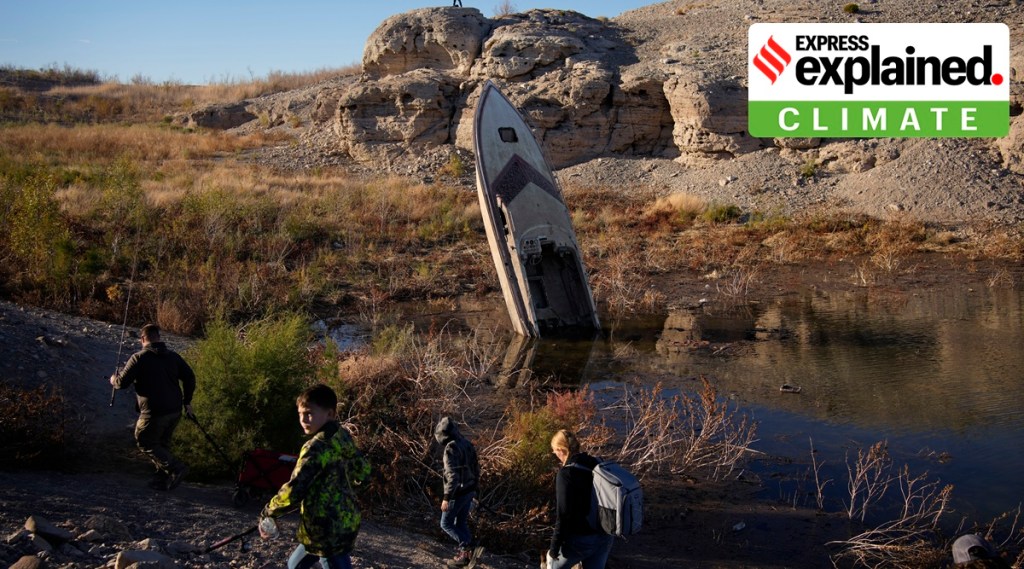 People walk by a formerly sunken boat standing upright into the air with its stern buried in the mud along the shoreline of Lake Mead at the Lake Mead National Recreation Area, Jan. 27, 2023, near Boulder City, Nev. (AP Photo/John Locher, File)

 Central Asia’s Aral Sea has significantly dried due to unsustainable water consumption. On the left is a satellite image taken in 2000 and on the right is an image clicked in 2018. (Photo: NASA Earth Observatory)

 Share


