Though scientists are still investigating the details of Wednesday’s avalanche-induced flash floods in Nepal, it is increasingly looking similar to the 2021 event in Chamoli district of Uttarakhand, only much more powerful.
“It seems to be very similar to the Chamoli disaster, but in terms of its impact downstream, and the destruction caused, it is more like the Kedarnath event of 2013,” said Farooq Azam, an associate professor at IIT Indore, currently heading the Cryosphere group at the Kathmandu-based The International Centre for Integrated Mountain Development (ICIMOD), a major research organisation working on the Himalayas.

Chamoli and Kedarnath were triggered by different mechanisms, both resulting in largescale damage downstream. Kedarnath incident was initiated by what is known as a GLOF event, a glacial lake outburst flood, in which lakes formed at the end of a glacier overflow or breach their boundaries, leading to a sudden release of very large volumes of water.
Chamoli, on the other hand, was caused by an ice and rock avalanche, a result of a large ice-block of a glacier breaking away and falling downhill. Both events led to major surges in mountainous rivers and caused flash floods downstream.
“Wednesday’s incident in the Rasuwa district of Nepal seems to have been caused by an ice and rock avalanche, possibly triggered by an earthquake in the region. The resulting damage is immense. A clear assessment of the extent of destruction will take a few days. But such events in the Himalayas do tend to become very destructive because of the cascading impacts downstream,” Azam, who is currently in China attending a disaster risk reduction conference, told The Indian Express.
The US Geological Survey had reported a 4.4 magnitude earthquake in the region, which was widely believed to have triggered the landslide. However, on Friday morning, the USGS updated its report saying that the seismic energy that was captured by its sensors was not generated by an earthquake but rather by a glacial collapse and debris flow.
“This event was initially reported as a magnitude 4.4 earthquake. Additional analysis of nearby seismic stations, long period seismic waves and satellite imagery led to the determination that the seismic event was instead a glacial collapse and debris flow, and that no earthquake had occurred,” USGS said in its update.
That makes it similar to the Chamoli disaster in which about 200 people were believed to have been killed, many of them workers at two hydroelectric power projects that came in the way of the avalanche. The scale of damage in Wednesday’s event in Nepal appears to be much bigger, with at least 1,500 people reported to be missing as of Friday, apart from the 150 who are known to be killed. About 60-70 bridges have been swept away, and hundreds of houses and other buildings have been destroyed.
Why the Nepal disaster could be more destructive than Chamoli
In a crucial contrast, the Nepal disaster happened during peak monsoon, when the rivers already have a fair amount of water.
“Chamoli had happened in February. But this one has come in the core monsoon season. The soil is already saturated, and most of the rivers are carrying waters near their capacity. Then there is an event like this in which a large chunk of ice and snow and rocks fall off. This will create havoc,” Azam said.
“The Himalayan region is very fragile. Such events lead to a chain reaction. A surging river with large rocks and ice blocks would erode the banks and slopes, and more soil, mud and rocks would become part of the raging river. It becomes a cascading disaster because the waters do not have any other way to spread out. That is why any such event in the Himalayan ecosystem becomes extremely dangerous,” he said.
What the 2023 Sikkim floods reveal about cascading disasters
A study published in Science last year about a 2023 event in Sikkim captured the cascading impact of such flash flood events in the mountains. This event was triggered by the collapse of a large chunk of glacier into the South Lhonak lake, situated over 5,000 meters above sea level, in northern Sikkim. This led to a GLOF event, the sudden release of a very large volume of water that took the shape of flash floods downstream.
The study found that a landslide caused the collapse of nearly 14.7 million cubic metres of rocks, soil and snow deposited around a glacier into the South Lhonak lake, which triggered a series of cascading events. The volume of the flowing sediment downstream had grown to about 270 million cubic metres.
“The collapse of approximately 14.7 million cubic metres of frozen lateral moraine into the South Lhonak Lake … on 3 October 2023 generated a 20-m-high displacement wave. The wave overtopped and breached the frontal frozen moraine, causing the sudden drainage of approximately 50 million cubic metres of water… The GLOF eroded approximately 270 million cubic metres of sediment and triggered 45 secondary landslides. Most of the erosion occurred within about 67.5 km of the lake,” the study had found.
The National Disaster Management Authority has now initiated a comprehensive exercise to study these glacial lakes with the objective of strengthening their boundaries and installing sensors that can warn of leakages and accumulation of water.
Azam said the entire Himalayan region was “out of balance entirely” because of population pressure and climate change.
“The whole ecosystem is vulnerable. Because of climate change and increasing instances of extreme weather events, newer areas are getting exposed. Earthquakes or heavy rainfall events are quite common, and any of them can trigger these kinds of disasters,” he said.

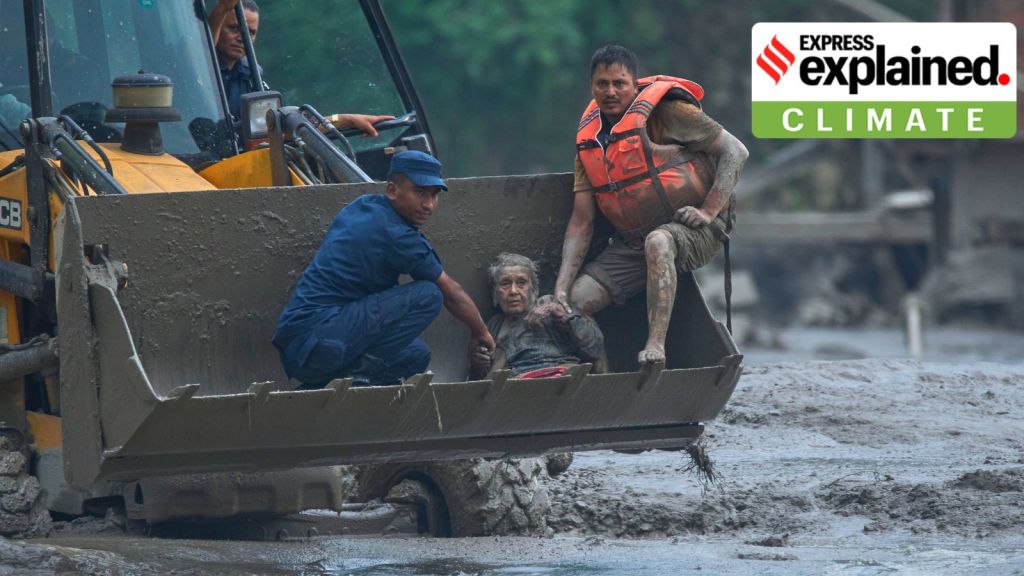 Rescuers use an earthmover to carry a victim of flash flooding to safety along the Trishuli River in Nepals Nuwakot district, Wednesday, Aug. 26, 2026. (AP Photo/Niranjan Shrestha)


 Share


