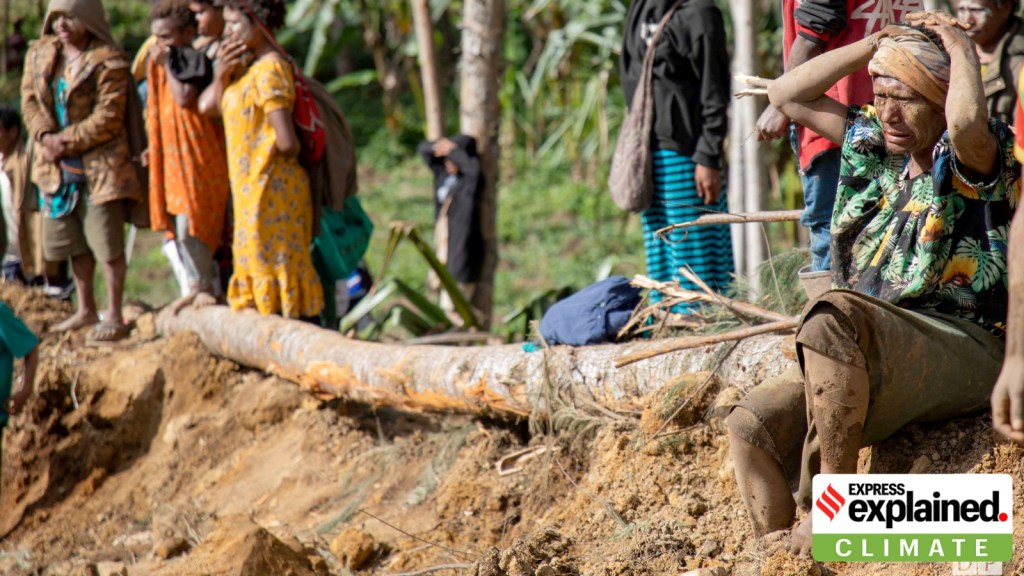
In the early morning of May 24, when most of the residents of Papua New Guinea’s Yambali village were fast asleep, parts of a mountain fell on them due to a colossal landslide. More than 2,000 people are estimated to be buried, with more than 70,000 affected by the disaster.
Rescue workers have been toiling to save the buried. But days after the incident, they seem to have lost hope. “It is not a rescue mission, it is a recovery mission,” UNICEF Papua New Guinea’s Niels Kraaier said in a statement. “It is very unlikely they will have survived.”
Papua New Guinea is vulnerable to natural disasters such as landslides and earthquakes because of a host of reasons, including its geographical location and deforestation. However, climate change has worsened the situation in recent years.
Here is a look at why Papua New Guinea witnesses frequent natural disasters, and how climate change is leading to more frequent landslides.
But first, what happened?
The Yambali village in Enga province was hit by a landslide around 3 am with boulders — as big as shipping containers — falling on buildings, homes, and at least one school.
Rescue efforts began immediately and videos posted on social media showed people frantically digging through the debris with makeshift tools. But the efforts were severely limited as “rocks are still moving, the mountain is still crumbling, and we are seeing rock and debris pile up on what’s already happened,” Sandis Tsaka, the administrator of Enga Province, said in a statement on May 25, according to The New York Times.
Till May 29 — five days after the incident — only six bodies had been recovered. With not much hope of finding any survivors, locals started to hold funeral ceremonies, collective events known locally as “haus krai”, last week.
Why is Papua New Guinea vulnerable to landslides and earthquakes?
The main reason is the geographical location of the country. It sits on the Pacific ‘Ring of Fire’ — a string of hundreds of volcanoes and earthquake sites which run along the Pacific Ocean. The ring, which is a semicircle or horse shoe in shape, witnesses many earthquakes due to constant sliding past, colliding into, or moving above, or below each other of the tectonic plates.
Frequent earthquakes also lead to a high number of landslide incidents in Papua New Guinea. For instance, in 2018, a large earthquake triggered many landslides across the region.
Other factors like the country’s mountainous terrain and tropical climate also contribute to more frequent landslides. Speaking to ABC News, Dave Petley, vice-chancellor of the University of Hull (UK) and an expert on landslides, said that “heavy rain and storms lead to increased erosion, flooding, and higher tides, all of which raise the chance of dangerous rockfalls”.
The situation is exacerbated by the fact that Papua New Guinea lacks infrastructure and economic development to deal with natural disasters — unlike other nations like Taiwan, Italy and Japan, which are also vulnerable to such disasters. As a result, death tolls are usually high when landslides or earthquakes take place in the country.
Besides the aforementioned factors, deforestation and mining have also played a role in more landslides. As Papua New Guinea is the world’s fifth largest exporter of palm oil, it is dominated by palm oil plantations, which have been cropped up in place of forests. The mining of “gold, silver, nickel, copper, and cobalt.. and LNG operations have been taking place in areas where deadly landslides occurred in the past,” according to the ABC News report.
What is the role of climate change?
Much like the rest of the world, Papua New Guinea is also reeling from the adverse effects of climate change. The country has witnessed an increase in temperature of approximately 0.8-0.9 degree Celsius, as measured in the difference between average temperature in 1900–1917 and 2000–2017, according to a report by the United Nations. Consequently, extreme weather events have become more frequent and intense in Papua New Guinea.
Although it is difficult to attribute the latest landslide to climate change, experts believe that the phenomenon contributed to the incident. Higher temperatures result in more evaporation of water, which enables the atmosphere to hold more moisture. In such a situation, storms can be more dangerous as they can cause a higher precipitation intensity. This is likely what happened in Papua New Guinea — it has experienced heavy rainfall so far in 2024, which could have triggered the landslide.
Last week, Prime Minister James Marape said, “This year, we had extraordinary rainfall that has caused flooding in river areas, sea level rise in coastal areas, and landslips in a few areas… We have faced extraordinary weather patterns and changes from dryness to wetness”.



 Share


