While around 70% of Earth’s surface is covered with water, less than 1% per cent is actually drinkable.
These finite freshwater resources are very unevenly distributed. In hot, dry regions with growing populations and increasing living standards, there is not enough water to go around — a situation exacerbated by climate change.
As solutions such as cloud seeding or even iceberg harvesting remain unproven at scale, the desalination of our oceans into drinking water has emerged as the ultimate means to drought-proof regions suffering water poverty.
The centuries-old concept uses thermal distillation or a reverse osmosis membrane to separate salt from the sea.
The technique is now being utilized globally, with well over 20,000 desalination plants currently operating in over 170 countries — the 10 largest in Saudi Arabia, the United Arab Emirates (UAE) and Israel. Around 47% of the world’s desalinated water is produced in the Middle East and North Africa alone, Manzoor Qadir, deputy director of the United Nations University Institute for Water, Environment and Health, told DW.
These arid regions have few other options since, according to Qadir, they generate less than 500 cubic meters of water per capita through rainfall or river runoff — which is half the upper limit of water scarcity as defined by the UN. The United States, by contrast, produces 1,207 cubic meters of freshwater per person.
Water poverty is set to worsen as populations increase along with temperatures, with Sub-Saharan Africa predicted to become a “hotspot of water scarcity” by 2050, Qadir noted.
“It is a great option in terms of enhancing water resources,” he said of desalination, adding that costs have “decreased tremendously” — from around $5 ($4.69) per cubic meter (1,000 liters) in the 2000s to 50 cents today.
“It’s a no brainer,” said Frithjof C. Kuepper, chair in marine biodiversity at the University of Aberdeen and an expert on the environmental impacts of desalination in Cyprus. “For countries like Cyrpus, there’s no other option if they want to maintain this living standard.” The hottest and driest nation in the EU, Cyprus relies on desalination for 80% of its drinking water, according to Kuepper.
With variable rainfall necessitating water restrictions in the country as far back as the 1990s, Kuepper explains that Cyprus’ government first tried to make up the shortfall by shipping in water from Greece. “But it cost about ten times more than desalinating,” he said, adding that the government started to build desalination plants in the early 2000s to avoid water shortages.
What are the marine and climate impacts of desalination?
But both Kuepper and Qadir concede that before becoming a magic bullet for water scarcity, desalination presents some serious environmental trade-offs in its current guise.
Firstly, separating salt from water is highly energy intensive.
A 2021 study on the environmental consequences of removing salt from seawater in Cyprus co-authored by Kuepper showed that the four desalination plants in the country generate around 2% of its total greenhouse gas emissions. The plants also accounted for 5% of the total electricity consumption in Cyprus, representing one of the largest shares by sector of electricity consumption, according to the study.
Furthermore, the report notes that desalinated water produced generated around 103 million cubic meters of toxic, high-salinity brine effluent that impacted the Mediterranean seagrass ecosystem in the region of the discharge pipes.
In a report-authored by Manzoor Qadir on the state of desalination and brine production globally, it was shown that increased salinity, combined with climate-driven temperature rise, can cause a decrease in the dissolved oxygen content, resulting in conditions called hypoxia.
This hypersaline water can sink to the ocean bed and kill marine microorganisms that are vital to the entire food chain. In addition, chemical compounds such as copper and chloride are also observable in the desalination pre-treatment process and can be toxic to organisms in the receiving water, according to the report.
How can desalination be made sustainable?
The authors of the Cyprus study conclude that the solution to the relatively high CO2 emissions is to deploy renewables to power desalination plants.
A Berlin-based company, Boreal Light, has developed off-grid solar and wind energy desalination plants that ensure greater energy independence and immunity from price fluctuations.
“We’ve got the water for free, we’ve got the electricity from the solar and wind for free, so we can now produce 1,000 liters [of fresh water] for 50 cents,” Ali Al-Hakim, Boreal Light co-founder and general manager, told DW. The price for one cubic meter is as competitive as directly accessing freshwater from rivers or wells, he added — and is equal to today’s cheaper desalination cost as quoted by Manzoor Qadir.
Meanwhile, though brine discharge can be better diffused through outfall pipes that are not in the vicinity of vulnerable marine life, Kuepper said a better solution would be to keep the remnant solids on the land.
The 2019 study on the state of desalination showed how sodium, magnesium, calcium, potassium, bromine, boron, strontium, lithium, rubidium and uranium could be harvested from the filtered material and reused in industry and agriculture. Recovery of these resources remains economically uncompetitive, however, Qadir believes.
This needs to change as reuse is an important sustainability solution, he added, especially “in countries producing large volumes of brine with relatively low efficiencies, such as Saudi Arabia, UAE, Kuwait and Qatar.”
Can the brine be reused?
Scientists at the US research body, the Massachusetts Institute of Technology (MIT), have suggested ways to repurpose brine by using the salt to produce caustic soda, or sodium hydroxide.
When used to pre-treat seawater entering the desalination plant, sodium hydroxide helps prevent the fouling of the reverse osmosis membranes used to filter the ocean water. The researchers note that such fouling is a typical source of breakdowns and adds to the energy inefficiency and overall cost.
Although such brine reuse is still in the early developmental stage, Qadir notes that newer, more modern plants in the US that utilize the latest reverse osmosis technology already produce less brine.
Around 12% of the world’s desalinated water is created in the US but only 3.9% of its brine, Qadir explains. By contrast, the Middle East and North Africa region generates around 47% of desalinated water but 70% of the total global brine output, he says, due partly to the presence of less efficient plants.
As the technology continues to improve, climate and environmental impacts will be reduced, says Qadir. Kuepper says desalination is the obvious way to go. “Our job is to make sure it is sustainable.”

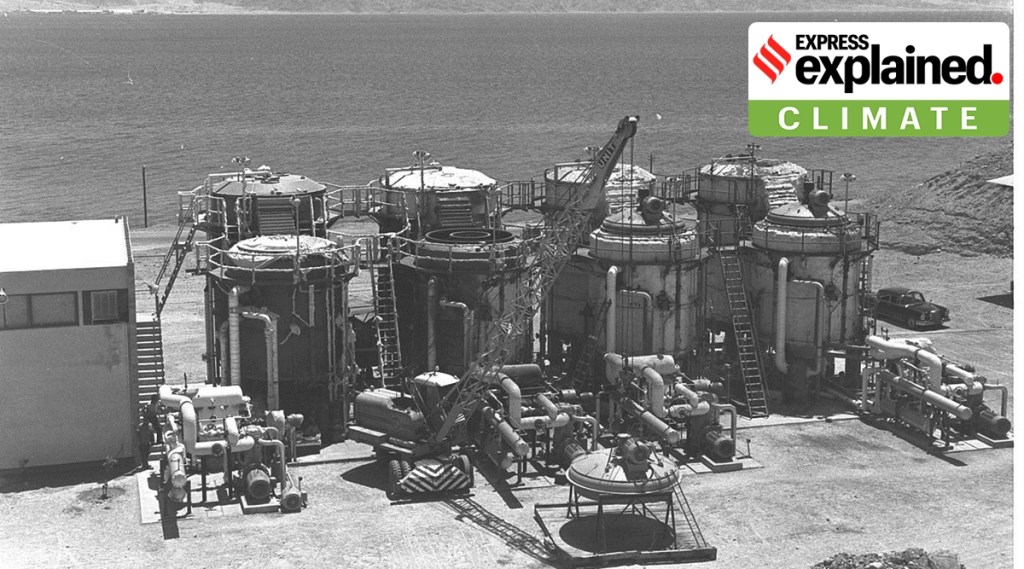 A view of the Zarchin desalination plant on the Red Sea in Eilat, Israel from 1964. While the tech to convert ocean water to fresh water is not new, it has not been a viable solution for most regions due to high economic and environmental costs. (Wikimedia Commons)

 Share


