Hurricane Beryl became the earliest storm on record during the Atlantic hurricane season to have reached the highest Category 5 classification.
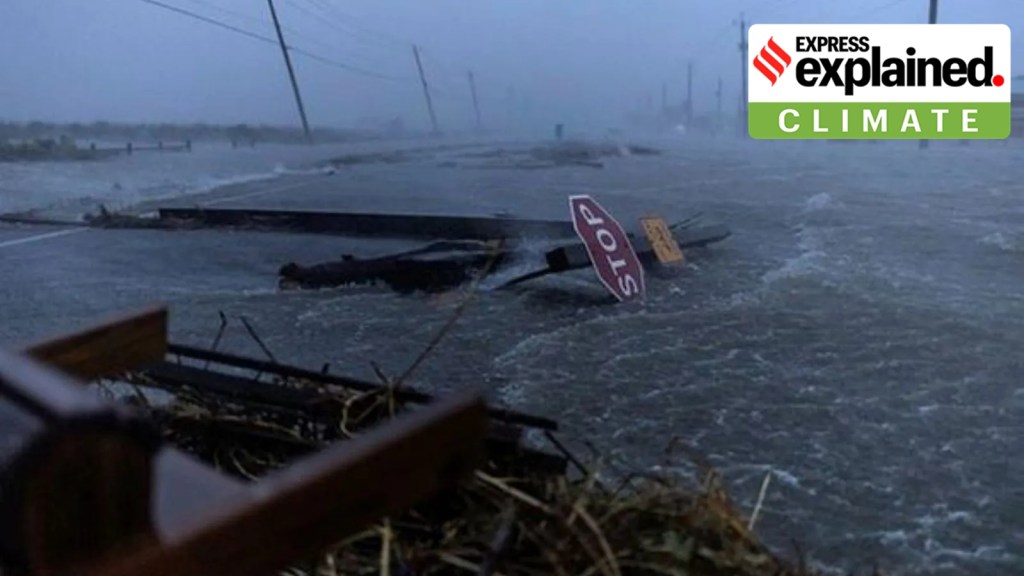
The storm, which tore through the Caribbean islands earlier this month, killed at least 11 people after triggering intense floods and dangerous winds in Jamaica, Grenada, Saint Vincent and the Grenadines, and northern Venezuela. On Monday, it made landfall in Texas, United States, as a Category 1 storm, flooding streets and knocking out power for more than two million people in the state.
Hurricanes, or tropical storms, form over warm ocean waters near the equator. When the warm, moist air from the ocean surface rises upward, a lower air pressure area is formed below. Air from surrounding areas with higher air pressure rushes into this low pressure area, eventually rising, after it also becomes warm and moist.
As warm, moist air rises, it cools down, and the water in the air forms clouds and thunderstorms. This whole system of clouds and winds gains strength and momentum using the ocean’s heat, and the water that evaporates from its surface. Storm systems with wind speeds of 119 kmph and above are classified as hurricanes.
Hurricanes are classified using the Saffir-Simpson Hurricane Wind Scale into five categories (Category 1 to Category 5) based on their sustained wind speeds. While Category 1 hurricanes bring winds of 119 to 153 kmph, Category 5 hurricanes, which are the strongest, have winds of 252 kmph or higher. Storms that reach Category 3 and higher are considered major hurricanes due to their potential to inflict significant damage.
How did Beryl become a Category storm?
Within 24 hours of emerging as a tropical depression with winds of 56.3 kmph on June 28, Beryl transformed into a hurricane. Over the next 24 hours, it rapidly intensified to become a Category 4 hurricane. At that point, Beryl was the first Category 4 hurricane to form in June, according to National Oceanic and Atmospheric Administration (NOAA). The earliest emergence of a Category 4 hurricane was previously seen in the case of Hurricane Dennis on July 8, 2005.

On July 1, Beryl made landfall on Grenada’s Carriacou Island as a Category 4 hurricane with sustained winds of over 241 kmph. As it travelled through the Caribbean Sea, it continued to gain strength, and became a Category 5 hurricane on July 2. This made it the earliest Category 5 hurricane seen during the Atlantic hurricane season on record. In fact, the Atlantic has only seen one Category 5 hurricane on record in July — Hurricane Emily, on July 16, 2005.
Beryl was also the strongest July Atlantic hurricane on record, with winds of 265.5 kmph, according to NOAA.
Why did Beryl become a Category 5 hurricane so early?
The hurricane season in the Atlantic begins in June and lasts until November. Generally, the first major hurricanes do not form until September. This is because till that time, the ocean is not warm enough either at the surface, or deeper down to fuel such strong hurricanes, according to NOAA.
This is what makes Beryl so unprecedented. Although it is difficult to attribute a specific hurricane to global warming, scientists see unusually warmer oceans as the primary reason behind Beryl turning into a powerful storm this early in the season.
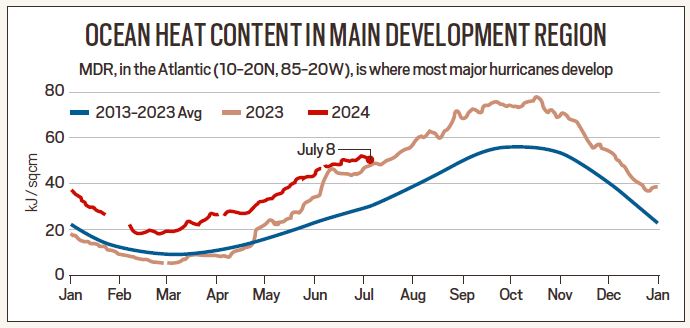
Since last year, ocean temperatures in the Atlantic — and across the world — have mostly been in record-breaking territory. Not only are sea surface temperatures rising, ocean heat content (OHC) — a measure of the amount of heat present in ocean water — is also soaring, which is a bigger worry. The graph shows that this year’s OHC (in red), for the area of the Atlantic Ocean where most major hurricanes like Beryl form, has been far above the 2013-2023 average (in blue).
“For storms like Beryl… if it were moving over a part of the ocean where the warm water was skin deep, it would easily churn up cooler water to the surface, [which can reduce its intensity]… But in this case… the warm water is so deep, it’s just going to churn up more warm water. The hot water goes down to probably about 100 to 125 meters deep… It is pretty crazy,” Brian McNoldy, an atmospheric scientist at the University of Miami, told Science News last week.
What happens next?
Scientists are still debating over how exactly climate change impacts hurricanes. There is agreement, however, that at the very least, climate change makes hurricanes more prone to rapid intensification — where maximum wind speeds increase very quickly.
The frequency and magnitude of these rapid intensification events in the Atlantic seems to have spiked between 1971 and 2020, according to a 2023 study published in the journal Nature.
Therefore, as the world and its oceans continue to become warmer, scientists are concerned that even more powerful hurricanes could form in the near future.
“We’re essentially ‘stacking the deck’ of extreme events against ourselves, making events like Hurricane Beryl not only possible, but more likely,” Andra Garner, an assistant professor at Rowan University, told the BBC.



 Share


