But there are more warning bells for India. As rising temperatures and shifting regional precipitation patterns reduce the stability of the Himalayan glaciers, some of them could evolve into “hanging glaciers” — ice masses perched on steep slopes that can detach and trigger massive avalanches.
How do hanging glaciers form?
 Distribution of glaciers in the Alaknanda basin. Credit: ‘Basin-scale inventory and exposure assessment of hanging glaciers, Central Himalaya’
The study — by Ashim Sattar of the School of Earth, Ocean and Climate Sciences, Indian Institute of Technology, Bhubaneswar and Nandu Krishnan of the Divecha Centre for Climate Change, Indian Institute of Science, Bengaluru, alongside two colleagues — flagged that Himalayan glaciers are increasingly exhibiting “geometric and dynamic instability” owing to rapid warming and climate variability.
Unstable glaciers are essentially those whose velocity may change by an order of magnitude and more during a comparatively short period of time. The result is redistribution of ice, accompanied by geometric and structural-and-tectonic shifts.
This instability then leads to the development of hanging glaciers on steep slopes. While these glaciers have been extensively studied in the Alps, basin-scale assessments in the Himalayas remain limited.
What happens if they break off?
Types of hanging glaciers. Credit: ‘Basin-scale inventory and exposure assessment of hanging glaciers, Central Himalaya’
Hanging glaciers pose a significant risk of break-offs. The study’s simulations indicated that the resultant avalanche flows could exceed 50 metres in height in Uttarakhand’s Badrinath-Mana sector. Such a severe event would swallow major settlements and infrastructure.
The break-offs from hanging glaciers can also trigger secondary hazards such as glacial lake outburst floods (GLOFs).
The study identified a total of 219 hanging glaciers in the Alaknanda basin of the Garhwal Himalayas, covering 71.7 ± 3.5 sq km, with an estimated ice volume of 2.39 ± 0.42 km³, including 0.74 ± 0.14 km³ of hanging ice mass.
Growing risk
Hanging glaciers in the Alaknanda basin. Credit: Basin-scale inventory and exposure assessment of hanging glaciers, Central Himalaya
Exposure to avalanche-related risks in this basin is projected to increase over the next decade, with 120% more buildings and infrastructure land area at risk by 2030 compared to 2000, said the study.
The number of people living in these at-risk areas, meanwhile, is projected to surge by 17% over the same period.
This underscores the need for systematic identification and monitoring of high-risk glaciers, alongside risk-informed land-use planning, to reduce downstream hazards in mountain regions. What happened in Nepal offers a clear warning sign.
“This study… sadly predicted the tragic events (and)… underscores the need to monitor such ‘hanging glaciers’ closely to give better warning of such catastrophes in future to vulnerable downstream communities. This will require much greater funding of monitoring programs; but such funding is small compared to the costs of loss of life and livelihoods,” Pam Pearson, Director of International Cryosphere Climate Initiative (ICCI) told The Indian Express.
“This should also, however, prove a wake-up call that we really must accept that the era of fossil fuel use needs to end, and transition to carbon-free energy sources, and on an emergency basis. Here again, the economic costs of such a transition will be far less than the cost of continued use, in terms of such disasters alongside other economic burdens from drought (in part from lesser snowpack) and heatwaves,” said Pearson.
The Burlington, Vermont-based ICCI had done a “capsule” summary of the April 2026 study, flagging it as a warning.
“Otherwise, these kinds of highly damaging events — where in this case, it appears that the previously-frozen ground under the glacier thawed to such an extent that it collapsed, carrying a massive piece of the glacier with it on a scale previously seen only in Greenland or Antarctica — will only continue and intensify,” Pearson said.
Preparing for calamity
Another relevant study, published in Nature on March 6, made an interesting point of preparedness in the event of a calamity in the warming Himalayas.
The study, by Anshuman Bhardwaj, Rayees Ahmed and two other colleagues, compared two events.
The first was the 2021 Chamoli disaster which saw a massive wall of ice and rock collapse into the Rishiganga valley. The event destroyed hydropower plants, swept away bridges and killed over 200 people.
Four years later, a large ice–rock avalanche struck and buried most of the village of Blatten in Switzerland. Only one person died.
The difference between catastrophe and survival, the study said, “was not luck, but preparedness, monitoring, and rapid response”. In Blatten, authorities and residents acted on precursory signs of slope instability, enabling timely evacuation.
Bhardwaj, one of the study’s authors, told The Indian Express: “The Nepal event highlights that we need to think of these as cascading hazards, rather than isolated landslides, avalanches, or floods… Second, we need to strengthen anticipatory monitoring and preparedness… Third, this is also a transboundary risk-management issue… Finally, we should be careful not to rush process attribution while responding to the immediate emergency.”
“Overall, the Nepal event reinforces the central message of our work: the Himalaya needs to shift from reacting to cryospheric disasters to anticipating them. With a warming Himalaya, the conditions that destabilise ice and rock are becoming more widespread, making preparedness increasingly urgent. The goal is not to predict every avalanche, but to systematically reduce the likelihood that a foreseeable mountain hazard becomes an avoidable human catastrophe,” said Bhardwaj, who is also the Head of Department (Planetary Sciences) and Programme Director (MSc Planetary Sciences) at the School of Geosciences, University of Aberdeen.

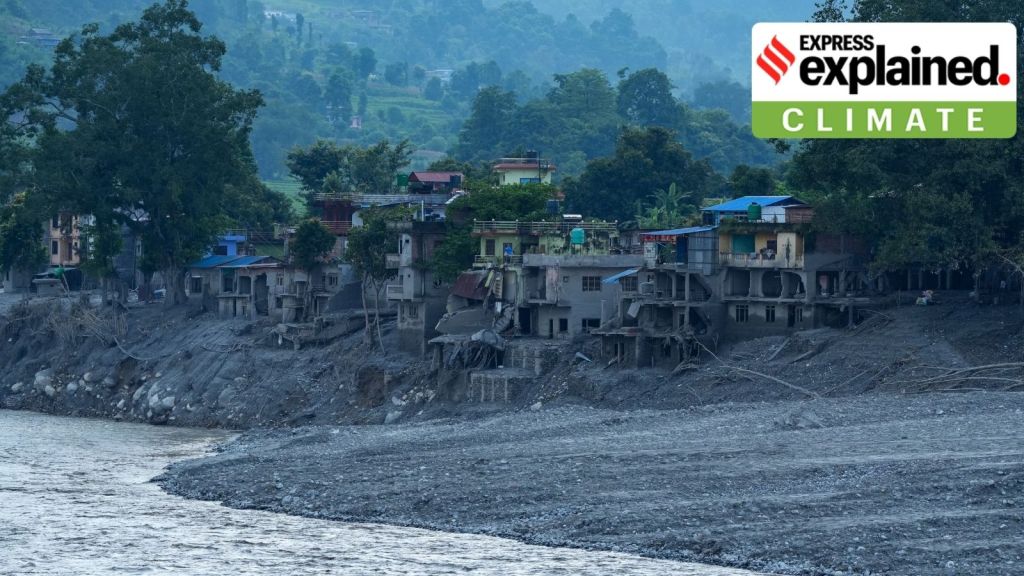 Damaged structures stand alongside a swollen river following devastating flash floods at Devighat, in Nuwakot district, Nepal, Saturday, Aug. 29, 2026. (PTI Photo/Arun Sharma)

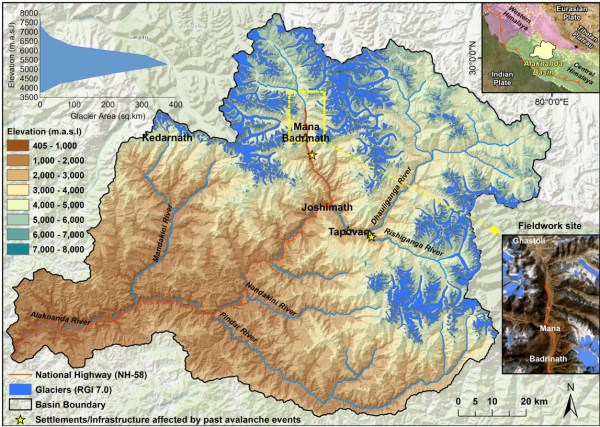 Distribution of glaciers in the Alaknanda basin. Credit: ‘Basin-scale inventory and exposure assessment of hanging glaciers, Central Himalaya’
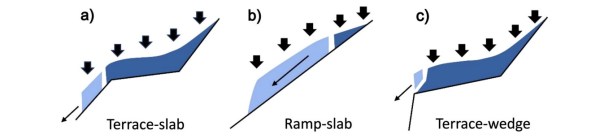 Types of hanging glaciers. Credit: ‘Basin-scale inventory and exposure assessment of hanging glaciers, Central Himalaya’
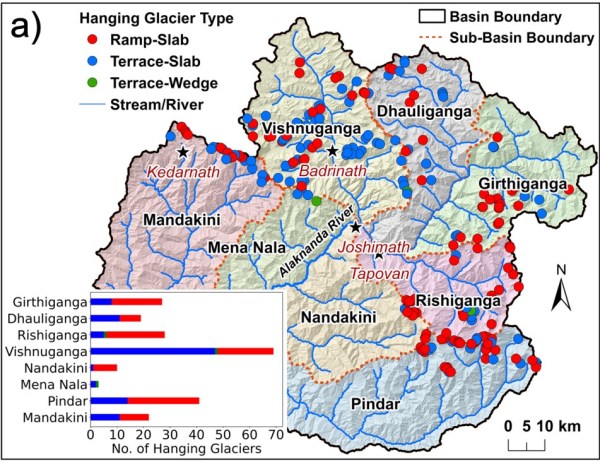 Hanging glaciers in the Alaknanda basin. Credit: Basin-scale inventory and exposure assessment of hanging glaciers, Central Himalaya


 Share


