
Explained: As Boko Haram completes a decade, the history of this Nigerian terror group
The group, officially called Jama’a Ahl as-Sunna Li-da’wa wa-al Jihad, is more commonly known as Boko Haram, a nickname given by the country’s local Hausa-speaking population, because of its rejection of Western education and culture.
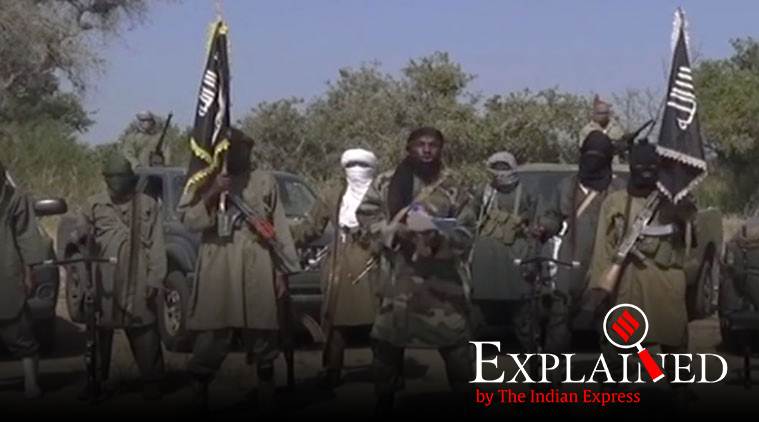 In the 2000s, Boko Haram emerged in Nigeria as a small Sunni Islamic sect advocating a strict interpretation and implementation of Islamic law.
Nigeria has witnessed several insurgencies from tribal militias in its 59-year modern history. But it was the emergence of Boko Haram as a violent Islamist insurgent group that altered the nature of violence that the nation had been witnessing.
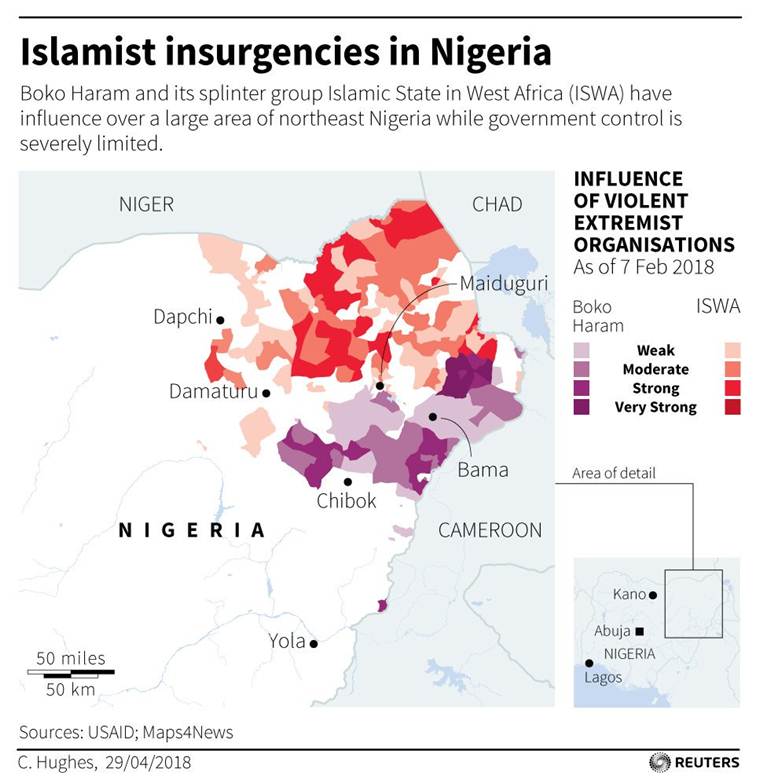
Over the decade, Boko Haram has spread from northeast Nigeria to neighbouring West African nations of Niger, Chad and Cameroon in the Lake Chad Basin. The terrorist group gained international notoriety when it abducted approximately 300 school girls in 2014 in the town of Chibok, Borno state, in northeast Nigeria.

What is Boko Haram?
In the 2000s, Boko Haram emerged in Nigeria as a small Sunni Islamic sect advocating a strict interpretation and implementation of Islamic law. The group, officially called Jama’a Ahl as-Sunna Li-da’wa wa-al Jihad, is more commonly known as Boko Haram, a nickname given by the country’s local Hausa-speaking population, because of the group’s call for rejection of Western education and culture that it viewed as un-Islamic—haram or forbidden—guided by Salafism, a conservative interpretation of Islam.
Around the year 2002, a Nigerian Muslim sect leader, Mohammed Yusuf set up an Islamic school and a mosque in Maiduguri, the capital of Borno state in Nigeria, an establishment that attracted some of the poorest people in the area. But it wasn’t only the poor who were drawn to Yusuf. Even college educated and wealthy Nigerians were attracted to Yusuf who was educated, with a masters degree equivalent in Islamic education, and was a charismatic leader. Scholars who have studied Boko Haram believe that it was the manner in which Yusuf sold this ideology that gained him followers. He spoke openly against corruption and police violence in Nigeria that made people sympathetic to his cause against the establishment.
 Boko Haram founder, Mohammed Yusuf, Mohammed Yusuf. (Photo: Wikimedia)
In 2009, Boko Haram launched a rebellion against the Nigerian government that was quashed and Yusuf was taken into custody. In police custody, Mohammed Yusuf was killed and the Nigerian government believed that they had controlled the uprising before it was allowed to manifest and grow. “(Boko Haram) members, including women and children were also subjected to torture, and many were killed by the police while in custody. Consequently, they declared war on Nigerian authorities,” said Mojúbàolú Olufúnké Okome, professor of Political Science, African & Women’s Studies at Brooklyn College, City University of New York, in an interview with The Indian Express.
Boko Haram became radicalised after Yusuf’s death and approximately a year later, one of his lieutenants, Abubakar Shekau announced that he was the new leader of Boko Haram. Over the decade, the violence continued due to the failure of the Nigerian government in controlling Boko Haram, until the group gained international attention by kidnapping 300 school girls in Chibok.
Why did the Nigerian government and international peacekeeping forces struggle to control Boko Haram?
According to Professor Okome at Brooklyn College, City University of New York, the government of Jonathan Goodluck, former president of Nigeria (2010-2015), failed to contain Boko Haram because “the group (operated) in a vigorous, organized manner” and the Nigerian armed forces were poorly armed in comparison with Boko Haram. Okome believes that Boko Haram also received funding during this time from influential politicians to further its operations in the country.
Boko Haram had intimate knowledge of the area and was able to infiltrate the communities, influence and intimidate locals and occupy territory in northeast Nigeria in a way that the Nigerian government was unable to counter. “By the time the government put up a serious fight, Boko Haram was already well-entrenched,” said Okome.
How did Boko Haram change its operational tactics after leader Yusuf’s death?
In 2011, two years after Mohammed Yusuf’s death, under the leadership of Abubakar Shekau, Boko Haram used a car in a suicide bomb attack at the United Nations compound in Abuja, the capital of Nigeria. The attack resulted in the death of 23 people with many more who were injured.
Over the next four years, Boko Haram continued waging war in Nigeria that the government found hard to contain. The government initially refused assistance from neighbouring nations and within years, the group became stronger. The group developed its operational tactics to include the use of suicide bombing and it’s violence increased in its “ferocity, brutality, and its fierce zealotry also proved hard to counter,” said Okome.
According to Okome, Boko Haram had started as an organisation that engaged in charity and proselytising in an area afflicted with extreme poverty while reinforcing Salafism. “It’s doubtful that a purely military strategy would defeat the group, given the combination of a militaristic religious ideology and social critique of the corrupt political and economic elites, (and) its belief that the secular state (was) immoral and must be replaced with an Islamic caliphate.” Given the assistance that Boko Haram had provided early on its establishment, poor Nigerians were more vulnerable to believing in the philosophies of the organisation and its indoctrination.
By 2015, Boko Haram had seized much of Borno state and its attacks began spreading beyond Nigeria’s borders to neighbouring nations of Niger, Chad and Cameroon. When Boko Haram founder, Yusuf Mohammed had rebelled against the Nigerian government in 2009, these neighbouring nations did not collectively mobilise against the organization. Six years later, they were facing the spillover of the violence perpetrated by the group. According to figures by the United Nations, some 2.2 million people in the region were internally displaced during this time.
Why did Boko Haram’s abduction of Nigerian school girls launch the international campaign #BringBackOurGirls?
In April 2014, approximately 276 schools girls at the Girls’ Secondary School in the town of Chibok in Borno state were asleep in their boarding school dormitories when armed men from Boko Haram kidnapped them. The students at the girls’ school came from a poor community and the perception was that there would be no fall-out for the Nigerian government, explained Okome. That their abduction would gain the massive international attention that it did, was not something that either Boko Haram or even the Nigerian government possibly anticipated.
“The Borno state and federal governments had advance notice that there would be abductions but allowed students to congregate in a poorly secured boarding school for an exam. After the abduction, the government failed to seriously try to rescue the girls,” said Okome. Nigeria did not begin rescue efforts immediately and that gave Boko Haram enough time to hide the abducted girls in the nearby Sambisa forest in Borno state.
Amnesty International’s Africa director, Netsanet Belay, released a statement soon after the kidnappings, saying, “The fact that Nigerian security forces knew about Boko Haram’s impending raid, but failed to take the immediate action needed to stop it, will only amplify the national and international outcry at this horrific crime.”
 Marine Lieutenant General Thomas Waldhauser said that Boko Haram leader Abubakar Shekau was asked by ISIL to stop using children as suicide bombers but he did not do so leading to the splinter group breaking away from the group. (Photo: Reuters)
Three weeks after the girls had been abducted, news agency AFP published a video showing Boko Haram leader Abubakar Shekau, acknowledging that his group had abducted the girls and said, “God instructed me to sell them, they are his properties and I will carry out his instructions,” adding that the girls should have been married already at their age, not studying.
The Chibok girls were mostly Christian, with a few Muslims, and had not converted to Islam. Shekau said in the video that he was willing to exchange the girls for “our brethren in your prison”.
The abduction led to global outrage and put Boko Haram in the international spotlight like never before. Politicians and celebrities began campaigning for the release of the girls and the hashtag #bringbackourgirls began trending worldwide.
Our prayers are with the missing Nigerian girls and their families. It's time to #BringBackOurGirls. -mo pic.twitter.com/glDKDotJRt
— First Lady- Archived (@FLOTUS44) May 7, 2014
Initially, Nigeria had rejected assistance from Britain, France and the US in retrieving the abducted girls, with nations like Britain conducting independent air reconnaissance missions that had tracked the movements of girls soon after they were kidnapped. Meanwhile, reports also emerged of the girls being subjected to murder and rape. Months of negotiations by various government and private parties took place with Boko Haram leaders to free the girls but without any results.
By the time Muhammadu Buhari became president of Nigeria in 2015, Boko Haram had split into separate factions and the girls had been divided among them. As of 2019, 112 girls remain in captivity.
Why did Boko Haram kidnap girls from Dapchi?
Boko Haram realised that through abductions and methods like those employed in the case of Chibok students, they could bring attention to themselves and in February 2018, they did it again. This time, they abducted 110 school girls from the town of Dapchi in Yobe state in northeast Nigeria.
Approximately a month later, according to reports, 106 girls were released from captivity. Of the kidnapped students, Lea Sharibu remains in captivity, purportedly because of her refusal to convert to Islam from Christianity. “The allegation that Leah wasn’t released because she’s Christian, and she was the sole abductee that wasn’t released out of over 100 schoolmates, as well as the involvement of many Christians in Nigeria and other countries, particularly in the West, made her continued captivity remain in global attention,” said Okome.
 In this file image taken from a video distributed Sunday, August 14, 2016, shows an alleged Boko Haram soldier standing in front of a group of girls alleged to be some of the 276 abducted Chibok schoolgirls held since April 2014, in an unknown location. Nigerian (Militant video/Site Institute, File via AP)
Why did Boko Haram attack schools and colleges in Nigeria?
“Mohammed Yusuf had Islamic education equivalent to a masters level education. His successor, Abubakar Shekau studied, but did not graduate from Borno College of Legal and Islamic Studies (now called Mohammed Goni College of Legal and Islamic Studies),” said Okome. Yet, the group carried out several attacks on schools and colleges in Nigeria in a rejection of Western education models and to push their own ideologies, especially in poor areas where there were more vulnerable people.
Does Boko Haram have ties with other terror groups?
After losing ground to the Nigerian military forces in 2015, according to the US Congressional Research Service, in March of that year, Boko Haram’s Abubakar Shekau pledged loyalty to Abu Bakr al-Baghdadi, leader of the Syria/Iraq-based ISIS, in an attempt to build new alliances to compensate for the loss of ground in Nigeria. According to documents from the Congressional Research Service, the pledge was welcomed by an ISIS spokesperson who urged Islamic State followers to travel to West Africa and provide support Boko Haram. Other reports suggest that ISIS had no intention to join forces with Shekau, but was actively planning on establishing its independent presence in West Africa. In 2016, it did just that by creating the Islamic State West Africa province (ISWA, also known as ISWAP), under the leadership of Abu Musab Al-Barnawi, believed to be one of the sons of Boko Haram founder, Mohammed Yusuf.
Is ISIS planning on establishing a Caliphate in West Africa?
Instead of being able to control and contain Boko Haram, Nigeria, neighbouring nations and the world at large, now have to deal with two terror groups operating in the same region. But Okome believes that it is too soon to say whether ISIS will be able to expand and establish its operations in Nigeria and the larger West Africa region as it has done in the Middle East.
“I’m not sure that the establishment of a Caliphate is feasible in the near future because the alleged declaration of allegiance doesn’t seem…to have had concrete manifestation and ramifications thus far. There is much still unknown about these groups and their plans, capacity and resources,” said Okome.
Not only have ISIS and Boko Haram influenced each other’s workings and philosophies, Okome points to Nigerians from Boko Haram who went to Syria as combatants for ISIS. “Each group used methods first deployed by the other, and it’s quite possible that having lost ground in Syria, ISIS might move increasingly into the West Africa region, including Nigeria, causing increased intractability in an already complex insurgency,” said Okome.
 Share


