
Navier-Stokes problem: The questions raised by OpenAI’s latest maths ‘breakthrough’
OpenAI claims its systems cracked a mathematical problem that was unsolved for decades. But the announcement was overshadowed by questions over user data and how the result was reached.
 AI systems are increasingly being used to generate proofs and explore problems that have resisted human researchers for decades. (Unsplash)
OpenAI’s claim that its artificial intelligence (AI) agents have generated a solution to the Navier-Stokes Millennium Prize Problem has posed a new question for mathematical research: What happens when researchers’ work is fed into AI systems, and “de-identified” data from those interactions is later used to improve the models?
The ChatGPT maker said its researchers and AI agents did not access specific user data to solve the problem. But in a blog post this week, the company also said it could not rule out the possibility that de-identified data from researchers’ use of its products had helped improve its models. De-identified data refers to information from which personal identifiers have been removed.

The blog post has drawn scrutiny from mathematicians, particularly because New York University professor Tristan Buckmaster and Anthropic researcher Levent Alpöge had been working on related Navier-Stokes research using AI tools, including OpenAI’s Codex.
Separately, mathematician Andreas Thom has raised a similar concern, questioning whether his private ChatGPT conversations on related research had informed an earlier OpenAI mathematical result.
An OpenAI researcher told him “that did not happen”, but Thom said the response did not clarify whether his conversations had been used in training. OpenAI has not publicly responded to his latest allegations.
“De-identified use of a researcher’s conversations blurs the line between assisting someone’s thinking and drawing on it without their knowledge,” Vijay Keswani, professor at the Indian Institute of Technology, Delhi told The Indian Express.
For Keswani, the issue goes beyond data privacy. It raises questions of “epistemic ownership” — whether AI companies can draw on ideas generated by researchers using their tools without clear acknowledgement or consent.
The controversy comes as AI systems are increasingly being used not just to assist mathematicians but to generate proofs and explore problems that have resisted human researchers for decades.
What does de-identification mean for researchers?
In general, de-identification involves removing or changing information that can identify the person who generated the data. But that does not necessarily mean the underlying information, ideas or content have not been used by a model. The exact process OpenAI uses for de-identification in this context is not publicly clear.
That has become particularly sensitive in mathematics because researchers increasingly use AI systems to discuss unfinished ideas, test approaches and work through problems before publishing them.
OpenAI has said no specific user data was accessed to solve the Navier-Stokes problem. But that is a narrower claim than ruling out the possibility that de-identified data from users’ interactions may have contributed to training or improving its models.
Keswani said the concern is amplified by the imbalance between individual researchers and AI companies, which have access to both researchers’ interactions with their systems and computing resources far beyond what individual mathematicians can access.
“Is it fair for a company to have visibility into researchers’ ideas and be able to leverage that visibility, combined with vast computing resources available only to them, to scoop the researchers whose thinking informed the result?” he said.
He also pointed to a distinction between what may be permitted under a service’s terms and what researchers may reasonably understand as informed consent: “De-identified” use of a researcher’s conversations may be permitted under terms of service, but that is different from the researcher knowingly consenting to their ideas being used in a competing research effort.
The $1 million Navier–Stokes Millennium Prize Problem
The Navier-Stokes Millennium Prize Problem is one of the seven mathematical problems identified by the Clay Mathematics Institute (CMI) as among the most important unsolved questions in mathematics, carrying a million-dollar bounty for whoever cracks it.
The Navier-Stokes equations describe how fluids move. They are used to model everything from water flowing around a boat and air moving around an aircraft to blood moving through the human body. The equations build on 19th-century work by Claude-Louis Navier and George Gabriel Stokes to describe how fluids move, taking into account factors such as pressure, velocity and viscosity.
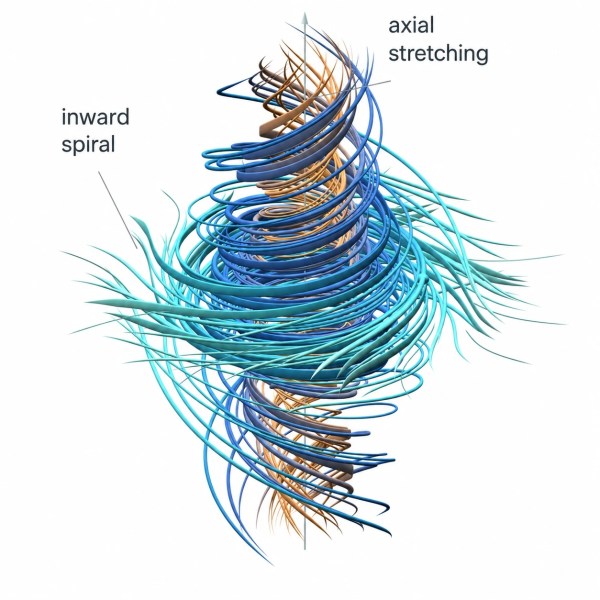 A vortex that spirals inward and gets increasingly elongated shows that the Navier-Stokes equations governing the motion of fluids can break down. (OpenAI)
The problem is whether, in three dimensions, a fluid that starts out behaving smoothly can always continue to do so — or whether its behaviour can become infinitely intense in a finite amount of time.
In simple terms, the question is: if you start with a fluid whose motion is well behaved, can the equations ever produce a point where the fluid’s velocity becomes infinitely large?
This possibility is called a singularity or “blow-up”. Viscosity tends to smooth out fluid motion, but the equations also allow different scales and forces within a fluid to interact in complicated ways. Understanding whether those effects can lead to a blow-up is at the heart of the problem.
This is largely theoretical. A solution would not suddenly make it possible to predict weather, design aircraft or model blood flow — those applications already use the Navier-Stokes equations — but it would establish whether the equations can always produce mathematically well-behaved solutions under the conditions in question.
How did OpenAI approach the problem?
In a blog post on Tuesday (September 8), OpenAI said 10,000 concurrently running AI agents — systems that carry out tasks autonomously — cracked the problem in about 88 hours.
The result was then formalised in Lean, a proof assistant used for checking mathematical arguments.
OpenAI said its paper constructs a mathematical fluid that starts from rest and, under a specially constructed smooth external force, develops a point at which the velocity grows without bound in finite time, while its overall energy remains bounded.
The result has not yet been independently verified or accepted by the mathematics community. CMI continues to list Navier-Stokes among the unsolved Millennium Prize Problems, while the Poincaré Conjecture remains the only one of the seven to have been resolved
Siddhartha Gadgil, a professor of Mathematics at the Indian Institute of Science, Bangalore, told The Indian Express that the use of formal verification could be significant as AI-generated mathematics becomes more common. “Lean provided hope for a superhuman level of correctness,” he said. “This can be much better than human evaluation for checking correctness,” although he cautioned that it is not foolproof.
A formally verified proof could also offer something beyond checking whether an argument follows logically from its formal assumptions. “Once we have a proof object in Lean — we can simplify it, view it in many ways, and try to extract insights,” he said.
But formal verification does not answer the question of how an AI model arrived at the result in the first place.
Can an AI system make a mathematical discovery?
The question is not entirely new. In May, one of OpenAI’s internal models successfully tackled the famous planar unit distance problem.
Thomas Bloom, a researcher at the University of Manchester who maintains the website erdosproblems.com, had told The Indian Express that he ranked the “unit distance problem” among his top 10 Erdős problems.
Notably, the previous breakthrough reflected AI’s reasoning and creation capabilities, as the “problem had no answer to retrieve. The model produced a new construction that humans had not found in eighty years of trying,” said Sayan Ranu, professor at the Indian Institute of Technology, Delhi.
If an AI system produces a proof that humans had not previously found, mathematicians may have to grapple with a question that traditional math research has largely avoided: is producing a correct proof enough to count as mathematical discovery if the machine’s route to that result is difficult for humans to understand?
“We lack reliable tools to trace how a model arrived at a given output,” Keswani said. That makes it difficult to determine whether a result is a near-retrieval of something already present in a model’s training data, a recombination of existing ideas, or genuinely new reasoning.
According to Keswani, current AI systems have not demonstrated complete autonomy in scientific research, because humans continue to frame the problem, define the objective and determine what constitutes a successful result. “Current systems haven’t demonstrated real autonomy, and more compute doesn’t change that,” he said.
For Gadgil, the question also extends to how mathematics recognises and rewards discoveries. “The traditional systems of credit and evaluation, including the Millennium Prize Problems, will face many problems in the age of AI,” he said.
Russian mathematician Grigori Perelman resolved the Poincaré Conjecture, the only Millennium Prize Problem to have been resolved so far, and later declined the $1-million prize. “Perelman posted a couple of preprints, but it was years before other mathematicians worked out the details and accepted this as correct. This has happened with many other major advances in mathematics,” Gadgil said.
On September 11 (Friday), Fields Medal winners issued an open declaration titled “A Severe Misalignment of AI in Mathematics”, warning that the AI industry’s push to use mathematical problem-solving as a benchmark risks undermining the discipline’s focus on conceptual understanding and insight.
“These issues must be addressed urgently, in the mathematical community, by the companies developing these technologies and, more broadly, by a society that will confront similar problems in many other forms of intellectual work,” it said.
Meanwhile, OpenAI has declined to claim the Millennium Prize for its result, saying that the aim behind releasing it was to report on the progress of its AI models.

 Share


