Last week, a district autonomous council in Meghalaya announced that it would introduce the ‘Khasi Inheritance of Property Bill, 2021, aimed at “equitable distribution” of parental property among siblings in the Khasi community. If implemented, the proposed Bill would modify an age-old customary practice of inheritance of the matrilineal Khasi tribe. While commentators say it is unlikely it would be made into a legislation, the Bill has brought into focus the practice of matriliny in Meghalaya.
The three tribes of Meghalaya — Khasis, Jaintias, and Garos — practise a matrilineal system of inheritance. In this system, lineage and descent are traced through the mother’s clan. In other words, children take the mother’s surname, the husband moves into his wife’s house, and the youngest daughter (khatduh) of the family is bequeathed the full share of the ancestral — or the clan’s — property.

The khatduh becomes the “custodian” of the land, and assumes all responsibility associated with the land, including taking care of aged parents, unmarried or destitute siblings. Custom also dictates that the khatduh cannot sell the property, without permission of her mother’s brother (maternal uncle) — since he technically belongs to the mother’s clan, through which descent is traced.
This inheritance tradition applies only to ancestral or clan/community property, which has been with the family for years. On the other hand, self-acquired property can be distributed equally among siblings.
In this traditional set-up, if a couple does not have any daughters, then the property goes to the wife’s elder sister, and her daughters. If the wife does not have sisters, then the clan usually takes over the property.
Does it really empower women?
Women activists have often pointed out that the matrilineal system in Meghalaya rarely empowers women. For one, custodianship is often misconstrued as ownership vested in just one person, that is the youngest daughter, said Shillong-based activist Angela Rangad. “This custodianship comes with the responsibility to care for aged parents, unmarried or destitute siblings and other clan members,” she said.
Moreover, the custodian cannot buy or sell the land, without taking permission from her maternal uncle. “The property is in the hands of the family or the clan, and the woman cannot make a decision on the property without consulting her maternal uncles,” said Joy Grace Syiem, who heads the Meghalaya chapter of the North East Network, a women’s rights organisation. She said that studies suggest only about 35 to 38 per cent of women own property in the state. “”This is because most of the property is clan property or community property,” she said.
Syiem added that people often confuse matrilineal with matriarchal, where women function as heads. “Of course, while women may have freedom of mobility and easier access to education, they are not decision makers in Meghalaya. “There are barely any women in positions of power, in politics, or heading institutions. The Dorbar Shnong (traditional Khasi village governing bodies) debar women from contesting elections. These are questions we need to introspect and ask,” she said.
What does the Bill aim to change?
The Bill is yet to be introduced in the Khasi Hills Autonomous District Council (KHADC), and its provisions have not been made public.
However, the main objective, according to Titosstarwell Chyne, who is the chief of the KHADC of the Bill, is “equitable distribution” of parental property among siblings – both male and female. Another provision would let parents decide who they want to will their property to. The third provision would prevent a sibling from getting parental property if they marry a non-Khasi and accept the spouse’s customs and culture.
Chyne reasoned that property should be distributed equally. “Many times, boys are not able to take loans because there is no collateral to show. Sometimes, when a couple has no children, and there is no genuine heir, the clan takes over the property, as per custom. It leads to a number of litigations by children against their parents.”
Over the years, a few groups have protested the system of property inheritance, saying it “disinherits” men, and pressed for equitable property distribution between all children in the family.
Commentators in Meghalaya say that it is too early to say whether such a Bill will actually be made into a legislation as the process is long-drawn and may draw opposition. Since KHADC is a body under the
Sixth Schedule of the Constitution, it does not have the power to legislate. Paragraph 12 A of the Sixth Schedule gives the final right of passing a law to the state legislature.
How is it being received?
While some groups have been campaigning for such a legislation, they do not quite agree with the manner the KHADC has introduced the BIll.
Michael Syiem, founder of a group called Maitshaphrang, which is rooting for a legislation that aims at “economic empowerment based on the principle of equitable distribution of property”, said they had been campaigning for such a law for thirty years. “Before the KHADC brings such a Bill, they should at least consult all stakeholders in the society, talk to community members,” he said.
Rangad said that “any move to further equality and justice was always welcome” but she was yet to read the Bill’s fine print. “Hopefully bestowing property rights equally on all children will also further and make caring for the aged and destitute in our society a shared responsibility. Even as I say this though I believe that the defining organising principles of Khasi matrilineal society, namely lineage and inheritance needs to be protected,” she said.
She also pointed out that there was growing landlessness among the Khasi community. “That 70 per cent of Khasi families are property-less needs to be acknowledged when we are discussing property rights and this Bill,” she said.
Newsletter | Click to get the day’s best explainers in your inbox

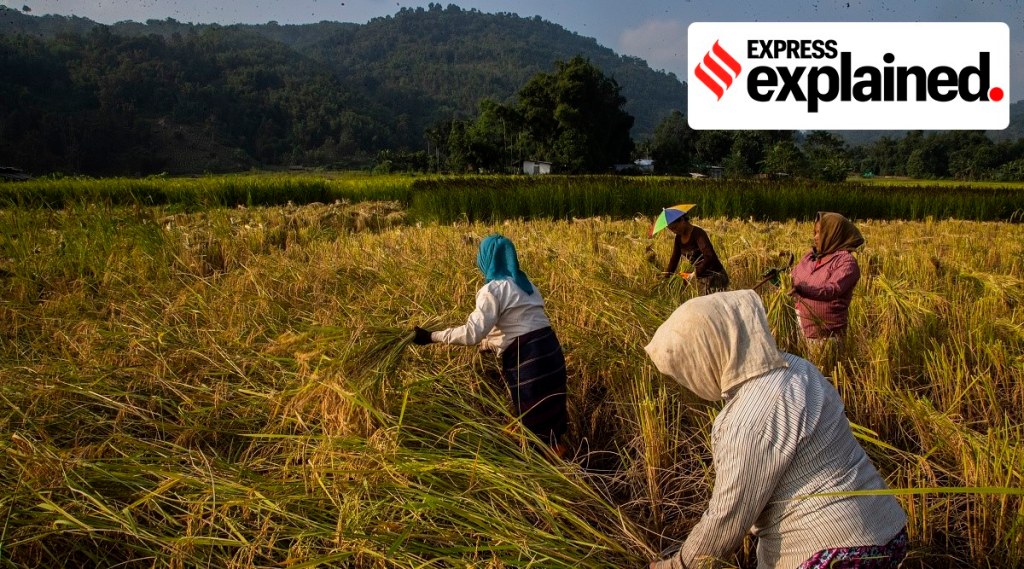 Ethnic Khasi women harvest paddy crop in Umwang village, along the Assam-Meghalaya state border. (AP)



 Share


