A committee constituted by the Ministry of Social Justice and Empowerment, which examined the income criteria for determining who are to be included among the Economically Weaker Sections (EWS), submitted its report recently. The government has accepted the report and filed an affidavit in the Supreme Court. The next hearing is on Thursday.

It followed the Supreme Court’s observation that the income criterion for determining EWS was “arbitrary”. The Supreme Court is hearing a number of petitions, including a special leave petition filed by the Centre against a Madras High Court order on EWS and OBC reservation in the all-India quota under the NEET entrance exam for postgraduate medical and dental admissions. On July 29 last year, the Centre had issued a notification for implementing 10% reservation for EWS along with 27% for OBC within these courses. Following the petitions, the Supreme Court has stayed counselling for admission until the matter is decided.
The NEET notification followed the same criteria for determining EWS as mentioned in a notification from the Department of Personnel and Training (DoPT) dated January 31, 2019. The criteria include a Rs 8 lakh income ceiling for inclusion in EWS — which is the same as the criterion for deciding the “creamy layer” among the OBCs (those who are not in government). The notification said income shall include income from all sources i.e. salary, agriculture, business, profession, etc for the financial year prior to the year of application. Another criterion is that a person whose family owns or possesses 5 acres of agricultural land or more will be excluded from EWS.
After the court raised questions, Solicitor General Tushar Mehta on November 25 submitted that the Centre would revisit the criteria. The committee was set up after that.
What has the panel recommended?
The committee’s 70-page report, which is now part of an affidavit filed by Social Justice and Empowerment Secretary R Subrahmanyam, says that the “threshold of Rs 8 lakh of annual family income, in the current situation, seems reasonable for determining EWS”. It recommends: “The current gross annual family income limit for EWS of Rs. 8.00 lakh or less may be retained.”
The committee has recommended, “EWS may, however exclude, irrespective of income, a person whose family has 5 acres of agricultural land and above.”
While it has retained this, the committee has removed criteria that excluded some categories from EWS: owners of residential properties of 1,000 sq ft and above; residential plots of 100 sq yards and above in notified municipalities; and residential plots of 200 sq yards and above in areas other than the notified municipalities. “The residential asset criteria may altogether be removed,” the committee said.
How does it address the questions raised by the Supreme Court?
On October 21, the Supreme Court had observed: “The income limit in the criteria for the determination of the creamy layer of the OBC category and the EWS category is the same, namely, Rs 8 lakhs. While the creamy layer in the OBC category is identified for excluding a section of the community that has ‘economically progressed’ to such an extent that the social backwardness of the community diminishes, the EWS category is identified to include the segment which is ‘poorer’ when compared to the rest of the community… In these circumstances, would it be arbitrary to provide the same income limit both for the OBC and EWS categories.”
The committee’s report now states “the two sets of criteria are significantly different despite both using the Rs 8 lakh cut-off and that the criteria for the EWS are much more stringent than those for the OBC creamy layer.” The report justifies this income limit, stating that “Rs 8 lakh cut off also has a link with the income tax exemption limit… It would, therefore, be logical to use the income tax exemption limit to determine the threshold for EWS.”
The Supreme Court had also questioned “on what basis has the asset exception been arrived at and was any exercise undertaken for that purpose; whether municipalities as required under the exception have been notified; The reason why the residential flat criterion does not differentiate between metropolitan and non-metropolitan areas.”
As mentioned earlier, the committee has retained the 5-acre criterion for exclusion from the EWS category, but done away with the residential assets criteria.
From when will the new criteria be implemented?
For ongoing admission processes, the existing criteria will continue. “The Committee… recommends that the existing and ongoing criteria in every on-going process where EWS reservation is available, be continued and the criteria recommended in this Report may be made applicable from next advertisement / admission cycle,” the report says.
Why was it set up?
“When the existing system is ongoing since 2019, no serious prejudice would be caused if it continues for this year as well. Changing the criteria midway is also bound to result in spate of litigations in various courts across the country by the people/persons whose eligibility would change suddenly.”
How has the EWS quota been implemented so far?
EWS reservation was granted based on the recommendations of a commission headed by Major General (retd) S R Sinho. The Commission for Economically Backward Classes was constituted by the then UPA government in 2005, and submitted its report in July 2010. To implement this, a Cabinet Note dated January 6, 2019 was prepared by the Ministry of Social Justice and Empowerment. Based on this, the Cabinet in January 2019 decided to amend the Constitution (103rd Amendment) to provide reservation to EWS.
With months to go for that year’s Lok Sabha polls, the government rushed the legislation through. The Bill was tabled and passed in Lok Sabha on January 8, 2019 and in Rajya Sabha the next day. Under the 2019 notification, persons not covered under reservation for SCs, STs and OBCs, and whose family has a gross annual income below Rs 8 lakh, among other criteria, are to be identified as EWS for benefits of reservation.
What happens now?
The Supreme Court will take a call, now that the government has accepted the committee’s report. While the government requested for an early hearing as counselling for NEET is held up, the matter is already listed to be heard on Thursday.
Newsletter | Click to get the day’s best explainers in your inbox

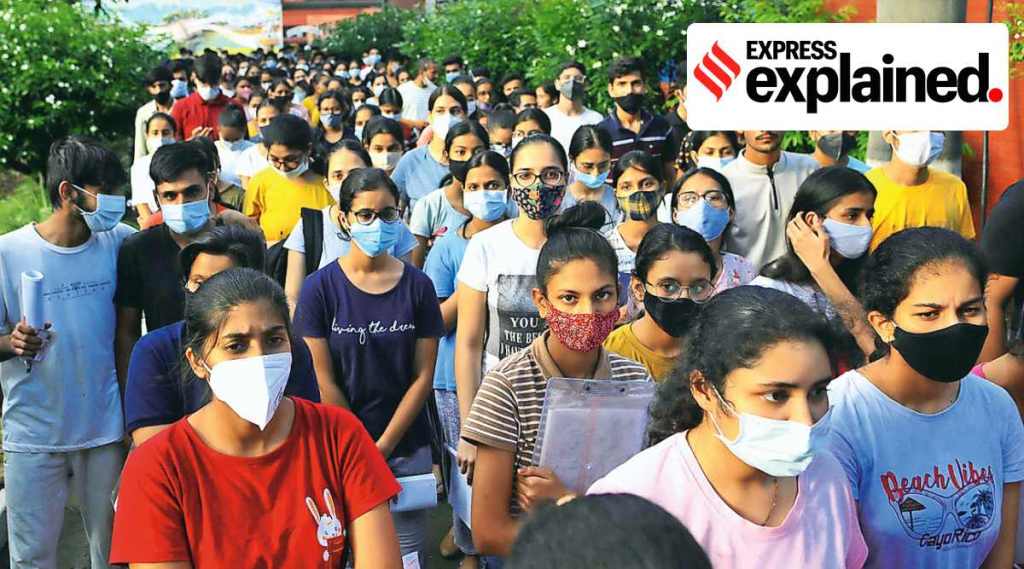 NEET candidates after the undergraduate entrance exam in Chandigarh last September. Counselling for postgraduate courses has been held up until the Supreme Court ruled on EWS. (Photo: Express Archive)




 Share


