
Few charges, fewer convictions: The Derek Chauvin trial and history of police violence
The New York Times reviewed dozens of cases in which encounters between Black people and police ended fatally. Though many cases prompted public outrage, that did not always translate to criminal indictments.
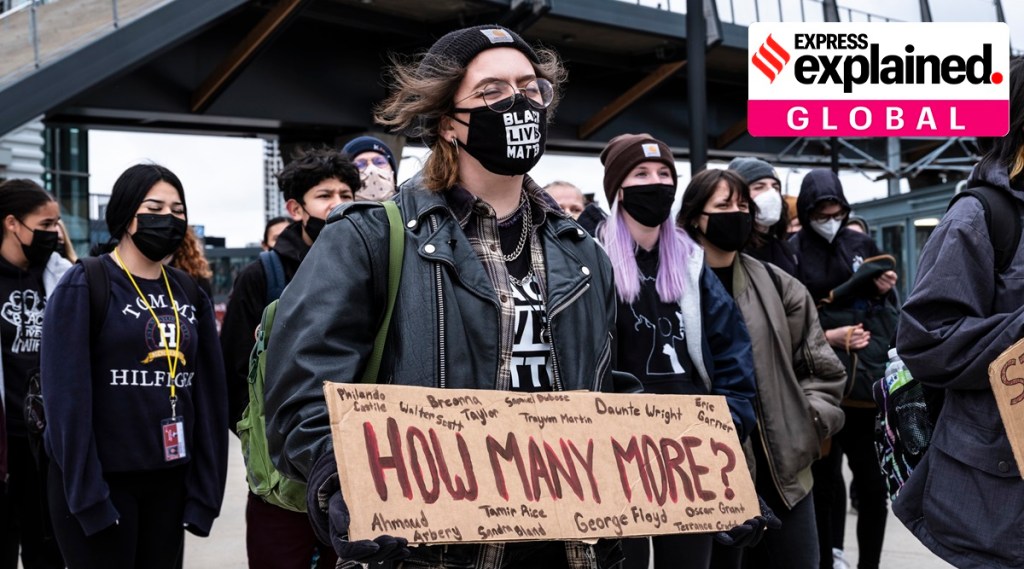 Roosevelt High School students protest in Minneapolis on April 19, 2021, as the Derek Chauvin trial hears closing arguments in the death of George Floyd while in police custody last year. (The New York Times: Joshua Rashaad McFadden)
Written by Aidan Gardiner and Rebecca Halleck
For many observers, the trial of Derek Chauvin, the former Minneapolis police officer charged in George Floyd’s death, has felt like the culmination of years of outrage and grief over police killings of Black people in America. Video of the arrest that led to Floyd’s death inspired demonstrations that touched every corner of the country last summer, with protesters demanding justice for Floyd.

Newsletter | Click to get the day’s best explainers in your inbox
The Times reviewed dozens of similar cases in which encounters between Black people and police ended fatally. Though many cases prompted public outrage, that did not always translate to criminal indictments. In some cases, police officers were shown to have responded lawfully. In others, charges were dropped or plea agreements were reached. Some have resulted in civil settlements. But very few have resulted in convictions at trial.
These cases offer valuable points of comparison about what issues — video evidence, drug use, whether the person who died was armed — proved decisive in each outcome and what consequences, if any, officers faced.
Even as the trial has unfolded, several events, including the killing of Daunte Wright just a few miles from Minneapolis, have provided a grim reminder that Floyd’s death is one in a decades-long history of fatal encounters.
Charges are rare
In many killings, the officers involved are never indicted, much less brought to trial, even when the victim was unarmed. Prosecutors charged Chauvin four days after his encounter with Floyd.
Eric Garner, Staten Island, New York, 2014
FATAL ENCOUNTER: Garner was standing outside a store when officers, who believed he was selling cigarettes illegally, confronted him. Officer Daniel Pantaleo wrapped his arm around Garner’s neck, forcing him to the ground as Garner told officers, “I can’t breathe.” Pantaleo testified to a grand jury that he had intended to use a maneuver he learned at the Police Academy and that he had tried to unhook himself when he heard Garner’s pleas.
OUTCOME: A grand jury ruled that there was not enough evidence to indict Pantaleo. Federal investigators also declined to bring charges.
Michael Brown, Ferguson, Missouri, 2014
FATAL ENCOUNTER: Michael Brown, 18, was shot and killed by a Ferguson police officer, Darren Wilson. Wilson originally testified that he had been responding to a report of a “stealing in progress” at a convenience store when he encountered Brown and another person walking in the street and tried to block their path with his car. A scuffle ensued, followed by a foot chase that ended when Wilson shot an unarmed Brown several times.
OUTCOME: A grand jury declined to indict Wilson. A separate U.S. Department of Justice investigation did not result in charges. More than five years later, a St. Louis County prosecutor reopened the case but ultimately decided not to prosecute Wilson.
 People celebrate after the jury found Derek Chauvin guilty of murdering George Floyd, in Minneapolis on Tuesday, April 20, 2021. (The New York Times: Amr Alfiky)
Tamir Rice, Cleveland, 2014
FATAL ENCOUNTER: Rice, 12, was playing with a toy gun in a park when he was shot and killed by Officer Timothy Loehmann. A 911 caller reported seeing a person with a gun but said that it was “probably fake” and that the person was “probably a juvenile.” Surveillance video showed that Loehmann had opened fire on Rice within two seconds of arriving on the scene.
OUTCOME: Local prosecutors never pressed charges against Loehmann or his partner, Frank Garmback. A federal investigation that languished under two administrations also ended without charges.
Stephon Clark, Sacramento, California, 2018
FATAL ENCOUNTER: Clark was in his grandmother’s backyard when Officers Terrence Mercadal and Jared Robinet, responding to a vandalism complaint, fatally shot him because they believed he was holding a gun. The police did not find any weapon but found a cellphone under his body.
OUTCOME: The officers believed that he was pointing a gun at them, according to the district attorney, who declined to charge them. State and federal prosecutors also declined to bring charges.
Breonna Taylor, Louisville, Kentucky, 2020
FATAL ENCOUNTER: Taylor was killed in her apartment during a botched raid by police officers who later said they had announced their presence, which most witnesses said they did not hear. When her door was broken down after midnight, her boyfriend shot at what he thought were intruders, striking one officer in the leg. In response, that officer and two others fired 32 shots toward the couple.
OUTCOME: Neither of the two officers who struck Taylor were indicted by a grand jury, which did indict a third officer on three counts of wanton endangerment for firing recklessly into her neighbor’s apartment. There is an FBI investigation into her death.
Trials avoided
Charging police officers with a crime in a fatal encounter does not guarantee that they will face a trial jury. Prosecutors may drop charges if they believe their case is weak or if they reach an agreement with the defendant to avoid trial. In fact, Chauvin initially agreed to go to prison for at least 10 years in a plea deal, but the deal was scuttled by the Justice Department.
Sandra Bland, Prairie View, Texas, 2015
FATAL ENCOUNTER: Bland was found hanged in her jail cell three days after a Texas state trooper, Brian T. Encinia, arrested her during a traffic stop. In an affidavit justifying the arrest, Encinia said he had removed Bland from the car so he could safely investigate it. A grand jury ruled that claim false and indicted him on a perjury charge.
OUTCOME: Prosecutors dropped the charge after Encinia agreed to end his career in law enforcement.
Freddie Gray, Baltimore, 2015
FATAL ENCOUNTER: Gray died after sustaining a severe spinal cord injury in a police transport van. He had been handcuffed but not secured with a seat belt. The state’s attorney charged the six officers involved. In four trials, defense lawyers raised doubts about the narrative laid out by the prosecution and argued that there wasn’t enough evidence to show that the officers had acted inappropriately.
OUTCOME: After failing to secure convictions at trials for the first four officers, the state’s attorney later dropped the charges against the others. Federal prosecutors also declined to charge them.
 A protester outside the Brooklyn Center Police Department in Brooklyn Center, Minn., on Monday, April 19, 2021, during a demonstration against the police shooting death of Daunte Wright during a traffic stop. (The New York Times: Amr Alfiky)
Video evidence
Videos captured by dashboard cameras, body-worn cameras and bystanders with cellphones have significantly changed the way police officers are prosecuted. In the Chauvin trial, the widely viewed bystander video was the central piece of evidence for the prosecution, whose experts analyzed it frame by frame.
Oscar Grant III, Oakland, California, 2009
FATAL ENCOUNTER: Grant was shot and killed by Officer Johannes Mehserle in Oakland, California. Dozens of bystanders watched and recorded as transit officers, who had been called to break up a fight, roughly detained several passengers. During the confusion, Mehserle fatally shot Grant in the back while he was being restrained by another officer. Mehserle would later say he meant to use his Taser, and not his gun, when he shot Grant — a claim disputed by prosecutors. Bystander videos led to citywide protests and provided critical angles not captured by surveillance video or police cameras.
OUTCOME: Mehserle was found guilty of involuntary manslaughter and sentenced to 11 months in prison in 2010. Last year, a district attorney said she would reopen the case, focusing on a different officer, Anthony Pirone, after a 2019 report showed that he had punched Grant in the face and used a racial slur.
Walter Scott, North Charleston, South Carolina, 2015
FATAL ENCOUNTER: During a traffic stop over a broken taillight, Scott left his vehicle and began running away. Officer Michael T. Slager shot and killed him, initially claiming that the two had scuffled over a Taser. But a bystander video showed Slager shooting an unarmed Scott in the back from 17 feet away and then planting his own Taser next to Scott’s body.
OUTCOME: Slager was tried on a murder charge in state court, but the jury was unable to decide whether he should be acquitted, convicted of murder or found guilty of voluntary manslaughter, and a mistrial was declared. Slager’s defense team later worked out a plea deal to settle all state and federal charges against him, but the plea agreement left it up to a judge to decide if Slager was guilty of second-degree murder or voluntary manslaughter. The judge ultimately found Slager guilty of second-degree murder and sentenced him to 20 years in prison.
Armed or not
Many investigations of police killings hinge on whether the person killed had been armed, or whether the officer had reason to believe he was armed, a judgment that officers say they have only a split second to make. That wasn’t a factor in the Chauvin trial — Floyd was unarmed, and there was never any contention that he had a weapon.
Sean Bell, Queens, New York, 2006
FATAL ENCOUNTER: Bell was with friends during his bachelor party the night before his wedding when detectives fired at the car they were in, killing Bell and wounding others. At trial, witnesses testified that they had heard a gun mentioned in an argument involving Bell. The detectives argued that they had believed they had to intervene to prevent a drive-by shooting. Investigators did not find any guns afterward.
OUTCOME: A judge acquitted the detectives involved, saying they had made a “fair and just decision” based on a reasonable fear that someone was armed. Federal prosecutors also declined to charge them.
Akai Gurley, Brooklyn, New York, 2014
FATAL ENCOUNTER: Gurley was unarmed and in the stairwell of a public housing complex when Officer Peter Liang entered it with his gun drawn. Liang’s gun went off, and the bullet ricocheted off a wall and struck Gurley, killing him. Liang said he had accidentally discharged his weapon. Prosecutors argued that Liang had been reckless in having his weapon drawn and that he had not done enough to save Gurley’s life.
OUTCOME: A jury convicted Liang of manslaughter.
Drug use
When drugs or alcohol are present, defense teams and police departments may cite them as a contributing cause of death or point to resulting erratic behavior as a justification for using deadly force. Chauvin’s lawyer, Eric J. Nelson, repeatedly asserted that Floyd’s death was caused by a combination of drug use and an underlying medical condition.
Terence Crutcher, Tulsa, Oklahoma, 2016
FATAL ENCOUNTER: Crutcher was standing in the street next to his SUV when the police approached him. He raised his hands but walked away from them, even after they told him to stop. Officer Betty Jo Shelby fired a single shot, fatally striking Crutcher in the chest. The police said Crutcher had been talking nonsensically and was not complying with officers’ demands. A vial of PCP was found in his vehicle, and an autopsy found that the drug was in his system at the time of his death.
OUTCOME: In her trial on manslaughter charges, Shelby testified that she had seen Crutcher reach into the SUV and that she had been trained to consider that a move to grab a weapon. A jury acquitted her.
Daniel Prude, Rochester, New York, 2020
FATAL ENCOUNTER: Prude was experiencing a psychotic episode when he ran out of his brother’s Rochester home. When officers arrived, they placed Prude, who was naked and high on PCP, in a “spit hood” and pinned him to the pavement for at least two minutes until he became unresponsive. Prude was taken to a hospital, where he died seven days later.
OUTCOME: Though the medical examiner ruled his death a homicide, a grand jury declined to indict any of the seven officers involved. The officers were suspended five months after Prude’s death.
 A demonstrator holds up a sign while protesting outside the Hennepin County Government Center in Minneapolis on Monday, April 19, 2021, where former police officer Derek Chauvin is on trial for the murder of George Floyd, a Black man, while in police custody last year. (The New York Times: Victor J. Blue)
Other officers’ testimony
Rebuking a fellow officer is rare. Police unions and top officials are often loath to speak out against one of their own. One of the most damning pieces of witness testimony against Chauvin came from the Minneapolis police chief, Medaria Arradondo, who said Chauvin had “absolutely” violated department policies on the use of force, de-escalation and the duty to render aid.
Laquan McDonald, Chicago, 2014
FATAL ENCOUNTER: McDonald, 17, was shot 16 times by Officer Jason Van Dyke. Van Dyke’s fellow officers initially backed his claim that McDonald, who was armed with a knife, had lunged menacingly toward police. The officers’ version of events was later disproved by dashboard camera video that showed McDonald had been walking away from officers when he was killed.
OUTCOME: Van Dyke was convicted of second-degree murder and sentenced to nearly seven years in prison. Three other officers were tried and acquitted on charges that they had conspired to protect Van Dyke. The case also prompted a federal investigation into to the Chicago Police Department that found that officers routinely violated civil rights and operated under a “code of silence” to protect one another.
Philando Castile, St. Anthony, Minnesota, 2016
FATAL ENCOUNTER: Castile was shot and killed by Officer Jeronimo Yanez during a traffic stop. During Yanez’s trial on charges of second-degree manslaughter and endangering safety by discharging a firearm, his defense relied heavily on the testimony of fellow officers, who argued that Yanez had reacted reasonably when Castile disclosed that he had a firearm in the vehicle.
OUTCOME: The St. Anthony police chief, Jon Mangseth, said Yanez’s actions were consistent with his department’s policies and training. Yanez was acquitted and cleared of all charges.
The heat of the moment
Courts have generally accepted the argument that the police need to make difficult, quick decisions while responding to perceived threats. In Chauvin’s trial, prosecutors argued that the defendant had ample time to change how he was subduing Floyd but did not, even after it was clear that Floyd had stopped moving.
John Crawford III, Beavercreek, Ohio, 2014
INCIDENT: Crawford picked up an unwrapped, unloaded air rifle while shopping at Walmart. Another shopper called 911 to report a suspicious man with a gun. Officer Sean Williams fatally shot Crawford in the store within seconds of seeing him holding the fake gun.
OUTCOME: The officers at the time believed they were responding to what could have turned into a mass shooting, the special prosecutor for the case said. A local grand jury declined to indict Williams in 2014. A federal grand jury did the same in 2017.
Sylville K. Smith, Milwaukee, 2016
FATAL ENCOUNTER: Smith was fatally shot about 12 seconds after the police confronted him and another man in a car about a suspected drug deal. The two men tried to run away. Smith tossed his gun over a fence and was trying to climb over it when Officer Dominique Heaggan-Brown shot him. The officer fired again once Smith had landed on the ground.
OUTCOME: Heaggan-Brown was charged with reckless homicide, but his defense argued that he had followed his training. A jury acquitted Heaggan-Brown in Smith’s killing, but he was later convicted on unrelated charges.
A deadlocked jury
Even when, as in the death of Floyd, much of the public views a killing as not justified and prosecutors believe they have strong evidence to prove that, the outcome is far from certain. Even when prosecutors sway some jurors, others may have remained unconvinced, which has led to mistrials. Prosecutors can sometimes secure convictions in subsequent trials.
Samuel DuBose, Cincinnati, 2015
FATAL ENCOUNTER: DuBose was driving without a front license plate when Raymond M. Tensing, a University of Cincinnati police officer, stopped him. As the officer questioned him, the car began to roll forward. Tensing shot DuBose in the head. The officer claimed that he felt that the car was dragging him and that he feared he would be run over.
OUTCOME: Jurors couldn’t agree that Tensing had intended to kill DuBose or that he had acted out of rage or passion, so the judge declared a mistrial. A jury deadlocked in a second trial, and prosecutors dropped the case.
Damon Grimes, Detroit, 2017
FATAL ENCOUNTER: Grimes, 15, was illegally riding an all-terrain vehicle when state troopers tried to stop him. As Grimes disregarded their orders and kept riding ahead, Trooper Mark Bessner shot Grimes with Taser darts from the passenger window, sending him careening into a parked truck. Grimes, who was unarmed, died shortly afterward.
OUTCOME: Bessner was charged with murder but testified that he had thought Grimes was reaching for a gun. The jury deadlocked; a second trial ended in his conviction on manslaughter charges.
 Share


