
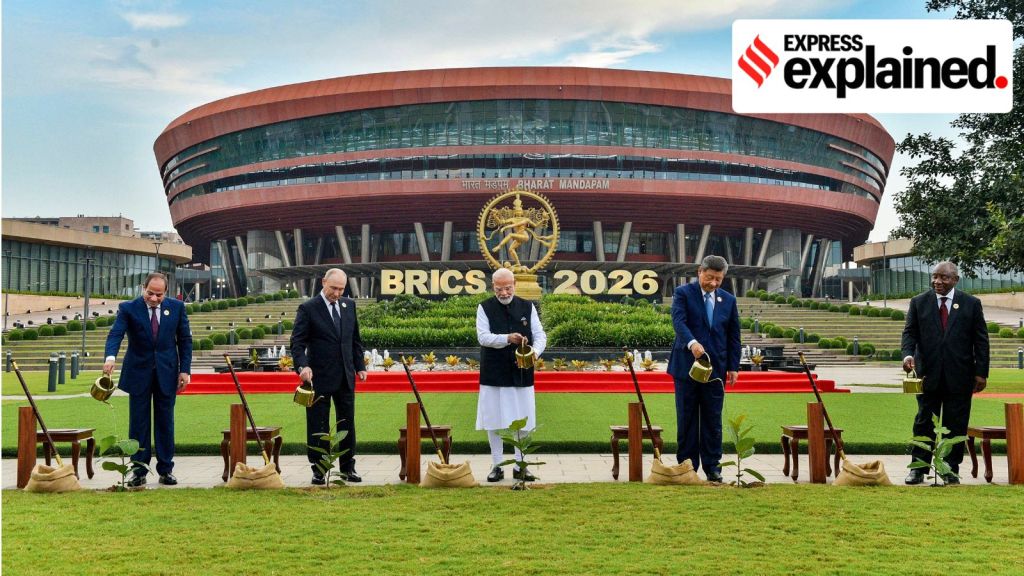
The BRICS grouping on Saturday (September 12) adopted the New Delhi Declaration, laying out common positions on issues ranging from trade and terrorism to artificial intelligence and institutional reform.
Set against the backdrop of tariffs, trade tensions, and geopolitical fragmentation, the grouping expressed its opposition to unilateral trade restrictions amid efforts to ease cross-border payments and investments across BRICS countries.

The declaration also contained several India-specific outcomes, from harsher language on cross-border terrorism to new cooperation mechanisms spanning digital public infrastructure, health and finance.
Reaching consensus was itself significant. BRICS foreign ministers had failed to issue a joint statement in May amid differences between Iran and the UAE, and diplomats had spent the run-up to the summit trying to find language on the conflict that both countries could accept. The final declaration reflects that balancing act, addressing the wars and tensions across West Asia without directly assigning responsibility to individual countries.
Here are the key takeaways.
1 – Pushback against unilateral tariffs and restrictive trade measures
Since early 2025, US President Donald Trump has announced a series of escalating tariffs against several US trading partners to extract concessions from them and correct a perceived imbalance — and “return” money — to the US.
The declaration expresses its condemnation of “unilateral coercive measures” which are contrary to international law and the United Nations Charter, and calls for their elimination.
While the BRICS declaration does not name the US president — who has famously attacked the grouping and called it “anti-American” — the grouping acknowledges its role as a collective affected by such “unjustified unilateral protectionist measures”. This language positions BRICS as a collective counterweight to the growing use of trade and financial restrictions by major Western economies.
“We acknowledge that BRICS members represent a broad diversity of societies and civilisations that are affected differently by unjustified unilateral protectionist measures inconsistent with WTO rules, and that BRICS should focus on promoting a just and fair, stable and predictable environment for mutually beneficial sustainable development,” the statement said.
The language stops short of announcing a retaliatory trade mechanism.
The declaration also addresses climate-linked trade policy, explicitly opposing carbon border adjustment mechanisms when they are unilateral, punitive, discriminatory or protectionist.
2 – Strong condemnation of terrorism, especially Pahalgam attack
The declaration expresses its commitment to combating terrorism in “all its forms and manifestations”.
In a diplomatic victory for India, the declaration specifically condemns in the “strongest terms” the April 2025 terrorist attack in Pahalgam in Jammu and Kashmir, in which 26 people were killed, and several others were injured.
The declaration also singles out the cross-border movement of terrorists, terrorism financing and safe havens, while expressing zero tolerance for terrorism and rejecting double standards in countering terrorism.
India has long sought international recognition of cross-border terrorism as a distinct security challenge. This language is particularly notable because BRICS operates by consensus and includes China, whose position on Pakistan-based terrorists at the UN has at times differed from India’s.
The declaration also reiterated that terrorism is not to be associated with any specific religion, nationality, civilisation, or ethnic group, and called for closer international counter-terrorism cooperation. In this light, it acknowledged the cooperation among member nations as part of the BRICS Counter-Terrorism Working Group (CTWG), the BRICS mechanism for coordinating counter-terrorism cooperation.
It identified extremism and radicalisation among the younger generations as a specific issue that needed to be addressed.
3 – Common ground on the war in West Asia
The presence of Iran and the United Arab Emirates, two sides that have found themselves on competing sides of the war in West Asia, raised concerns about finding a consensus.
Against this backdrop, the declaration expresses “deep concern” over the escalation of tensions across West Asia and calls for maximum restraint and the resolution of disputes through dialogue and diplomacy. Without assigning responsibility to individual countries, it condemns attacks on civilian infrastructure and safeguarded nuclear facilities, while stressing the importance of maintaining uninterrupted trade, supply chains and energy flows.
The declaration also expressed grave concern over the humanitarian situation in Gaza and the Occupied Palestinian Territory. It calls for maintaining the Gaza ceasefire and unhindered humanitarian access, and opposes forced displacement of Palestinians. It condemns all such violations of international human rights law, including the use of starvation as a method of warfare, attacks targeting civilians and civilian objects, including healthcare facilities and other civilian infrastructure, and the unlawful obstruction of humanitarian access.
The declaration affirmed its support for UNRWA (United Nations Relief and Works Agency for Palestine Refugees in the Near East) and noted the International Court of Justice’s provisional measures in South Africa’s case against Israel, which reaffirmed Israel’s legal obligation to ensure the provision of humanitarian aid in Gaza.
The declaration reiterated the group’s support for a two-state solution, with a Palestinian state within the 1967 borders, with East Jerusalem as its capital. It called on Israel to adhere to the Lebanon ceasefire and for Israeli withdrawal from remaining Lebanese territory, as well as an inclusive political transition in Syria.
4 – Local currencies, but no common BRICS currency
While speculation about a unified BRICS currency has been rife for years, the declaration steered clear of the subject.
Instead, BRICS continued to focus on a more incremental goal: making it easier for members to promote trade settlements and investments in their own currencies to achieve faster, cheaper and safer cross-border payments. The declaration acknowledged discussions on promoting the use of BRICS local currencies while respecting national priorities and recognising that there is “no one-size-fits-all approach”.
The declaration says that the BRICS Payment Task Force, a collaborative grouping of central bank experts from BRICS nations, has been studying how their payment and messaging systems could work more easily with one another. The stated aim is to make cross-border payments among BRICS countries faster, cheaper, more accessible and safer.
Separately, the declaration encouraged the New Development Bank to further expand local-currency financing, diversify its funding sources and mobilise resources for development and infrastructure projects.
BRICS will also continue technical work on its proposed New Investment Platform, with members backing a consensus-based, phased approach rather than announcing a new investment mechanism at the summit. Members also expressed interest in taking forward discussions on India’s proposal for a BRICS Risk Lab at the GIFT City International Financial Services Centre in Gujarat.
5 – A Global South position on AI
The declaration specifically addresses artificial intelligence as an economic and governance opportunity for the Global South. It broadly calls for wider access to AI resources while stressing safety, security, inclusiveness, reliability, energy efficiency and “trustworthy AI”, while emphasising the needs of the Global South.
It also congratulates India on hosting the AI Impact Summit in February 2026 and commits members to implementing the BRICS Leaders’ Statement on the Global Governance of Artificial Intelligence.
6 – The Indian imprint on the summit
The declaration contains several initiatives that India has prioritised as BRICS chair, particularly in digital infrastructure, health and development cooperation.
In digital public infrastructure, the declaration notes a proposal to create a BRICS repository for digital public infrastructure (DPI) and undertake pilot projects using DPI solutions across member countries.
Regarding health, the declaration backs the development of a BRICS Training Hub Network and a network of Centres of Excellence on mental well-being, with Bengaluru-based NIMHANS serving as the coordinating centre.
In industry, the declaration welcomed the establishment of an India Centre for BRICS Industrial Competencies to support manufacturing firms and small businesses in adopting Industry 4.0 – which accounts for the integration of technology and automation with manufacturing – and advanced digital technologies.
Among other India-led initiatives, BRICS welcomed a new Task Force on Growth and Development and the launch of a BRICS-New Development Bank Knowledge Portal to share policy experiences and lessons from development projects across member countries.

 Share


