
#BlackLivesMatter: ‘There has never been a reckoning for (American) policing’s slave-patrol origins’
Hiring more Blacks, Hispanics and women into law enforcement will certainly help, but it’s not the sole fix for systematic racism in policing. A more multi-pronged approach is needed.
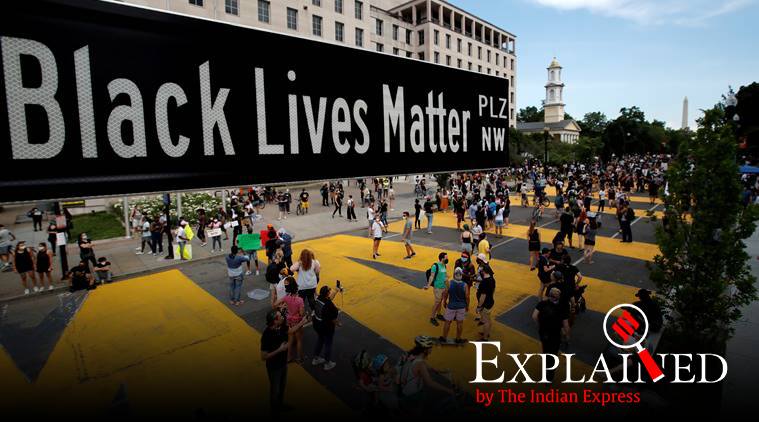 A street sign of Black Lives Matter Plaza is seen near St. John’s Episcopal Church, as the protests against the death in Minneapolis police custody of George Floyd continue, in Washington, U.S. (REUTERS)
Dr Connie Hasset-Walker is assistant professor of Justice Studies and Sociology at Norwich University. She was interviewed by Devyani Onial about the roots of US police atrocities against African-Americans, and the way ahead for America after the extraordinary events that followed the murder of George Floyd.
Police relations with the African American community have always been fraught. How much does it owe to the past? You have written about slave patrols. Can you please talk a bit about the violent roots of policing in the US and how systemic racism is?

I personally see the US history of slavery (about 250 years long) and then Jim Crow laws (about 80 years long) as very connected to what’s happening now. American policing is decentralised, meaning there’s no main headquarters that can set policy for all police departments throughout the country. To my knowledge, there has never been a reckoning for policing’s slave-patrol origins. By reckoning, I mean an admission that it happened and a deep commitment to purge that past from the present and start over.
It is also worth noting that not all American states were slave states. At the time of the American Civil War (1861-1865), there were only 34 states at the time (now there are 50); 15 of those 34 states were slave states. As the slave population grew in the slave states, there was concern among the white landowners, as well as the rest of those states’ population, that there could be slave revolts and escapes. (And there were.) So the states began to pass slave laws or codes. These facilitated the creation of the slave patrols, sometimes also known as paddy rollers. Members of the slave patrols were typically white men.
Their job was to capture escaping slaves and return them to the plantations/slave owners; as well as terrorise and discipline any slaves that slave owners said were misbehaving. Their tactics were brutal, similar to actions that plantation overseers would use. The Carolina Colony (which would later become North and South Carolina) was the first to create slave patrols in 1704; by 1837, South Carolina slave patrols had more than 100 members – larger than the police forces of some northern cities.
By the end of the 1700s, every American slave state had slave patrols. They lasted for about 150 years, ending with the South’s loss in the Civil War and the passage of the 13th Amendment to the US Constitution, which outlawed slavery.
After that, the former southern slave patrols morphed into police departments that technically were different from slave patrols, but were basically still charged with controlling the freed former slaves (Black people). About 30 years after the end of the Civil War, we start to see the passing of what are called Jim Crow laws. These laws basically kept segregation – separation of whites and blacks – in place legally until the late 1960s. A key factor in bringing Jim Crow to an end was the passage of the Civil Rights Act (1964).
So 150 years of slave patrols (in the southern states; in the northern states, policing evolved differently) and about 80 years of Jim Crow laws, all enforced by police – this is 230 years of structural racism and violence in policing versus only about 50 years of post-Jim Crow policing. I am of the opinion that people cannot just flip ‘off’ the switch and forget about structural racism, discrimination and violence. It takes generations to evolve beyond that, and a commitment to do so.
Cases of police atrocities by whites against African Americans and little police accountability have been recorded regularly over the past decades. How has this particular aspect affected race relations in the US? Has it kept the two communities wary of each other?
In a word, yes (e.g., the African American community are wary of police, more so in some communities than others). While George Floyd’s death as seen on widely available video (YouTube) is particularly terrible, there have been many others: Eric Garner, Mike Brown, Ahmaud Aubrey (recent), Breonna Taylor (recent), Walter Scott, Freddie Gray, Tamir Rice, and on and on and on. The difference nowadays, to me, is that everyone seems to have a smartphone and knows to pull it out and start video recording a citizen-police encounter once they see it; and then they upload it to their social media for the world to see.
If you know about the police beating of Rodney King back in Los Angeles, California, in 1991, Mr King was certainly not the first Black man to be beaten up by police, but it was the first time that someone video-recorded the beating. That video validated what many African Americans knew at that time – that Los Angeles police were very brutal towards Black people. The frequent lack of consequences in the justice system for police that beat up and sometimes kill African Americans – that was a leading cause of the start of the #Blacklivesmatter movement.
What is different about the murder of George Floyd is how quickly the police officer, Derek Chauvin, who kneeled on his neck, was charged with third-degree murder. (The charge has since been upgraded to second degree murder. The other officers who were present but did not intervene when Mr Floyd was killed have also been charged) Whether Mr Chauvin will ultimately be convicted… we’ll see. But the swift arrest and issuing of a charge – that’s important, and unusual.
The police are often highhanded with all minority groups, but would you say the bias is more stark against African Americans than, say, Hispanics or Asians?
I can’t say definitely against which race/ethnic group police bias is worse; it would depend on what data were being used and how bias was defined and measured. In general, there are disproportionately more arrests of Blacks and Hispanics (disproportionate to their size in the overall US population) than of whites. Asians tend to get arrested less frequently in the US.
A disproportionate number of African Americans are in American prisons. Could you talk a bit about that?
Arresting/policing and corrections are two different branches of the justice system. They’re related obviously, but there are differences. Much of the current disproportion of Blacks and people of colour in jails and prison – both men and women – stems from the “war on drugs” that was launched in America around the 1970s. Lots of get-tough-on-drugs laws were passed (e.g., three strikes laws, truth-in-sentencing laws).
Fast forward to 2020, most criminologists would agree that the “war on drugs” was basically a failure. It didn’t stop people from buying or using drugs, but it did put lots of people of colour, African Americans particularly, in prison. This has more to do with modern racial disparities stemming from the war on drugs than the country’s history of slavery and Jim Crow laws.
What reforms does the police need? Has anything been done in recent years, and what could be the road ahead? What would you say about police accountability?
There’s no quick fix for systemic racism in policing, but my suggestions would be:
* Acknowledgement that the origins of American policing (slave patrols, enforcers of Jim Crow laws) still echo today
* Agreement that there cannot be another murder like what happened to George Floyd
* Continued hiring of more officers of colour & women, including in supervisory positions
* Have officers live in the communities they police
* Consequences for bad behaviour (arrest, charging)
* Proper training emphasising techniques to use and not use force, when to stop using force (i.e., when a citizen is adequately subdued and no longer a threat)
* Police unions should take ownership of this issue
Is underrepresentation of African Americans in law enforcement agencies part of the problem? Is there any data on their representation? Is the proportion better for other minority groups?
This is not my area of expertise, but from what I understand the hiring of Blacks as well as other people of colour to police forces has improved over the decades. I am of the impression that there is a lack of representation of non-whites in supervisory law enforcement positions. Hiring more Blacks, Hispanics and women into law enforcement will certainly help, but it’s not the sole fix for systematic racism in policing. A more multi-pronged approach is needed.
📣 Express Explained is now on Telegram. Click here to join our channel (@ieexplained) and stay updated with the latest
Emmett Till’s murder and the acquittal of his killers in 1955 became a rallying point against racism and was seen as a catalyst for the next phase of the civil rights movement. The riots of the 1960s, the Rodney King riots, what are the instances you would say that became turning points in America and where would you locate the killing of George Floyd in this?
My sincere hope is that Mr Floyd’s murder – the sheer awfulness of it, how terrible his final moments must have been – is a catalyst to help bring about real change in police-citizen interactions and relationships. Sometimes in the wake of a terrible event, such as Martin Luther King’s assassination, change can happen. I hope that will happen this time, so that another murder like George Floyd’s will not happen again.
 Share


