
Growth gone rogue: Why Bengaluru’s Bellandur lake keeps catching fire
Smoke on the water, flames in the foam — The Indian Express describes the extraordinary harm chemical pollutants, thoughtless development, and a builder-politician nexus can do to lakes
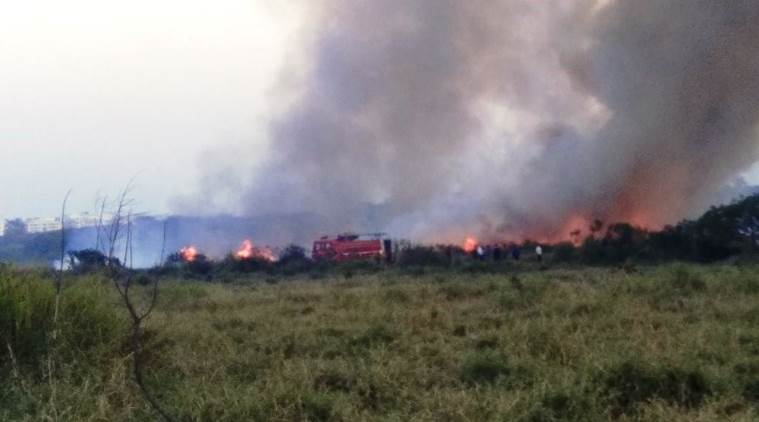 A major fire on Bellandur lake in Bengaluru, Karnataka, was brought under control after seven hours on Saturday (Source: Twitter/@adgpi)
The Lake
Bellandur Lake, spread over 906 acres in southeastern Bengaluru, is the city’s largest lake, and one of the only 70 that survive from the 272 of four decades ago. Until the Eighties, the lake was a vibrant ecosystem that nurtured a variety of birds, fish and insects, and a popular picnicking, boating and fishing site. Today, the lake, with a catchment area of nearly 279 sq km, is severely polluted. The dramatic growth of Bengaluru over the last two decades has led to massive amounts of domestic and industrial waste flowing into the lake. The encroachment of vast swathes of its catchment area by hundreds of apartment blocks, and the dumping of garbage on its shores, have throttled the flow of water into the lake and killed its biodiversity over time. The flow of untreated sewage and industrial waste has rendered the lake’s water unusable for even irrigation. Bellandur Lake is now infamous for the gigantic clouds of froth that accumulate on its surface, spilling over into the many busy roads that skirt its shores several times a year.
A study by the wetland research group at the Indian Institute of Science’s Centre for Ecological Sciences reported last year: “Land use analyses using temporal (1970s to 2016) remote sensing data show an increase in built-up area (paved surfaces, buildings, roads) from 5.4 per cent (1973) to 92.3 per cent (2016) with the decline in vegetation cover (58.0 per cent to 4.1 per cent), water bodies (4.3 per cent to 1.4 per cent) and other (open lands, agriculture) land uses (32.3 per cent to 2.1 per cent). Predication of likely land uses reveals that 94 per cent of the catchment would be concretised by 2020.”


The Fire
It is not clear how a nearly five-acre area of the lake bordering an Army property caught fire on January 19. The fire raged for over seven hours, and required some 5,000 Army and fire service personnel to extinguish. Police and the state Pollution Control Board suspect the blaze started after miscreants set on fire dry grass on the lakeshore. But experts like environmentalist A N Yellappa Reddy believe that the deadly chemicals and large amounts of methane in the lake may have resulted in an accidental or small fire spreading over a vast area.
Bellandur Lake has witnessed occasional fires on its surface in the past as well, for which scientists have blamed the pollutants in the water. “Discharge of untreated effluents (rich in hydrocarbons) with accidental fire (like throwing cigarettes, beedi) has led to the fire in the lake,” the IISc study said. “Incidence of foam catching fire are due to compounds with high flammability, i.e., mostly higher hydrocarbons and organic polymers from nearby industries…”
The largescale frothing on the lake’s surface has also been attributed to the inflow of phosphorus from detergents and personal cleaning products through domestic sewage. “High wind coupled with high intensity of rainfall leads to upwelling of sediments with the churning of water as it travels from higher elevation to lower elevation forming froth due to phosphorous,” the IISc study reported.
The Failure
One reason why the pollution-linked frothing on Bellandur Lake has continued for over three decades now, is the absence of any real accountability for the death of Bengaluru’s lakes. Civic agencies have failed to upgrade in step with the unplanned growth of the city, resulting in the unregulated flow of sewage and industrial pollutants into water bodies like Bellandur Lake. The political will to act has been lacking, as the builder-politician nexus has rendered agencies like the state PCB largely ineffectual over the decades.
Is it Unique?
Of the 200-odd lakes that Bengaluru has lost over the past four decades, the government itself has reclaimed several dozen — to create bus stands, sports stadiums, housing complexes, and for public sector organisations like ISRO to set up facilities. Real estate firms have also been major beneficiaries of land allotment on lakeshores.
While Bellandur is most frequently in the news for the froth it throws up and the fires that break out on its surface every year, it is only one among several similarly polluted lakes. Varthur Lake, the second major lake in the city, is in an almost equally bad state. Again, the Vrishabhavati River in the western part of Bengaluru is now recognised only as an open sewer; like the Bellandur Lake, this river was once a source of drinking water for the city.
Way Forward
The IISc study recommended a “ban on phosphorus use in detergents or regulation of detergents with phosphorus in the market” as one of the most important steps to stop the incidents of fire on the lake. It also recommended a decentralised treatment of sewage, enforcement of the “polluter pays principle” for industries dumping untreated waste, and protection of the catchment area from further deterioration due to real estate projects, garbage dumping and encroachments.
 Share


