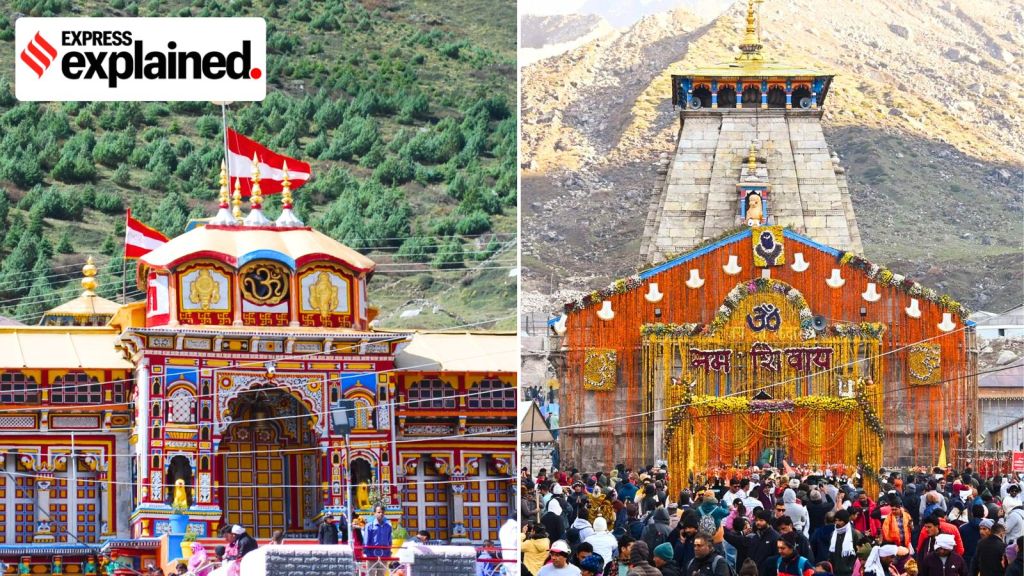
In recent days, the committee heads of the ‘Chota Char Dham’ shrines in Gangotri, Yamunotri, Kedarnath, and Badrinath in Uttarakhand have said that non-Hindus may soon be banned from entering the temple premises.
Last week, the head of the Badrinath-Kedarnath Temple Committee (BKTC), Hemant Dwivedi, cited the demands of local priests as the reason for the proposed change. The heads of the Gangotri and Yamunotri Dham committees said they will examine a similar proposal.
Questions have since been raised about how the decision may actually be instituted, as well as its constitutionality.
The United Provinces Shri Badrinath [and Kedarnath] Temples Act of 1939, later amended in 1948, bestows the duty of administration and governance of the temple and its funds upon the BKTC. The ownership of the temple funds is vested in the deity of Badrinath or Kedarnath, and the committee is entitled to their possession.
The committee was originally meant to comprise two people elected by the Hindu members of the Uttar Pradesh Legislative Assembly, and one person elected by the Hindu members of the UP Legislative Council (later the Uttarakhand Legislative Assembly after the state was formed).
Four other members were elected from the districts of Garhwal, Tehri Garhwal, Uttarkashi, and Chamoli by the Hindu members of their Zila Parishads.
Today, the state government also nominates the committee president and seven members. It can appoint any member of the committee as vice-president. In 2025, the government amended the Act to allow for two Vice-Presidents.
The committee will, in turn, appoint the Rawal or head priest of the Dham, and a Naib-Rawal or assistant priest. After consulting the committee president, the state government shall appoint a person possessing the prescribed qualifications as Mukhya Karyadhikari, who will be the chief executive officer of the committee.
Importantly, the state government can supersede the committee’s decisions. Although the committee can terminate a Rawal or Naib Rawal, they can appeal to the government. The state government also appoints an auditor for the temple accounts and endowments. The committee must also submit a report on the administration of temple affairs at such time as the government may prescribe.
The heads of the committees said they will deliberate on the motion to bar non-Hindus in the upcoming board meetings and with the government.
In 2019, Char Dham was at the centre of controversy after the then BJP government passed the Uttarakhand Char Dham Devasthanam Management Act, allowing the state government to take over the management of the four main temples and smaller temples under the committees. The Uttarakhand High Court upheld the move, but it was later scrapped amid opposition from right-wing Hindu groups.
And what is the bar on non-Hindus based on?
Dwivedi said that Articles 25 (right to freedom of religion) and 26 (freedom to manage religious affairs) of the Constitution protect their religious rights.
The Congress party claimed that if instituted, such a ban would also prevent the constitutional head of state, Governor Lt Gen Gurmit Singh, from visiting the temple. “Article 25 (2)(b) of the Constitution includes Sikhs, Buddhists and Jains under Hinduism,” Dwivedi said. “This is not a divisive move; anyone who respects and worships Baba Kedar, Badri, Maa Ganga, and Yamuna can visit the temples. We have spoken to the stakeholders of all 47 temples under the committee, and everyone is on board,” he added.
In a similar incident in January 2024, the Madurai Bench of the Madras High Court directed the state government, the Hindu Religious and Charitable Endowments Department and temple authorities to install boards at the entrances and prominent locations of temples (including the kodimaram or flagpole). These were to indicate that non-Hindus were not allowed beyond the kodimaram. It followed a petition by a man from Dindigul who owned a toy shop near the hillock where the Dhandayuthapani Swamy Temple is located.
The petition said that non-Hindus often treated temples like tourist spots, disrespecting the sanctity of the faith. It said non-Hindus consuming non-vegetarian food within temple premises and attempting prayers of other religions, raising concerns among Hindu devotees about the erosion of their religious spaces.
The Tamil Nadu government had argued that prohibiting entry to non-Hindus who believe in the deity could contravene their constitutional rights. However, the court countered that the state’s concern for the sentiments of non-Hindus overshadowed the need to protect Hindu religious practices.
Dr Kartikeya Hari Gupta, an advocate at the Uttarakhand High Court, argued that the proposed ban in Uttarakhand was unconstitutional. He reasoned that Article 19(1)(d) of the Constitution allows the right to move freely throughout the territory of India.
“The government can curtail freedom of movement only on two conditions: For the interests of the general public or the protection of the interests of scheduled tribes. The restrictions for the interests of the general public manifested as curbs during Covid-19, a health emergency. However, it cannot be for a community’s interests,” he said.
Challenging the committee’s arguments based on Article 25, he said that its application was not absolute, but conditional. “There is an essential religious practices doctrine test set by the Supreme Court. If any religious group wants to protect any religious activity, they have to prove it is essential to their religion, so much so that if you remove that practice, the person will stop belonging to the religion. The committees here will have to establish that prohibiting a Muslim from entering the shrines can make the temples essential for being a Hindu institution,” Gupta added.
Originating in the 1950s, the essential practices doctrine states that the practices and beliefs that a religious community considers integral are to be regarded as “essential” and protected under Article 25. In the 2018 Sabarimala temple case judgment, the majority opinion held that barring certain women from entering the temple owing to the celibate nature of Lord Ayyappa was not an essential religious practice, thus allowing them in the temple.
Before Char Dham, the idea of barring non-Hindus was also raised for the Har ki Pauri ghat in Haridwar, with religious leaders citing its religious significance to Hindus, and the Ardh Kumbh Mela in 2027. However, questions of practicality were raised given the high tourist footfall in Haridwar, which recorded 3.49 crore visitors in 2024, including foreign visitors.




 Share


