Because of the lack of a legislature, the people of the Union Territory found themselves under direct central administration. They also began to feel the loss of significant powers of autonomous councils, and the shortage of jobs after being delinked from Jammu and Kashmir’s recruitment boards.
There had been four MLAs from the region in the Jammu & Kashmir Assembly; the administration of the region is now completely in the hands of bureaucrats. To many in Ladakh, the government now looks even more distant than Srinagar.
Also, the changed domicile policy in Jammu and Kashmir has raised fears in the region about its own land, employment, demography and cultural identity.
Why does Ladakh want to be part of the Sixth Schedule?
Given that over 90% of Ladakh’s population belongs to the Scheduled Tribes, there has been a consistent demand to include the region under the Sixth Schedule. Ladakh’s Leh district, in particular, is dominated by Buddhists.
The Sixth Schedule under Article 244 of the Constitution provides for the formation of autonomous administrative regions called Autonomous District Councils (ADCs), which govern tribal-majority areas in certain northeastern states.
ADCs have up to 30 members with a term of five years and can make laws, rules and regulations on land, forest, water, agriculture, village councils, health, sanitation, village- and town-level policing, etc. Currently, there are 10 ADCs in the North East, with three each in Assam, Meghalaya and Mizoram, and one in Tripura.
Ladakh does have two Hill councils — the Ladakh Autonomous Hill Development Council (LAHDC) Leh and the LAHDC Kargil — but neither is under the Sixth Schedule. Their powers are limited to collection of some local taxes such as parking fees and allotment and use of land vested by the Centre.
Why was Sonam Wangchuk arrested?
Wangchuk is an engineer and innovator of sustainable products. He is best known as having inspired a character essayed by Aamir Khan in the 2009 Hindi film 3 Idiots.
In 2018, he was awarded the prestigious Ramon Magsaysay Award, in recognition of “his uniquely systematic, collaborative and community-driven reform of learning systems in remote northern India…”
In recent years, Wangchuk has flagged issues related to autonomy in the administration of Ladakh. In 2019, He wrote a letter to then-Union Tribal Affairs Minister Arjun Munda seeking Scheduled Area status for Ladakh under the Sixth Schedule of the Indian Constitution.
Wangchuk has maintained that protections under the Sixth Schedule were an election promise made by the BJP in 2019, and that the Government of India has to keep its word.
He was at the forefront of the 2025 protests seeking statehood and Sixth Schedule protections, and even went on a hunger strike.
But the Centre held him responsible for instigating the violent protests that broke out in Leh on September 24, in which four persons were killed in police firing and 50 were injured.
Previous protests in Ladakh
Last year was not the first time Ladakh saw protests over the demand for greater autonomy. Student-led protests in 2019 were supported by former MP Thupstan Chhewang, who then created the Leh Apex Body (ABL). Organisations in Kargil also came together to form the Kargil Democratic Alliance (KDA).
On March 6, 2024, two days after talks among the Union Ministry of Home Affairs, the ABL and KDA fizzled out, Wangchuk and others began a fast in Leh. He subsisted on water and salt and slept outdoors in sub-zero temperatures for 21 days.
Subsequently, a planned ‘Pashmina march’ to the China border was cancelled, with Wangchuk claiming the administration warned them of imposing prohibitory orders under Section 144 of the CrPC. The march was meant to highlight the issues faced by shepherds who have traditionally reared the famed Pashmina goats in Leh.
In September 2024, the ‘Delhi Chalo Padyatra’ was organised by the ABL, with a four-point agenda for the support of Ladakh’s statehood, extension of the Sixth Schedule, early recruitment process, as well as a public service commission for Ladakh and separate Lok Sabha seats for Leh and Kargil districts.
Can Ladakh be included under the Sixth Schedule?
In September 2019, the National Commission for Scheduled Tribes recommended the inclusion of Ladakh under the Sixth Schedule, noting that the new UT was predominantly tribal (more than 97%), people from other parts of the country had been restricted from purchasing or acquiring land there, and its distinct cultural heritage needed preservation.
Notably, no region outside the Northeast has been included in the Sixth Schedule. In fact, even in Manipur, which has predominantly tribal populations in some places, the autonomous councils are not included in the Sixth Schedule. Nagaland and Arunachal Pradesh, which are totally tribal, are also not in the Sixth Schedule.
“Ladakh’s inclusion in the Sixth Schedule would be difficult. The Constitution is very clear, Sixth Schedule is for the Northeast. For tribal areas in the rest of the country, there is the Fifth Schedule,” a Home Ministry official said.
However, it remains the prerogative of the government — it can, if it so decides, bring a Bill to amend the Constitution for this purpose.

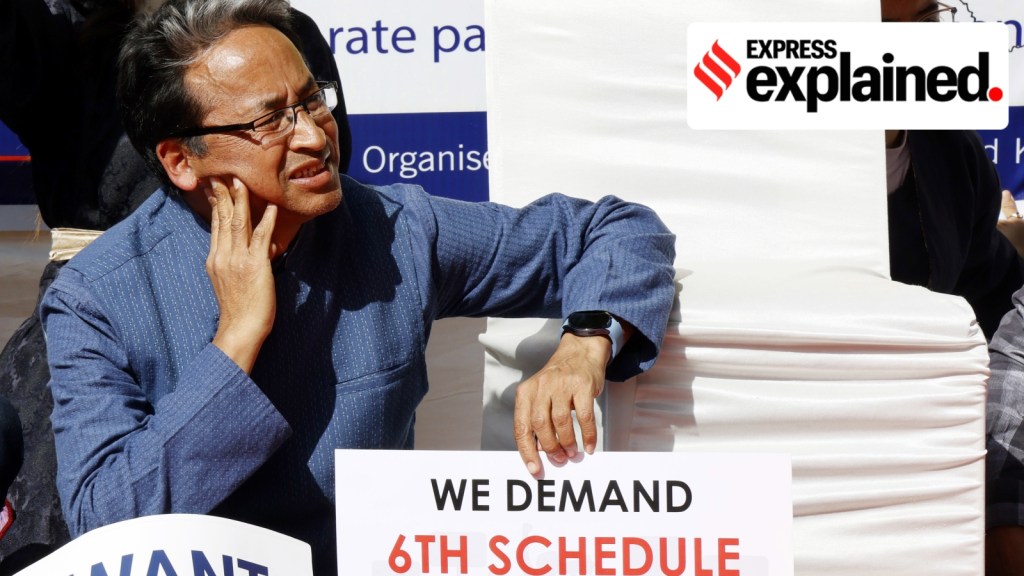 Activist Sonam Wangchuk during a protest in New Delhi. Prem Nath Pandey/File


 Share


