
Explained: How Supreme Court’s Sabarimala verdict differs with Ayodhya order
Sabarimala verdict: The majority of CJI Ranjan Gogoi and Justices Khanwilkar and Malhotra has held that the correctness of the essential practices test is to be examined by a larger Bench.
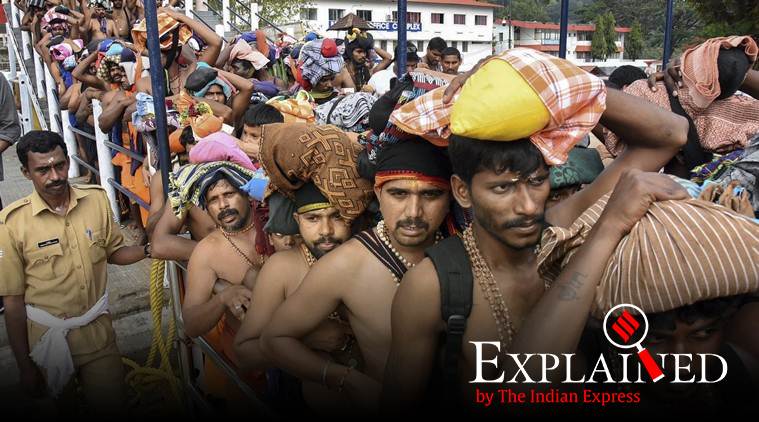 Devotees on their pilgrimage to Sabarimala temple. (File Photo)
In Adelaide Co. of Jehovah’s Witnesses Inc. v Commonwealth (1943), Australia’s High Court observed: “What is religion to one is superstition to another”. The Supreme Court has once again taken up the task of defining “essential religious practices”.
The Sabarimala review has been referred to a seven-judge Bench of the Supreme Court. The minority judges have correctly quoted the law on the limited scope of review to hold that neither has an error in the 2018 judgment been pointed out, nor has any new fact been discovered after the judgment. Those who are planning to seek a review of the court’s Babri judgment (November 9) must read the minority judgment in the Sabarimala review.

The two minority judges also disagreed with the Chief Justice of India on clubbing with the Sabarimala review the issues of female genital mutilation among Bohras, entry of women into mosques, and Parsi women married to non-Parsis visiting the Agyari. The minority judges are right — this case was limited to only the review of the Sabarimala judgment, and no arguments were heard on other issues.
The law and state cannot and should not tell us what is essential or non-essential in a religion. The judiciary is not supposed to take over the role of the clergy. It was only on Saturday that the court in the Babri judgment observed that it cannot scrutinise anyone’s religious beliefs. The Sabarimala reference order is inconsistent with the Babri judgment — the five judges in that case, while accepting the Hindu belief of the birth of Lord Ram at the disputed site, did not ask whether the belief about Lord Ram’s birth under the central dome of the Babri mosque was an essential practice of the Hindu religion. No one asked whether one could remain a Hindu despite not having such a belief.
The minority of Justices Nariman and Chandrachud, while rejecting the extreme plea of Sabarimala not being a Hindu temple as people of other faiths too worship there, have observed that a church remains a church despite people of different faiths visiting it. The primary reason to deny possession to the Sunni Waqf Board was its failure to prove that Muslims were exclusively praying in the inner courtyard of the Babri Masjid from 1528 to 1856. Going by Thursday’s order, even assuming that Muslims were not exclusively praying in the inner courtyard, and that sometimes Hindus too prayed there, ought not to have changed the character of the mosque.
Also read | Sabarimala majority ruling: Review pending, scope widened
 Justices D Y Chandrachud and R F Nariman (Illustration by Suvajit Dey)
***
Our Constitution combines the freedom of religion with a mandate to the state to intervene in religious affairs if social welfare so demands. The state does have the power to regulate secular activities associated with religious practice. The question is, how to decide whether an activity is religious or secular? This is important — because if it is religious, it cannot be regulated by the state.
In the Shirur Mutt (1954) case, the court held that “religion” in Article 25 covers all rituals and practices that are “integral” to a religion. It thus took upon itself the responsibility to determine what is integral or essential; and impliedly rejected the ‘assertion test’ of the United States under which a plaintiff could just assert that a particular practice was a religious practice, and courts would not probe any further.
This test of arriving at the definition of religion was called the essential practices test. But the exercise of determining essential practices of a religion took judges into a domain beyond their expertise. The majority of the CJI and Justices Khanwilkar and Malhotra in the Sabarimala reference has held that the correctness of this approach is to be examined by a larger Bench. However, the majority has also said that it’s the duty of the court to decide this issue in view of the obligations imposed upon it by the Constitution.
The essentiality test was crystallized in the temple entry case (1958). The court dealt with the question of whether untouchability, manifested in restrictions on temple entry, was an essential part of the Hindu religion. The court after examining select Hindu texts came to the conclusion that untouchability was not an essential Hindu practice. In the Sabarimala (2018) judgment, Justice Chandrachud said that ban on the entry of women in Sabarimala is a kind of untouchability, and thus violative of Article 17. Indeed, the temple was ‘purified’ after three women made a symbolic entry last year.
Also read | Sabarimala verdict: How majority view echoes dissent of 2018
Over the years, courts have been inconsistent in their application of the essentiality doctrine. Consider:
* In Gram Sabha Battis Shirala (2014), a particular sect claimed that capturing and worshipping a live cobra on Nag Panchami is an essential part of their religion. They placed reliance on the Shrinath Lilamrut; however, the Bombay High Court relied on the more general Dharmashastra text to reject their contention, without dealing with the question that the specific religious text of the villagers prescribed such a practice. In Sabarimala, the court overlooked the particular practice of Ayyappa devotees and relied on the general Hindu practice, refusing to recognise them as a separate Hindu sect.
* When a Muslim police officer challenged in Kerala High Court a regulation that did not permit him to grow a beard, the court rejected the plea by simply relying on the fact that certain Muslim dignitaries did not sport beards, and that the petitioner did not have a beard in his previous years of service. The court looked at empirical evidence of the practice, rather than at religious texts. However, despite empirical evidence to the contrary, courts have refused protection to animal sacrifice among Hindus, terming the practice as barbaric.
* In the Tandava dance case, the apex court relied on the doctrine of precedent to hold that tandava dance was not an essential practice of the Ananda Marga faith. It also said that the faith had come into existence in 1955, while the tandava was adopted only in 1966 — therefore, as the faith had existed without the practice, the practice could not be accepted as an essential feature of the faith. This was a strange argument that suggested that to be essential, religious practices must remain frozen in time, with no evolution.
* In Ismail Faruqui (1994), the Supreme Court dealt with the issue of the state acquiring the land over which the Babri Masjid had stood. Instead of settling the question in favour of the Centre on the principle of eminent domain, the court went into the question of whether praying in a mosque is an essential practice in Islam — and ruled that while praying is an essential practice, the offering of such prayers in a mosque is not, unless the place has a particular religious significance in itself.
It is well known that congregational prayer is central to Islam and that mosques are essential means to achieve this objective. In 2018, the court rejected a plea to review this absurd judgment. However, in the case of Sabarimala, it has agreed that the essentiality test does require a review.
***
 Chief Justice of India Ranjan Gogoi (centre) with Justice A M Khanwilkar (left) and Justice Indu Malhotra (right). (Illustration by Suvajit Dey)
The Supreme Court has itself acknowledged that “every person has a fundamental right to entertain such religious beliefs as may be approved by his judgment or conscience”. Thus, it is an individual right not a group right. The essential practices test is antithetical to the individualistic conception of rights. Under the test, the court privileges certain religious practices over others, when it does not have the expertise to decide which practice/ritual of a religion is essential/non-essential. These are purely theological questions.
The cases above suggest that the judiciary has styled itself as a reformer of religions with its own idea of rationality and morality. The Supreme Court’s insistence on applying the essential practices test strikes at the very foundation of religious freedom in India. Practices of Hinduism (and its denominations) have been targeted by reformist judges who consider them to be based on superstition, while practices central to Islam have been targeted either because of the sentiments of the majority community or due to misplaced understanding of Islamic practices.
The concept of providing constitutional protection only to those elements of religion, which courts consider “essential” is problematic. Such an approach assumes that one element or practice of religion is independent of the others; also that while some practices are central to a religion, others are merely incidental.
Prof Faizan Mustafa is Vice-Chancellor of NALSAR University of Law, and an expert of constitutional law.
 Share


