Addressing a gathering to mark the 100th foundation day of the Shiromani Gurudwara Parbandhak Committee (SGPC) on November 17, Akal Takht Jathedar Giani Harpreet Singh called the body the mother of the Shiromani Akali Dal. Not a surprise considering that the body has often been accused to being the “under the shadow of Shiromani Akali Dal (SAD)”. Here is a look at its tumultuous journey of the SGPC, once considered a strong political power in the state.
The sudden rise in the activities of Christian missionaries and Arya Samaj after the annexation of Punjab by the British led to the Singh Sabha movement among Sikhs to stop what was then termed the ‘degradation of Sikh thought and principles’ in daily life. The foundation of Khalsa College in Amritsar in 1892 was an amalgamation of this activism.
But the control of the Golden Temple and gurdwaras continued to be in the hands of ‘mahants’ (priests) who enjoyed the tacit support of the British government. These ‘mahants’ often treated the gurdwaras as their personal fiefdoms and encouraged practices such as idol worship and discriminated against Dalits, both in violation of the tenets of Sikhism.
After much discussion among the thought leaders of the community, a big gathering was called at Jallianwala Bagh on October 12, 1920 to restore the rights of Dalit Sikhs to offer parshad at the Golden Temple. Soon, the assembled people moved to Golden Temple and removed the mahants who had little mass support.
A 25-member committee dominated by Dalit Sikhs was formed on the same day. This committee encouraged the community members to get organised and finally led to the formation of a 175-member body called Shiromani Gurudwara Parbandhak Committee (SGPC) on November 15, 1920.
Interestingly, two days earlier, the British government had set up its own committee consisting of 36 Sikhs to manage the Golden Temple. The SGPC included members of the British committee as well. The first SGPC meeting was held at the Akal Takht on December 12, 1920.
The SGPC is headquartered at Teja Singh Samundri Hall, in Sri Harmandir Sahib Complex.
Relationship between the SGPC and Shiromani Akali Dal
The Akali Dal was formed on December 14, 1920 as a task force of the Shiromani Gurudwara Parbandhak Committee. With the SGPC, the community managed to soon take control of many gurdwaras though at the cost of many lives as the mahants resisted this drive.
Their efforts were applauded by Indian National Congress which passed a resolution at its annual assembly held at Gaya in December 1921 which read, “It is a matter of pride and appreciation that Akalis displayed unprecedented bravery in non-violent movement for the goodwill of whole community.”
The British government finally passed the Gurudwaras Act in 1925, making SGPC a democratic body.
At least 500 Sikhs sacrificed their lives, and 4,000 were arrested during the five-year movement that made SGPC the legal body of Sikhs to manage gurdwara affairs. The movement also strengthened the Shiromani Akali Dal as a political party.
As strange as it may sound, the SAD passed a resolution on September 30, 1956, in which it agreed that ‘it will not have any separate political agenda’. “SAD will protect religious, academic, cultural, social and economic concerns of the panth,” reads the resolution which also emphasised that SGPC functioning and religious affairs were more important than the Akali political agenda. After this meeting, SAD announced recruitment of 2 lakh Akali workers into the Congress party. However, it couldn’t happen as the relationship between Congress and Akali leaders was short lived.
Don’t miss from Explained | With trains suspended, what happens if Punjab fields don’t get urea on time?
SGPC elections and Punjab politics
Before the formation of Punjabi Suba in 1966, the democratically elected SGPC had great sway over the political agenda of Shiromani Akali Dal in Punjab politics. The defeat of Master Tara Singh in the SGPC president’s elections in 1958 was decoded as the defeat of Punjabi Suba movement.
Then, in January 1960, the Shiromani Akali Dal was pitched against Congress supported ‘Sadh Sangat Board’ and Left leaning Desh Bhagat Party, in the SGPC elections. In fact, the Left leaning SGPC members had played a pivotal role in the removal of Master Tara Singh from the president’s post in 1958. It was alleged that then Punjab chief minister Partap Singh Kairon had used his influence to remove Master Tara Singh.
It was also the reason that the performance of Shiromani Akali Dal in the SGPC elections of 1960 was considered a referendum on the Punjabi Suba movement. SAD won 132 out of the 139 SGPC seats with a big majority and on January 24, 1960, Master Tara Singh hailed this as a referendum in favour of Punjabi Suba movement.
By 1965, there were two factions of the SGPC, under Master Tara Singh and Sant Fateh Singh. In the elections that year, Sant Fateh Singh won with a thumping majority. Around six months later, Master Tara Singh decided to unite both the factions.
SAD’s dominance over SGPC
SAD had won the 1979 SGPC elections in which the hardliner Damdami Taksal and Dal Khlasa also contested unsuccessfully. This was followed by 1984 Operation Blue Star and militancy. The troubled period allowed Gurcharan Singh Tohra to become the longest serving president of SGPC. Tohra served as its chief for 26 years. The next SGPC elections were held in 1996 and it was followed by the formation of SAD government in the state in alliance with Bhartiya Janata Party in 1997.
This also started a new era where the appointment of SGPC president came to be decided by the party high command. The SAD high command allowed Avtar Singh Makkar, who was almost unknown in Akali politics, to become SGPC president in 2005 and he remained on the post for 11 years. Incumbent president Gobind Singh Longowal was also appointed by the party high command despite his limited experience with SGPC. 📣 Click to follow Express Explained on Telegram
The present crisis
There have been no SGPC elections for the last nine years and the leadership has failed to act on the report about the 328 missing copies of Guru Granth Sahib, arguably the biggest issue to grip the body in recent times. This is why there have been unprecedented protests outside the SGPC office in Amritsar.

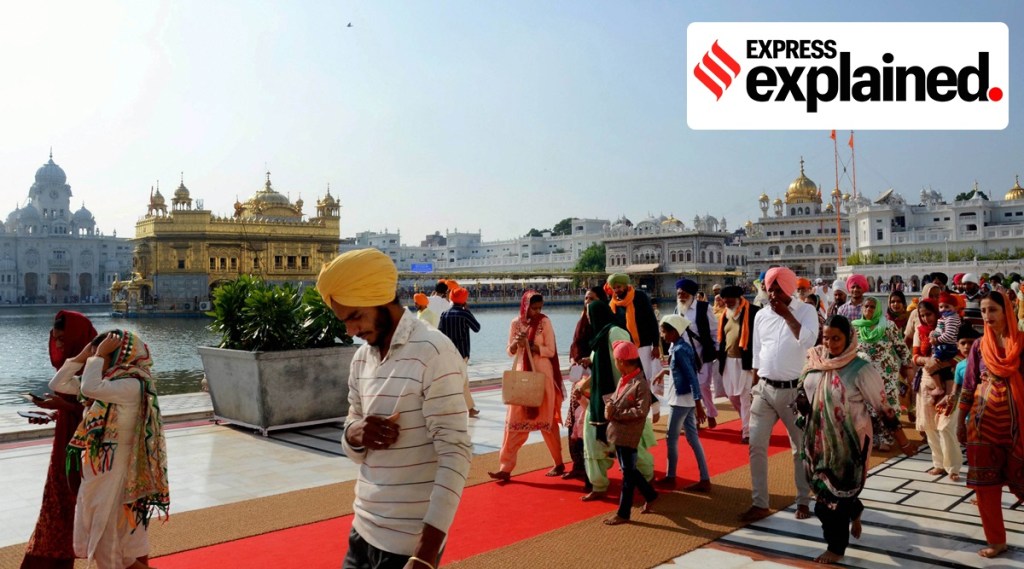 Sikh devotees offer prayers at the Golden Temple in Amritsar, Tuesday, Nov. 17, 2020, when Shiromani Gurdwara Parbandhak Committee (SGPC) celebrated its 100th foundation day. (PTI Photo)


 Share


