


Click here to follow Screen Digital on YouTube and stay updated with the latest from the world of cinema.
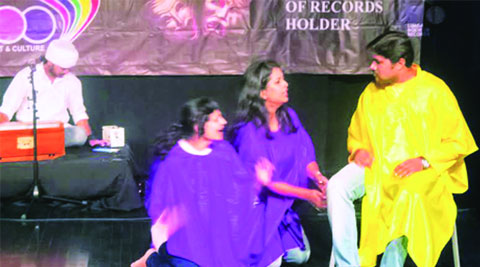 A scene from the play Antarang
How conscious is one of religion? Is it not during religious festivals and conflicts that one is aware of the religious alignments the most? These were a couple of questions that director-playwright Amey Pangarkar was toying with early last year, which formed the spine of his satire Antarang, his maiden play with his production company, Hridgandha Studios.
Antarang was immediately spotted as a play of immense cultural significance and selected as India’s only entry by Akhil Bharatiya Sansrutik Sangh to its Third Global Cultural Olympiad of Performing Arts in Dubai last December, where it won in the Open Drama category. Antarang was staged for the first time in Pune at Bharat Natya Mandir. Its staging was preceded by that of Nautanki, a play also written by Pangarkar, which competes at this year’s Global Cultural Olympiad in Malaysia, with two other entries from India and several others from over 14 countries.
Pangarkar, 24, says he wrote Antarang as a reaction to the “religious chaos in contemporary society”. “I was born a Hindu, but I do not visit the temple everyday or pray regularly. I don’t even wear religious symbols. The only time in the year when I’m aware of my religion is during Ganeshotsav, perhaps,” says Pangarkar, adding, “Antarang is based on such people, who aren’t obsessed with religion but participate in its cultural aspects.”
In Antarang, Pangarkar creates the mythical town of Janakpuri, which has people of three major religions cohabiting, symbolised by the colours black, yellow and purple. In this secular state, they are allowed to practise their faiths freely and all is merry until the king passes a decree to bring all three under a single colour.
“That is when they are made conscious of their respective religions. All kinds of atrocities ensue — riots, abductions and rape. The matter is aggravated by the rangpramukhs (heads of religions), who provoke their kin,” says Pangarkar, who decided to render the play in street-theatre style.
The theme, he believes, pertains to the common man. His style, he says, is “experimental”. “The production is played out by 11 actors, six dancers and two singers,” says Pangarkar. “A lot of communication happens through live original music, choreography and shadow play. The choreography comprises of kathak, Bharatnatyam and contemporary, which in the play are peculiar to the three colours, respectively,” he adds.
Pangarkar recalls being asked by the Olympiad jury about his take on Indian culture. His answer forms the moral of Antarang. “All of us, irrespective of religion, share a common ancestor. We are the same people divided by religion. I also doubt whether those who commit heinous acts in the name of religion even know what lies at its core. In most cases, they are manipulated by those seated at the top,” he believes.
The play, therefore, ends with a long monologue by a fakir, who doesn’t relate to any religion. Towards the end of the play, the warring colours, having fought over everything else, fight over the fakir, who, says Pangarkar, symbolises the common man who generally loses out in such situations.