6 min read


Click here to follow Screen Digital on YouTube and stay updated with the latest from the world of cinema.
© IE Online Media Services Pvt Ltd



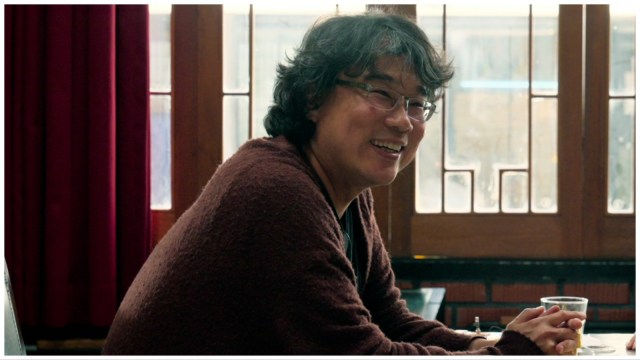 Bong Joon-ho in a still from Yellow Door. (Photo: Netflix)
 There are people out there to this day that can demonstrably claim to have had their wedding videos directed by Bong Joon-ho in the early 1990s; those whose 60th birthday parties he shot, however, are probably not around anymore. The new Netflix documentary Yellow Door: ‘90s Lo-fi Film Club takes a bittersweet look at the filmmaker’s origins, focusing on a ephemeral moment in time when he joined a collective of like-minded people and harnessed his passion for movies.
Part street gang, part Dumbledore’s Army, the Yellow Door film club grew to include around 30 young men and women, many of whom are featured in the documentary, directed by former member Lee Hyuk-rae. Some of them appear on Zoom screens, others are filmed in magic hour at their respective places of work. Director Bong is a near-constant presence, wistfully looking back at the good old days, when he’d scrounge around for bootlegged VHS tapes on the streets, and cradle his pricey new Hitachi camera like a father holding his newborn child.
He wasn’t ‘Director Bong’ then, and indeed, for many of his former cohorts, he was, and remains, ‘Joon-ho’. Yellow Door also unearths his first-ever film, a stop-motion short about a gorilla who escapes his basement home and goes on a quest, Looking for Paradise. The film was screened publicly only once, in December of 1992, at a screening attended mostly by the members of the Yellow Door club. Many of them loved it, several others thought it was nonsense, but didn’t have the courage to say this to Bong. Perhaps they sensed that he was going to make it, and didn’t want to stop him in his tracks. What a tragedy that would’ve been.
The Yellow Door club was founded by the filmmaker Choi Jong-tae, who had become disillusioned by all the theory that was being taught to him at film school, where students were allowed to gawk at a 16mm Arriflex camera, but not allowed to use it. And for many years, that’s what the members of the Yellow Door club did as well. A bunch of misfits and outcasts, they’d meet with religious regularity in a nondescript second floor facility in Seoul that came to become their church. There, they’d dissect cinema from across the world. Many of them, including Bong, sheepishly admit in the film that they had no idea what they were talking about. But those were the days.
“People who were like liquid came together and had dreams like gas,” a former member says poetically, recalling how they’d collect, catalogue, and sometimes even pirate VHS copies of everything from Francis Ford Coppola’s The Conversation to Robert Weine’s The Cabinet of Dr Caligari. Bong was given the task of printing out tags for each VHS that the club owned. It’s one of his core memories. But years removed from those heady times, the members of the Yellow Door film club frequently misremember details of the many activities they participated in — in a particularly humorous exchange, Bong swears that he never transcribed the entirety of a film theory book from English to Korean, even though others could swear that he did.
Part of the joy of watching this film, more than the historical insight that it provides, is to see a group of old friends reconnect over shared memories. For many of them, including Bong himself, the days and nights they spent in that second floor facility remains the best time of their lives. But as the very idea of local community disappeared, so did the Yellow Door film club. These young men and women were fortunate to have found each other, and to have had the opportunity to channel their angst into storytelling and cinema. Imagine if they’d never mustered up the courage to ignore conventional academics; the world would have been poorer for it. Because decades before Bong won four Oscars in one night for Parasite, he helped shape the world’s perception of his country’s cinema.
The club played a massive role in empowering a generation that would go on to create one of the most influential film movements in history, right up there with German Expressionism and the French New Wave. The work of directors Bong, Park Chan-wook, Kim Ki-duk, Lee Chang-dong, Kim Jee-woon has impacted everyone from Quentin Tarantino to the New-Gen directors of Kerala. And regardless of which side of the aisle you stand on, it’s difficult to erase the direct line between this movement and the utter global domination that Korean culture has staged in the last decade or so.
Thankfully, Yellow Door’s reach doesn’t exceed its grasp; at no point does someone draw a connection between the goings-on in that second-floor apartment to, say, Innisfree. Instead, it doubles as a coming-of-age story, effectively capturing the shared idealism that drew these film fanatics towards each other. But it also holds onto its melancholic whimsy. As one past member reflects while talking about Bong, “I knew he’d make it… but not this big.”
Yellow Door: ’90s Lo-fi Film Club
Director – Lee Hyuk-rae
Rating – 4/5
Click here to follow Screen Digital on YouTube and stay updated with the latest from the world of cinema.