


Click here to follow Screen Digital on YouTube and stay updated with the latest from the world of cinema.
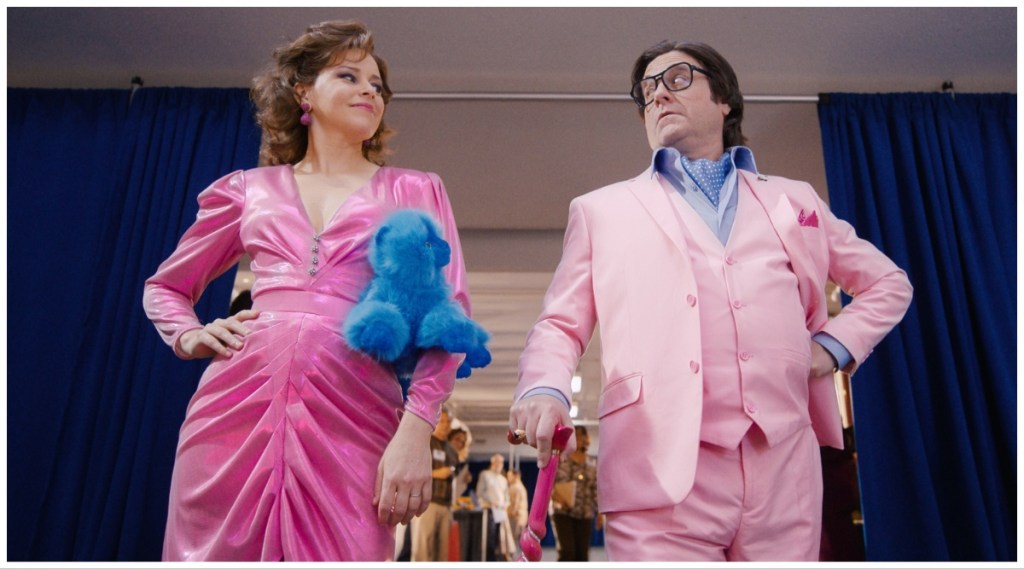 Elizabeth Banks and Zach Galifianakis in a still from The Beanie Bubble. (Photo: Apple TV+)


Commerce and coercion collide in Apple’s The Beanie Bubble, a tonally inconsistent new movie that is simultaneously timely, and also shockingly shallow. Based on the Beanie Baby craze that swept America in the early 1990s, the film tells the admittedly intriguing story of the toy magnate Ty Warner, but loses sight of its target after being struck by an unnecessary bout of virtue signalling.
“I like having the power to shape myself,” says the perpetually creepy man-child Ty, as he justifies his obsession with plastic surgery. This happens only some scenes after he has fat-shamed a prospective customer. If you didn’t know any better, you’d think that Ty consulted on the script, which bends over backward to avoid skewering him (and being slammed with a lawsuit). Directed by Kristin Gore (daughter of Al Gore) and Damian Kulash (her husband, the lead singer of OK Go), the movie could’ve easily highlighted the creepier side to his personality, but chooses instead to portray him, less controversially, only as a babbling fool. Played by Zach Galifianakis, Ty, at the height of his success, was worth billions of dollars. He still is. But the film suggests that he was a mostly clueless, chocolate milk-guzzling middle-aged man who succeeded only because he had the good fortune of being surrounded by three resourceful women.
He dated two of them simultaneously — the women didn’t know, of course — and the third, he exploited financially for over a decade. By the time the movie reveals its cards, you’re so completely checked out that you don’t even feel obliged to award it brownie points for at least being on the right side of morality. Elizabeth Banks and Sarah Snook play Robbie and Sheila, the two women he gets romantically — and in the case of Robbie, also professionally — involved with. Geraldine Viswanathan plays the young Maya, who aggravates her Indian parents greatly when she decides to drop out of med school to join Ty in his plush toys business and literally invent the concept of e-commerce.
It is Maya who discovers that the toys have organically developed a cult of fans on online message boards in the earliest days of the internet. What we see next, in a frustratingly disjointed manner, are the market economics that create bubbles similar to what we’re witnessing currently with sneaker culture, or Bitcoin. But the movie doesn’t ever feel current. It fails both as a character study of a megalomaniac, and also as a satire of the times.
A large part of that is down to Gore’s script, which goes back and forth between 1983, when Ty and Robbie were making their first moves in the toy industry, and 1993, when more than half the country owned at least one Beanie Baby, often purchased for obnoxiously inflated prices. While Ty is initially outraged that his toys are being sold under the table for thousands upon thousands of dollars, Maya convinces him that in the long run, the perception of exclusivity would do wonders for their business. A similar strategy, you might recall, encouraged Aryan Khan to become an entrepreneur and made Michael Jordan a billionaire.
That second bit was left out of the recent Air, which smartly adopted the language of sports movies to avoid seeming like a shill for shoes. This year, we’ve seen several films that have attempted, in pleasingly different ways, to address America’s infatuation with consumerism. While Air is easily the best of the lot, the recent Flamin’ Hot skirted around the pro-capitalism complaints by convincing everybody that it was an immigrant tale. Apple’s own Tetris made top use of its Cold War era setting to tell a mostly enjoyable tale of corporate espionage, while the Canadian indie BlackBerry was most incisive in its unpacking of greed — the foundational theme of not only these enterprises, but also movies about them.
The beardless Galifianakis is dependably dry in the central role. But because the movie doesn’t lift a finger to flesh Ty out, we’re either expected to fill in the blanks ourselves, or not bother about this at all. The Beanie Bubble willfully avoids dramatising the growth of Ty’s business, and instead, has characters sauntering onto the screen, declaring things like, “Did you see the latest numbers? We’re having a billion-dollar profit year,” only for Ty to reply, “I’m going to make $700 million, just me!” There you go, the movie seems to be saying lazily; you’re caught up.
“There are parts of the truth you can’t make up. The rest we did,” reads the opening text in The Beanie Bubble. But if Gore and Kulash were always going to make things up, they could’ve at least had the decency to do it in a more entertaining manner, couldn’t they?
The Beanie Bubble
Directors – Kristin Gore, Damian Kulash
Cast – Zach Galifianakis, Elizabeth Banks, Sarah Snook, Geraldine Viswanathan
Rating – 2/5
Click here to follow Screen Digital on YouTube and stay updated with the latest from the world of cinema.