


Click here to follow Screen Digital on YouTube and stay updated with the latest from the world of cinema.
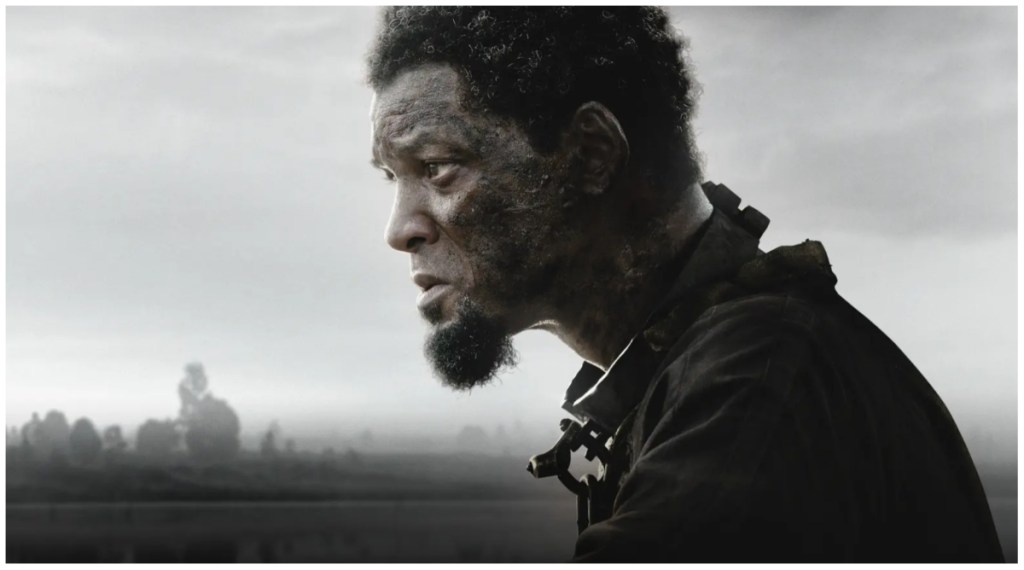 Will Smith in a still from Emancipation. (Photo: Apple TV+)
Watching Emancipation, you begin to suspect that Will Smith maybe knew that was going to slap someone at the Oscars and be in immediate need of a prop to parade around on an apology tour several months later. It’s exactly the kind of movie you’d expect a star to do when they want to rehabilitate their image after humiliating themselves in front of millions across the globe. But more realistically, Emancipation is the sort of movie you do when you want to win an Oscar.
And that’s its biggest flaw. Every second of its 132-minute run time feels like it was manufactured in some secret government lab, purely to win Smith an Academy Award. Which suggests that nobody involved expected him to win for King Richard. Perhaps Emancipation was his standby, which somehow makes it an even more cynical exercise. And now, he finds himself with the difficult task of convincing everybody that his new prestige picture isn’t actually a $130 million B-movie for which he was paid the equivalent of Ponniyin Selvan: I’s entire budget. But it is.
A borderline parody of Oscar-bait dramas — complete with a ridiculously desaturated palette and near-silent narrative — Emancipation has delusions of being something as culturally important as Schindler’s List, but is instead a Revenant clone with a fraction of that film’s narrative scope.
Based on the story of Whipped Peter, an escaped slave who inadvertently became a symbol of the abolitionist movement when a picture of his scarred back essentially became a viral propaganda tool during the Civil War, the film is undone by director Antoine Fuqua’s tendency to reduce virtually every poignant moment into some kind of action beat. Peter fled his captors and survived for 10 days in the swamps before being ‘rescued’ by Union soldiers. How material this grave ended up in the lap of the man behind Olympus Has Fallen and two Equalizer movies is anybody’s guess. But there you have it.
Peter travelled over 60 kilometres on his journey, which itself was an act of survival. Danny Boyle extracted real human drama out of a stationary man. But Fuqua can’t help but revert to his default setting. Which is how you end up with a movie that looks and sounds like something important, but is actually a Liam Neeson thriller in disguise. And I could happily argue that even The Grey is a more complex experience than this film.
We never see Peter simply exist, or scavenge for food, or wrestle with his thoughts. At Fuqua’s mercy, he is always doing something. The movie — or, more likely, Smith himself — isn’t satisfied with quiet acts of heroism; it is willing to settle for nothing less than Peter literally rescuing a little girl from a fire, or fighting an alligator with his bare hands. Which isn’t to say that he didn’t do any of these things. But according to Emancipation, this is all he did.
The is a Smith-show of epic proportions; a living, breathing monument to one man’s dedication to portray himself as a hero. It’s unsettling that they’d rather use a moving real-life story for this purpose, instead of inventing one of their own. Because even though Emancipation is about a real historical figure, you never get a sense of who Peter was as a person beyond his quiet dignity and his devotion to God. Other characters exist — Ben Foster, for instance, appears as an over-the-top villain — but purely for plot purposes.
In the third act, Peter is quickly enlisted as a Union soldier, in a twist that feels like it belongs in a different movie altogether. At no point does Emancipation grapple with the complexities of this situation; that Peter is essentially being made to serve another white man moments after being ‘rescued’ from one. Instead, Fuqua uses this as an opportunity to make the war movie that he perhaps always wanted to make.
There is, however, still a lot to admire about Emancipation, despite its many flaws. Smith is a true movie star, regardless of his off-screen behaviour; of that there can be no doubt. If we can make the same concessions for Tom Cruise, then we can make them for Smith, as well. The movie doesn’t allow him to speak much — most of the time, he’s in beast mode — but it certainly gives him a monologue towards the end that feels like it has the power to physically enter an Academy voter’s house and hold them at gunpoint until they punch in Smith’s name on the ballot. He tries so hard to power through the bloated second act, despite having nothing but his own charisma to rely on, and remains the film’s only engaging element. But in the end, Emancipation is too shackled to tired genre conventions to be truly regarded as a work of any cultural importance.
Emancipation
Director – Antoine Fuqua
Cast – Will Smith, Ben Foster
Rating – 2.5/5
Click here to follow Screen Digital on YouTube and stay updated with the latest from the world of cinema.