


Click here to follow Screen Digital on YouTube and stay updated with the latest from the world of cinema.
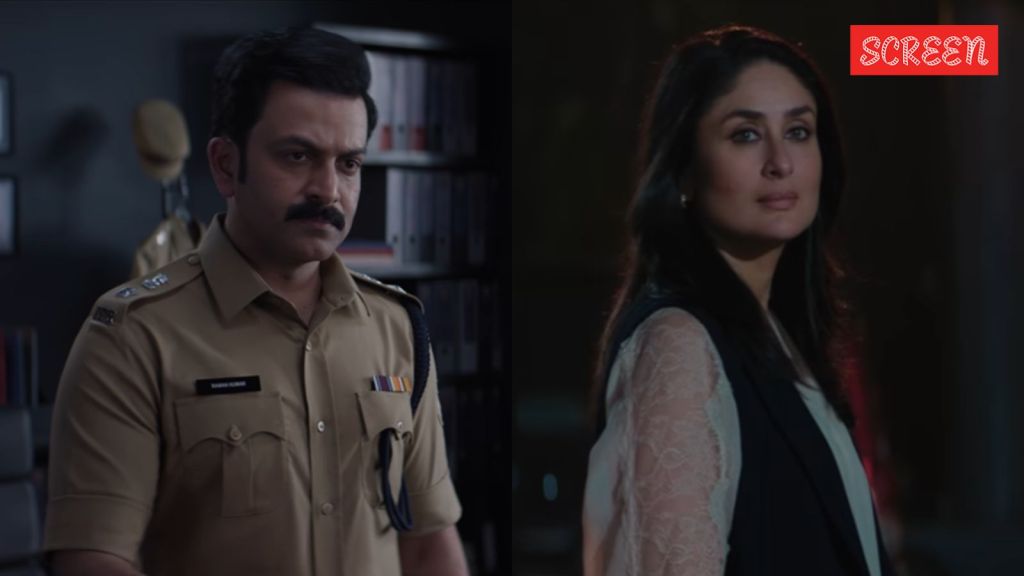 Meghna Gulzar's Daayra asks us to rethink the system for crimes against women. (Photo: Junglee Pictures/YouTube)
Bollywood cinema has given us a host of quick-on-the-draw cop dramas, where the policeman dispenses justice with his fists—a vigilante who doesn’t function inside the realm of law, at the heart of a film that shouts for attention. In this world of black and white, Meghna Gulzar invites you to a nuanced discussion on crime and punishment, the cost of extra-judicial justice and why the humdrum procedure matters with Daayra.
Daayra is an exception in the loud and angry mainstream Bollywood cinema of today. It is not a revenge drama where one man exacts violent retribution, nor is it a courtroom drama where justice is demanded with heavy theatrics. Instead, it features two cops, played by Kareena Kapoor and Prithviraj Sukumaran, dedicated to the uniform but divided by what they perceive as justice. One believes justice delayed is justice denied, while the other believes the rule of law takes precedence even when an interminable wait is part of the process. The film showcases the minutiae of police procedure and asks difficult questions along the way. The most important question comes early in the film and leaves you uncomfortable: what happens when those supposed to implement the law believe it’s not enough?
While you are dealing with the horror of watching a young woman being kidnapped, abused and burnt, you are hit by visuals of people celebrating the police for killing the suspects the same week the crime was committed. Visuals of fireworks, dhols, dancing and celebration recreate the public reaction to the 2019 Hyderabad case in which four suspects in a rape and murder case were killed by the police in an alleged encounter. As you watch the film, you don’t feel the happiness or relief that ‘justice’ was quickly dispensed; instead, Daayra makes you examine the system and procedure that led to that moment.
And perhaps that’s the biggest takeaway from Daayra — it is time to reconsider the laws, procedures and systems that deal with crimes against women, right from the moment a distressed family member walks into a police station.
The encounter is the last chapter of this film, the story starts much earlier when a scared woman calls her brother to say that she is stranded on a highway at night, and a truck driver has offered help. Her worried mother approaches the police, only to be turned away. The police officer quotes his 25 years of experience to announce that most missing girls eventually return home. His attitude is summed up in the line: “100 baar mein 99 baar ladki ghar aa jaati hai.”
The mother is asked inappropriate questions, made to go through unnecessary procedures and then told the case doesn’t fall under that particular police station’s jurisdiction.
This is where the film made me question the procedure itself. When a family member walks into a police station saying that their daughter is missing and potentially in danger, should the first response really be about jurisdiction and paperwork? Shouldn’t the first response be to find her?
The concept of a Zero FIR exists precisely to ensure that a complainant is not made to run from one police station to another simply because an incident falls outside territorial jurisdiction. But Daayra makes you think about something beyond whether a provision exists on paper: how quickly and humanely is the system actually able to respond when a person walks through that door in distress?
ALSO READ | Daayra box office collection day 3: Kareena Kapoor’s film shows growth, earns Rs 5.6 cr
In the film, by the time the system begins moving, the girl has been abducted, raped, killed and burnt. And that is where the question becomes much bigger than one police officer.
One of the most uncomfortable things that Daayra raises is that almost everyone appears to be operating within a system that has its own rules, procedures and explanations. But somewhere in that process, the person at the centre of the case disappears.
The mother is not looking for an FIR number, she is looking for her daughter. That distinction seems simple, but it is important.
The question becomes even more pertinent when we remember what happened after the 2012 Nirbhaya case. The public outrage led to the Justice JS Verma Committee, followed by the Criminal Law (Amendment) Act, 2013. The law introduced new offences such as stalking and voyeurism, strengthened punishments for several sexual offences, and brought in procedural safeguards for victims. It also made the failure of a public servant to record information relating to certain sexual offences punishable.
And yet, Daayra takes us to a police station where the problem seems to begin with something much more basic: whether the person in distress is being heard and whether the system is responding with the urgency that the law intends.
There is a line in the film that stays with you. Kareena Kapoor’s character says: “The laws changed, but the people are the same.”
This is where the encounter becomes complicated; when the police kill the four suspects, the public celebrates. There are fireworks, dancing and applause. The officers are treated as heroes. But the victim’s family doesn’t celebrate as their daughter is still dead.
And through that contrast, Daayra asks a larger question: what exactly are we celebrating when the supposed “justice” arrives only after the worst has already happened? The encounter may provide the appearance of immediate justice, but it cannot undo whatever failures preceded it.
At the same time, the film does not simply replace one easy answer with another. It takes us into the other side of the argument — the fear that a case could take years in court, the uncertainty surrounding punishment and the frustration of families who believe that justice may come too late. “Abhi toh court-kacheri ke chakkar. Humara wakeel, unka wakeel. Abhi toh shuruaat hai,” says the victim’s mother.
The family of one of the accused says, “Court le jaate toh saza kam ho jaati.” It is a disturbing line because it captures the very different ways people view the same judicial system. For one family, the court represents the possibility that their son might receive a lesser punishment. For another, the court is supposed to be the institution that establishes guilt and delivers justice.
And somewhere between these two perspectives lies the public’s complicated relationship with the justice system. Daayra also brings the Nirbhaya case into its narrative, particularly to highlight how some crimes receive national attention while countless others disappear without the same scrutiny.
Prithviraj Sukumaran’s character sarcastically asks: “Yeh desh ki beti nahi hai na?”
The point is not simply about media attention. It is about what happens when the machinery of the state responds differently depending on how much attention a case receives. The film does not give us an easy answer to any of the questions, waiting for you to reach your own conclusions. By the end of Daayra, I didn’t come away thinking that the film wanted me to choose between law and justice, or between punishment and procedure. Instead, I felt it was asking something much more uncomfortable: why are we discussing justice only after a woman has already lost her life?
Maybe the conversation needs to begin much earlier. It needs to begin when a mother walks into a police station with a complaint of her missing daughter. It needs to begin with whether jurisdiction should matter more than urgency. It needs to begin with whether procedures designed to protect the system can sometimes become barriers for the very people the system is supposed to protect. It needs to continue through investigation, prosecution, trial, punishment and rehabilitation.
And it needs to ask whether each stage is actually designed around the victim’s need for timely justice — or whether we have simply accepted the existing process because it is the process we have always followed. That, for me, was the most unsettling part of Daayra.
Click here to follow Screen Digital on YouTube and stay updated with the latest from the world of cinema.