8 min read


Click here to follow Screen Digital on YouTube and stay updated with the latest from the world of cinema.
© IE Online Media Services Pvt Ltd



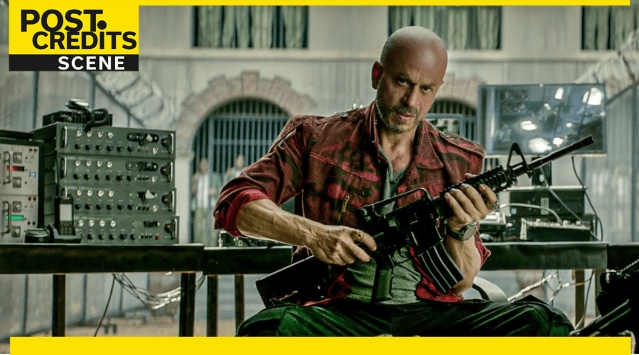 Shah Rukh Khan in a still from Jawan.
 It’s clear that Shah Rukh Khan, like the rest of us during the pandemic, also spent a lot of time watching TV shows. Chained as SRK always has been to his fame, he probably knows that he can never star in one. And so, as always, he scratches every creative itch by just producing his own material and inserting himself into universes that he has enjoyed as a fan. His new film, Jawan, functions essentially as a Letterboxd watchlist of his favourites, but it also serves as a second bite at the apple of sorts. He isn’t merely revisiting a genre that he failed at in the past; he is trying to woo, only as Shah Rukh Khan can, a generation that he failed.
Released over a decade after the debacle of Ra.One, Jawan is SRK’s latest love-letter to superhero cinema, bubbling with that same rage against the machine that was also felt in his last film, the slickly packaged Pathaan. Considered as a collective artistic statement, the two movies are an acknowledgement of the years that he has spent in silence — silence that his fans would often remind him about — and a promise that he is determined to do better.
Glossy to look at and epic in scope, Jawan is a far more accomplished comic book-inspired movie than Ra.One ever was. But perhaps keeping with its overall maximalist vibe, it transcends the confines of superhero filmmaking by occasionally turning into a passionate rallying cry. Pathaan was also rather political. But its messaging was more subliminal, and therefore more effective. Jawan, however, can often feel like a lecture, especially in a show-stopping moment near the end, when the protagonist basically turns into Ravish Kumar and monologues about civic duty. As on-the-nose as the scene is, however, it must be applauded for its courage, as must another, less noticeable moment, in which the antagonist, a corrupt warmonger named Kalee, remarks, “Wah, kya scene hai.” But we’re getting ahead of ourselves.
SRK plays two characters; the first, and more prominent, is a man named Azaad. The second is Azaad’s father, an Army veteran named Vikram Rathore. Azaad works as a jailer at a women’s prison, but moonlights as a crusader for justice with a penchant for theatrics and the content strategy of a vlogger. After crossing paths in an undeniably joyous pre-interval scene, they join hands to take down Kalee, while Azaad regularly goes live to taunt the authorities and charm the populace. This, by the way, is also what SRK is doing with this film.
The premise provokes an interesting question: “What if a law-abiding citizen snapped one day, and decided to turn into a vigilante?” But Jawan’s protagonist isn’t merely a vigilante; he’s a vigilante who is one second away from asking viewers to like, share and subscribe to his channel. He craves the attention; like a movie star who derives validation from box office numbers, he wants his actions to be seen.
A less convoluted story than director Atlee’s unwatchable Mersal, Jawan finds him recycling familiar tropes — double-roles, dead mothers, dramatic slo-mo shots — in a tonally messy quest to generate mass appreciation and incite ‘morchas’. While Jawan might look like a Marvel movie on the surface, the comic book property that it shares the most similarities with, surprisingly enough, is Alan Moore and David Lloyd’s V for Vendetta. Published in the late ‘80s at the tail end of the Cold War, the story is set in a dystopian future where a neo-fascist regime has exterminated all its opponents and rules as a police state. The protagonist is V, an anarchist who conducts a series of theatrical revolutionary acts to exact vengeance on his former tormentors and overthrow the fascist government. He is joined by a female companion named Evey. Azaad has six, and they can also dance.
In fact, Azaad uses the same strategy to evade capture and confuse the cops as V did when he made hostages wear masks like his own in the film adaptation of the book. Of course, Jawan takes this basic premise and filters it through the lens of Salim-Javed’s Angry Young Man template, but considering the fact that V’s face was hidden behind a mask and SRK can hardly be described as ‘young’ anymore (despite the decades that digital de-ageing can scrub off a movie star’s face these days), let’s just say that Azaad has more in common — ideologically and cosmetically — with the Naseeruddin Shah character from A Wednesday.
But the origin arc that Azaad receives in Jawan is standard superhero stuff — dead parents, sidekicks, and later, a secret benefactor. Some of Atlee’s visuals pop off the screen, like that splash page tableau of a bandaged Vikram, lit by flashes of lightening, spearing his enemies with zero remorse. Or even the final showdown, in which Azaad and his father — who, by the way, looks like a cross between Old Man Logan and Gabbar Singh — engage Kalee in a tag-team match. This scene is almost designed with applause breaks in mind, as are similar action sequences in Marvel movies these days. But Jawan can erratically switch tones from one moment to the next. While the vigilante sequences are fun, the sappy flashbacks are an unnecessary buzzkill. It’s obvious that Atlee had a better two-hour film in there if he had any interest in shearing off the fluff.
No movie should prioritise activism over storytelling, and Jawan can’t seem to separate the two. But conversely, no culture should push filmmakers to a point where activism is no longer a choice, but a responsibility. We’ve seen this in the movies of Anubhav Sinha, Anurag Kashyap, Hansal Mehta and Sudhir Mishra, and now we’re seeing this sentiment seep into the proper mainstream. Aamir Khan starred in the Bharat Jodo Yatra equivalent of rebellion last year.
Curiously, Jawan’s closest superhero counterparts in Hollywood — The Dark Knight Rises and Captain America: The Winter Soldier — featured villains that could easily be interpreted as revolutionary anti-heroes by some. Indeed, Christopher Nolan has been criticised in liberal quarters for portraying Bane — who many saw as a representation of the Occupy Wall Street protests — as the villain in what was viewed as a pro-capitalist story.
But here’s the thing; in India, characters aren’t superheroes, but movie stars are. Whether SRK likes it or not, the success or failure of his films will always be attributed to him and nobody else. Which is partially how we’ve collectively decided that Jawan’s politics reflect SRK’s own, and not, say, Atlee’s, or writer Sumit Arora’s. This obviously isn’t accurate, but in fairness, there has also been a concerted effort to blur the lines between his public persona and the characters he plays on the big screen, and like a lot of his previous work, Jawan actively invites these comparisons.
This might sound abstract, but Jawan hits that elusive sweet spot that movies of this magnitude often strive for and fail. During that climactic monologue, the star becomes inseparable from their character, and in one indescribable moment, manages to strike a connection with their audience that is so rare it is almost as if they’ve become telepathically aligned. Not everybody can do this, but when Shah Rukh Khan stares directly into your eyes, and instead of saying sweet nothings commands you to be a more responsible citizen, you pay attention. And then you use your finger, either to flip him off, or vote.
Post Credits Scene is a column in which we dissect new releases every week, with particular focus on context, craft, and characters. Because there’s always something to fixate about once the dust has settled.
Click here to follow Screen Digital on YouTube and stay updated with the latest from the world of cinema.