



Click here to follow Screen Digital on YouTube and stay updated with the latest from the world of cinema.
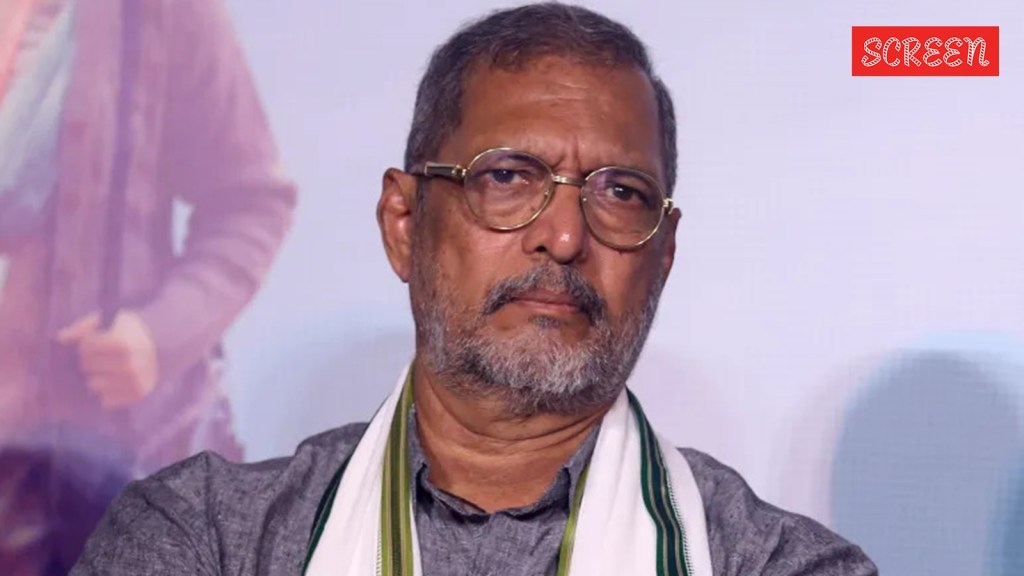 Nana Patekar died on October 8 at the age of 75


A sharp satire written by Vijay Tendulkar in the 1970s, Pahije Jatiche demanded its actors to walk the terrain of caste, power and love. When Jabbar Patel, the award-winning theatre and film director, went to watch a show in Mumbai, his eyes stayed on a new actor in the play. A few years into his twenties, the young performer was balancing layers of humour, politics and the confusions of youth with elan.
“I requested him, ‘You please do a role in my film,’” says Patel. That is how Nana Patekar came to be a part of Patel’s Simhasan in 1979. One of the actor’s first films but the intensity was already there. In a scene, Nana gets beaten up by some people. “It has to be very good. You have to look very hurt,” said Patel. Nana answered, ‘Mujhe sachhi maro (Beat me in reality)’. “He really was beaten. There were marks on his body,” says Patel.
Patel would argue with Patekar that such intensity was not required. That this was acting. But Patekar, an artist who had trained at JJ School of Art in Mumbai and knew that power of truth, countered, “Even acting must have realism in it.”
Patekar, who died on October 8 at the age of 75, never changed the way he worked. He rose through different roles on the Marathi stage and Marathi and Hindi films, gathering textures in his art.
Whatever the role, Patekar brought an intellectual leaning to it. He was deep into several art forms. A lover of music, his home always had the music of Kumar Gandharv or Kishori Amonkar playing. He knew the majority poets of Marathi by heart. He had watched the play, Ghashiram Kotwal, 10-15 times. He cared for society. There was also Patekar’s legendary fearlessless—any political leader who asked for his honest opinion got it.
“My first published newspaper article was on Nana Patekar. His passing is a terrible loss. He was the master of, both, maximum acting and coiled restraint. Time and again he showed tremendous intelligence to reverse the self caricature that invariably creeps in with elaborate mannerism and popular demand. A worthy actor who took ‘angry young man’ forward which, for a serious cinema lover, is just one of the dimensions of his multi-faceted talent,” says Dhiraj Singh, Vice-Chancellor, Film and Television Institute of India (FTII).
ALSO READ | Nana Patekar, India’s Krantiveer, dies of cardiac arrest at 75; to get full state honours
Patel approached Patekar again for the biopic Yashwantrao Chavan: Bakhar Eka Vaadalaachi (2014). “He studied the role so widely and put his every argument and analysis of the political situation in a beautiful way,” says Patel.
Patekar had begun his life in performance in school plays and sustained it through a time of family hardship. The Prithvi Theatre in Mumbai hosted some of his later performances. At the National School of Drama (NSD) in Delhi, there are memories of Patekar’s visit in 2016 for the Bharat Rang Mahotsav, the annual theatre festival. His session had energised students. It is being recalled today as the school mourns Patekar.
“Nana Patekar came to NSD for the Living Legend Series 30 minutes before the scheduled time. He sat on the steps of Abhimanch, the main hall, and interacted informally with the students and the audience. Referring to the stage set up for the interaction session, Patekar had said, “Waha se girne ka darr rehta hai, yahan se nahin,’” says an NSD staffer.
Chittaranjan Tripathi, Director of the National School of Drama in Delhi says Patekar created, in many ways, his own school of acting—and inspired generations of actors. “In my younger days, after watching films like Ankur, Pratighaat, Parinda and many others, there was a time when I dreamt of acting like him. His acting had a rare quality: it seemed to speak the language of the common man. The emotions were raw, instinctive and deeply truthful, without ever feeling artificial or clichéd,” says Tripathi.
“As a trained artist from JJ School of Art, he brought something more to the outer creation of a character—much like a painter who does not merely reproduce what he sees, but gives it his own form, texture and perspective. His presence, his voice, his silences, his eyes and his extraordinary understanding of human behaviour created a language that was unmistakably his own,” he adds.
One of Patekar’s more powerful roles would be Ganpat Belwalkar, a Lear-like thespian in Mahesh Manjrekar’s Natasamrat. “Can someone provide a home, a home,” cries the great actor played by Patekar who fills the pain of ageing, suffering and pain in a protagonist passing through his final years.
Click here to follow Screen Digital on YouTube and stay updated with the latest from the world of cinema.