


Journalism of Courage
 World largest examinations: SBI Research (Photo: AI Generated)
A recent study by the State Bank of India (SBI) highlights the world’s largest examinations by the number of candidates applying for them. Receiving as many as 25 lakh applications every year, the National Eligibility cum Entrance Test for undergraduate admission (NEET UG) sits firm on the fifth position in the table containing several international exams like Gaokao, ENEM, SAT, and many more.
The research also displays the number of applications submitted for other national-level competitive exams in India such as Joint Entrance Examination (JEE) Main, Union Public Service Commission (UPSC) Civil Services Examination (CSE), and University Grants Commission (UGC) National Eligibility Test (NET).
Check the list of the world’s largest examinations
The table below lists the examinations, the number of applications they receive, and the country conducting them, as listed by SBI in its report.
| Name of the examination | Country | Number of applications (in million) |
|---|---|---|
| Gaokao | China | 12.9 |
| ENEM | Brazil | 4.8 |
| Central Civil-Service Examination (Guokao) | China | 3.7 |
| National Master’s Entrance Examination | China | 3.4 |
| NEET UG | India | ~2.5 |
| YKS | Türkiye | 2.4 |
| UTME | Nigeria | 2.2 |
| SAT | US / International | 2.0 |
| SSC and equivalent examinations | Bangladesh | 1.8 |
| ACT | US | 1.4 |
| UPSC CSE | India | ~1.2 |
| HSC and equivalent examinations | Bangladesh | 1.2 |
| JEE Main | India | ~1.0 |
| UPSC NET | India | ~0.8 |
(Note: The above-mentioned figures are extracted from SBI Research released on September 30)
Also Read | Outsourced workforce, single-officer control: Why SBI Research calls for new NTA law
How China conducts Gaokao?
In its research, SBI elucidates how China conducts the world’s largest competitive examination and its national college-entrance examination ‘Gaokao’ by combining national standards with provincial delivery.
In 2026, a total of 1.29 crore candidates registered in China for Gaokao. The conducting authority established 7,981 exam centres, 348,000 examination rooms and 21,000 reserve rooms, with accommodations arranged for more than 14,000 candidates with disabilities.
The question papers are drafted and printed in highly secured designated locations such as state prisons under round-the-clock surveillance. They are then transported in armored, GPS-tracked vehicles which are guarded by armed police, SWAT escorts, and live-stream monitoring that triggers alarms for any diversion in the route.
Once arrived at the exam centres, the question papers are stored in steel-reinforced rooms with motion sensors and alarms linked directly to local police quarters.
Candidates appearing for the Gaokao face identity and prohibited-item checks, with continuous video monitoring in all examination rooms. For a disruption-free conduct, the interdepartmental support in China covers traffic, noise, food, healthcare and severe weather, in addition to reserve rooms and emergency power support continuity.
Despite a watertight exam conduct structure as in China, incidences of documented theft, cheating and disruptions show that the structure is not entirely failure-proof.
The research comes at a time when India’s only undergraduate-level medical entrance examination, NEET-UG, remains the epicentre of discussions over ruptures within the country’s education and examination system.
Days after the NEET UG 2026 was held on May 3, the test came under public scrutiny as reports of a paper leak flashed across screens. The row subsequently triggered widespread student-led protests backed by the Cockroach Janta Party (CJP), and concluded with the resignation of former Union Education Minister Dharmendra Pradhan on July 25.
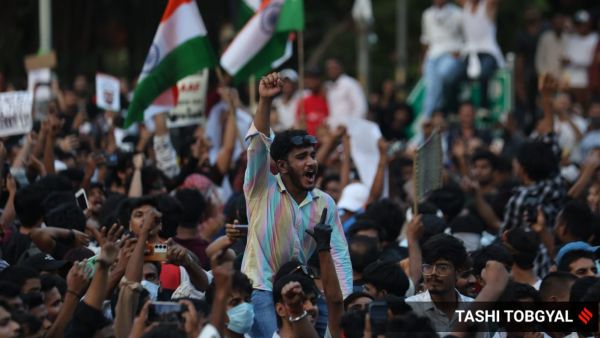 CJP Protest at Jantar Mantar, Delhi.
Also Read | IITs, IIMs see more women joining than ever as placements and salary packages rise
SBI outlines ‘lessons’ for India
Drawing lessons from China’s Gaokao, India can strengthen the conduct of its national-level examinations by improving paper security, marking controls and emergency response mechanisms, according to recommendations in an SBI research report.
The measures suggested in the research include assigning clear accountability for the custody of question papers, establishing specified procedures for postponements and re-tests, arranging reserve question papers and alternative examination venues, and protecting affected candidates during the admissions process.
The report also recommends strengthening anonymous double-marking and automated scoring audits. It calls for transparent incident reporting, time-bound appeals and monitoring of examination disruptions, scoring corrections and associated costs. It further recommends tracking the impact of such disruptions and corrective measures across different candidate groups based on gender, disability, rurality and SC, ST and OBC categories.


