


Journalism of Courage
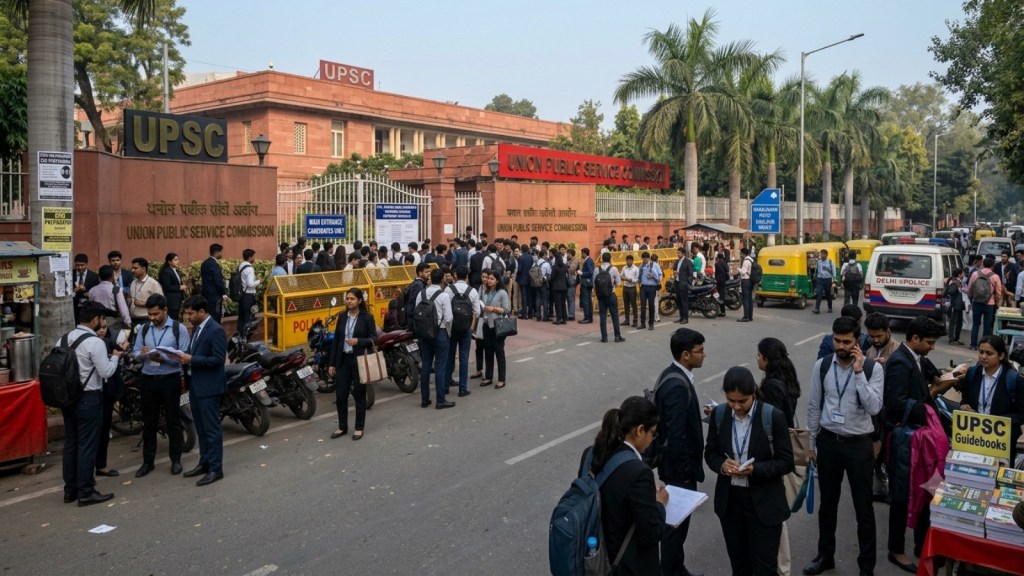 UPSC examination calendar is prepared 18 months in advance, reflecting the extensive planning involved in its recruitment processes. (Image: AI generated)
Prime Minister Narendra Modi will on Thursday participate in the centenary celebrations of the Union Public Service Commission (UPSC), which began its two-day programme on September 30. UPSC chairman Ajay Kumar stressed the need to assess candidates on reasoning, spontaneous thinking and judgment under ambiguity rather than their ability to reproduce predictable or coached answers.
Addressing the inaugural event, Kumar outlined the Commission’s vision for its next phase through three guiding principles — trust, transparency and technology. He said institutions must adapt to changing circumstances while preserving the principles fundamental to their constitutional role.
“While technology and examination formats can evolve, the core constitutional principles of merit, fairness and equal opportunity remain enduring,” Kumar said.
He further emphasised the importance of assessing candidates for reasoning, spontaneous thinking and judgment under ambiguity. He said the focus should be on qualities that cannot be captured by predictable or coached model answers.
Kumar also highlighted digital e-admit cards and face authentication as measures to strengthen examination integrity.
The UPSC commenced its two-day centenary celebrations, titled ‘Manthan’, at Bharat Mandapam in New Delhi, marking 100 years of the institution’s journey. PM Modi will attend the programme on Thursday, where he is scheduled to release a commemorative coin, a stamp and a book titled ‘100 Landmark Judgements: Shaping the Policies of UPSC and Public Service Commissions in India’, besides addressing the gathering.
The celebrations, which began on October 1, 2025, brought together senior public functionaries and eminent speakers to discuss the evolving role of civil services, innovations in public administration and institutional values underpinning public service.
Kumar highlighted the scale and diversity of the Commission’s work, noting that the UPSC undertakes around 250 distinct recruitment processes every year across disciplines including engineering, medicine, science, economics and defence. It also conducts the Civil Services Examination annually to select officers for the Indian Administrative Service (IAS), Indian Foreign Service (IFS) and Indian Police Service (IPS), among others.
He said the UPSC examination calendar is prepared 18 months in advance, reflecting the extensive planning involved in its recruitment processes.
The first session of the centenary deliberations, on the theme ‘Role of Civil Services in Viksit Bharat’, was led by Suman Sharma, Member, UPSC. Sharma called for outcome-driven administration and a shift from procedural approaches towards proactive facilitation, with governance measured by transformative outcomes on the ground rather than financial expenditure alone.
Gen N S Raja Subramani, Chief of Defence Staff, stressed the need to overcome departmental silos, take intelligent risks and demonstrate decisiveness in an environment marked by rapid disruption and increasing civil-military convergence.
Harsh Vardhan Shringla, Member of Parliament and former Foreign Secretary, emphasised widening recruitment from Tier-2 and Tier-3 cities and aspirational districts, while also bringing younger candidates into public service. Uttar Pradesh Public Service Commission Chairman Sanjay Shrinet called for greater accountability at the grassroots level and said administrators should function as genuine public servants or ‘sevaks’.
The second session, ‘Innovations in Public Service’, was chaired by Lt Gen Raj Shukla (retd), Member, UPSC. Shaktikanta Das, Principal Secretary-2 to the Prime Minister, described the UPSC as the “gateway to public service” and highlighted the importance of integrity and fairness in the selection process.
The discussions examined the potential of artificial intelligence, data analytics and digital architectures to reduce bureaucratic friction and improve service delivery. The speakers also stressed the need for cross-departmental learning and a future-ready civil service capable of responding to emerging challenges.
The centenary discussions also traced the Commission’s technology journey, which began with the introduction of computers in 1978. Recent reforms include the Universal Registration Number introduced in 2025, randomised interview boards, a Candidate Helpdesk with a 30-channel IP call centre and a two-level escalation mechanism, and expansion of examination centres.
The first Public Service Commission in India was constituted on October 1, 1926, as an advisory body. Over the decades, it evolved into an independent constitutional body, marking a century of its institutional journey.
— with inputs from PTI