


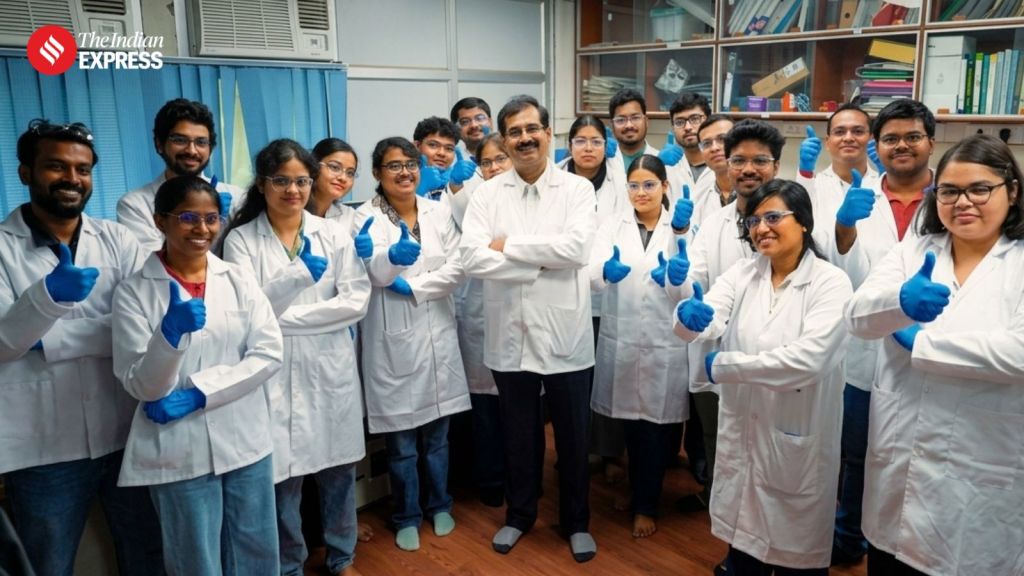
 Prof Rath with his students at IIT Kanpur (Image: Videograb via MoE/Upscaled with AI)
At the Indian Institute of Technology (IIT) Kanpur, engineering is the main story: students arrive chasing ranks, jobs, and the promise of building what comes next. But alongside the students in one of India’s most prestigious engineering colleges is a quieter academic world of chemistry labs, unanswered questions, and teachers trying to make students care about subjects they never chose for themselves.
Professor Sankar Prasad Rath, from the Department of Chemistry, has spent two decades in that world. This year, he has been awarded the National Teachers Award.
His story doesn’t start in a classroom. It starts in Mirzapur, a small village in East Midnapore, West Bengal, one that floods often and offers little beyond farming. “Agriculture was the only source of income in my family,” he says.
He studied at a local school. Then, one step at a time, the world opened up: Ramakrishna Mission Vidyamandira, Belur Math; a Master’s at the University of Calcutta; a PhD at Indian Association for the Cultivation of Science (IACS) Kolkata under Professor Animesh Chakravorty; a postdoc at UC Davis. In December 2004, he joined IIT Kanpur and never left.
He doesn’t necessarily romanticise the climb.
“The transition from a rural upbringing to demanding centres of higher education was itself formative. It made me value discipline, self-learning and perseverance,” he said. But it also left him with something sharper, an eye for students who walk into IIT without the same head start as their classmates.
Also Read | JEE Main 2027 from January 22, UGC-NET from December 14
“A teacher must recognise potential even when it is not yet polished by privilege or opportunity,” he says.
One widely held perception about IIT students is that they are there for one reason: engineering leads to a job, and a job offers security. For many of them, chemistry is simply a subject to clear along the way.
Rath has spent two decades trying to flip that script.
“I try to use questions, real chemical problems, experimental observations and connections with everyday life, so that students see chemistry as a way of understanding the world rather than as a collection of reactions to memorise.”
He’s also not in a rush to make it easy. “If we give them every answer too quickly, we may improve short-term performance but weaken independent thinking.”
For him, the best moment in any class isn’t the right answer. It’s a question he didn’t see coming.
When asked, why do so many bright students skip research for industry altogether? He says, “Talented students often see a clearer career path, faster financial security, larger teams, and more immediate applications there.”
Academia, in contrast, asks for years of training with no guarantee at the end. His fix isn’t guilt-tripping students into staying. It’s making research worth staying for.
“Better mentoring, greater stability, adequate resources, intellectual freedom and a culture in which good science, not merely the number of publications, is genuinely valued.”
On AI, he’s watchful more than worried. “Easy access to an answer can create the illusion of understanding,” he says; students may get faster at finding answers while getting slower at actually thinking through them.
His answer isn’t to ban the tools. It’s to change what teachers ask for: reasoning explained, evidence checked, conclusions defended, not just typed out.
Ask him what two decades at IIT Kanpur have given him: “What gives me the greatest sense of fulfilment is the combination of students I have taught and mentored.” Not a paper, a designation or title; just students.
So what does he actually study? How nature uses iron, the same element that runs through your blood, to power some of the most efficient chemical reactions inside living cells. Understanding that machinery, he believes, could one day help build cleaner, smarter chemistry for the real world. ‘Curiosity,’ Rath says, ‘is not a luxury. It is the only thing that makes the work last.’