


Journalism of Courage
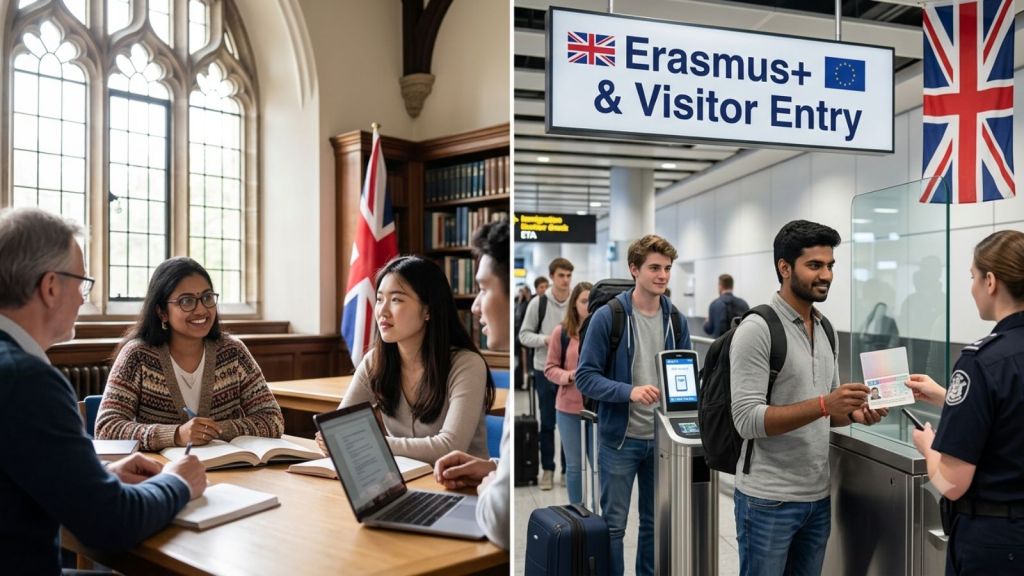 Under the revised rules, participants can study at a UK organisation or educational institution as part of an Erasmus plus mobility project (AI Image)
The United Kingdom is easing immigration requirements for people coming to the country through Erasmus+ mobility programmes, ahead of its return to the European Union’s Erasmus Plus (+) programme in 2027. Changes to the UK immigration rules will allow eligible Erasmus+ participants to undertake study, training, job shadowing and some other activities through the Visitor route starting October 8, 2026.
The changes are aimed at facilitating short-term mobility between the UK and participating Erasmus+ countries. Participants coming under the programme will not need to be sponsored for activities permitted under the Visitor route.
Read | UK university crisis: Job cuts, strikes and course closures put arts, humanities under pressure
The Home Office said the changes would allow UK organisations and educational institutions to host Erasmus+ participants without the sponsorship requirements that apply to some other immigration routes.
Under the revised rules, participants can study at a UK organisation or educational institution as part of an Erasmus+ mobility project. They can also provide or receive training, undertake job shadowing and, for participants aged 18 or under, complete a traineeship of up to 30 days.
Read | Indian students in Australia face high rent, cost and housing crisis
Sports staff, coaches and volunteers can also undertake certain coaching or training assignments.
However, it was also clarified that job shadowing must be limited to practical observation and cannot amount to filling a permanent role. Participants must also show that they are genuine participants in an Erasmus+ mobility project.
For participants under 18, permission from their parent or legal guardian and their home institution will be required for traineeships and job shadowing.
The changes also cover international students coming to the UK through Erasmus+. The Student and Child Student rules have been amended so that qualifying Erasmus+ courses can meet the requirements of those routes even where the programme does not lead to an approved UK qualification.
The Government Authorised Exchange route has also been expanded to include Erasmus+.
Note that the Visitor route is different from the separate notification that modified the UK’s Electronic Travel Authorisation (ETA) rules. An ETA is a travel authorisation for nationals who do not normally need a visa to visit the UK. A person who needs a visitor visa must still obtain that visa before travelling.
The new rules change what eligible Erasmus+ participants can do under the Visitor route; they do not remove the existing visa requirements.
The change applies to participants selected for Erasmus+ mobility irrespective of where they are travelling from. However, the immigration process will still depend on their nationality.
For example, an Erasmus+ participant travelling from India will generally continue to require a UK visa before travelling because India is on the UK’s visa-national list. A participant from a country whose citizens can travel to the UK without a visitor visa may instead need an ETA.
The difference is therefore in the entry-clearance process, rather than eligibility for the Erasmus+ activity itself.
This is relevant as Erasmus+ also supports international cooperation beyond the EU and other European programme countries. India participates in the international dimension of the programme, including through higher-education partnerships and Erasmus Mundus scholarships.
Erasmus+ is the EU programme covering education, training, youth and sport. It supports mobility such as studying, training and work placements abroad. In 2024, the programme supported almost 1.5 million learning-mobility participants across more than 34,400 projects involving over 85,600 organisations.
The latest programme data provide country-level figures for mobility to and from Erasmus+ programme countries. The European Commission’s database covers 2024 exchanges and includes data on the number of people travelling to or from individual countries.
The UK is currently outside the Erasmus+ programme but is set to become associated with it again in 2027. The EU and UK agreed the arrangements in April 2026, with the European Commission saying the association will put UK learners, staff, institutions and organisations on the same footing as those in EU member states and other associated countries for the programme.
The October immigration changes therefore prepare the UK’s immigration system for Erasmus+ mobility before the country’s formal participation resumes in 2027. They make specific Erasmus+ activities possible through existing immigration routes, while existing visa and entry requirements continue to apply based on the participant’s nationality and the nature of their programme.


